This article is published in Aviation Week & Space Technology and is free to read until May 30, 2026. If you want to read more articles from this publication, please click the link to subscribe.
An adaptive automated laser welding system increases high-pressure turbine blade repair yield and reduces turnaround times.
Record engine deliveries eventually mean record repairs and overhauls. How can aftermarket providers solve the conundrum of handling rapidly growing volumes while decreasing all-important turnaround times?
The challenge is particularly acute for GE Aerospace, the world’s biggest engine company, which, together with its CFM International joint venture partner Safran, is in the middle of a ramp-up of historic proportions in production and aftermarket capacity on the single-aisle and widebody engine families.
“Safety, quality, delivery and costs are always there, but now we’ve got a transformational mindset to face the challenge of how to grow without growing footprint,” GE Aerospace Component Repair Singapore Managing Director Iain Rodger says. “How can we do it?”
Widely viewed within the company as the jewel in the crown of GE’s global component repair network, a collection of 10 facilities—including five overhaul shops with repair capability—the Singapore site is at the forefront of developing repair technologies and processes. Set up in 1981, the Singapore facility now makes up 60% of GE Aerospace’s component repair revenue and is gearing up for further growth.
The importance of GE’s repair capability to reducing turnaround time (TAT) cannot be understated, Rodger says. Engine component repairs are viewed as part of a three-gate process from induction to redelivery, and the company says those can cut TAT by up to 50%—an important metric, particularly in an environment stressed by supply chain shortages and material constraints.
The Singapore site covers the core of engines across the GE portfolio, including CFM as well as Engine Alliance, a joint venture between GE and Pratt & Whitney. The site focuses on repairs of key hot-section components—including high-pressure (HP) turbine blades and nozzles, low-pressure turbine blades, HP compressor blades and vanes, and combustors.
As part of its work on the GE product range from the GE90 and GEnx to the Leap, CFM56 and CF34, the facility performs cleaning and inspection, welding and brazing, chemical coating and nondestructive testing. Additive manufacturing, automation and robotics are also part of the site’s increasingly important capabilities.
Turbine blades, nozzles and combustors are repaired in Plant 23, the initial GE Singapore site. Compressor blade and vane repairs are done in the adjacent Plant 62, originally operated as a joint venture with Teleflex but wholly owned by GE since 2009. Plant 46, in the nearby Seletar Aerospace Park, originally opened in 2018 for production of GE90 and GE9X HP compressor vane sectors, is the focus for expansion of repair space as the new-build work transfers to another site in Singapore.
As part of a $300 million investment supported by the country’s Economic Development Board, announced at the recent Singapore Airshow, GE is establishing an artificial intelligence (AI) center of excellence to develop enhanced and automated digital inspection techniques, as well as a new coatings facility and a regional center for critical shaft repairs. The engine-maker is also adding a new module repair facility dedicated to the Leap-1A/-1B HP turbine module at its Seletar campus.
The current “sweet spot” period between receiving a purchase order and shipping repaired parts is averaging fewer than 30 days, Rodger says. “We’ll get some products like combustors that are above that because we currently must ship them to the U.S. to get coatings,” he explains. “But that’s part of our transformation. We’re going to bring those coatings here to Singapore, and that’s part of our goal to get to 21 days or better.”
FASTER TATS
Trimming component repair time is vital to GE’s push to reduce overall engine turn time, says Tim McQueen, general manager of GE Aerospace’s global component repair network. “Overall, an engine TAT is 120-140 days,” he says. “Our true north is to get to 60 days, and to enable that to happen, we must get to 21 days for component repair. We want to be able to disassemble an engine in a week, do a three-week turnaround time on repair and then a two-week turnaround time on reassembly test.”
The timing varies from one engine family to another, McQueen adds. CFM engines, for example, “just made a pretty big jump,” he says. “They were 110-120 days, but last year they did it in the high 80s to the low 90s. This year, a GE90 or GEnx would probably be in the 140-150-day range. It’s coming down to the 120s and 130s, so on aggregate, it’s a little bit off from the larger to the smaller engines, but the goal is to do everything to get there by 2028.”
GE has seen volumes through its Singapore site increase 46% in 2020-25, yet in the same period, TATs have fallen by 24%—an achievement made possible by several lean initiatives. These include the introduction of U-shape cells to improve flow, reduced travel distance through the facility, smarter use of the space’s existing footprint and consolidation of equipment to free up room.
“We want to grow without growing,” says Rodger, who attributes the accelerating improvement to GE’s Flight Deck operating model and “real lean techniques.” “We can save 30-40% footprint, and we can also add technology and develop new repairs. It’s not just about doing more of the same.”
In 2021-25, the site’s TATs were reduced across the board, from 15% lower for combustors to 30% for HP turbine nozzles and 45% for HP compressor blades. Based on further improvements scheduled through Flight Deck initiatives and capacity increases, GE plans over the next five years to reduce TATs another 28% while boosting volumes by 33%.
Flight Deck “really brought us together as a company,” Rodger says. “It codified everything. Before that, everybody was talking about their own ways of improving. Now Flight Deck has let us pull all that together. We all work the same way, and we started by looking at daily and visual management, how we perform [key performance indicators] linked to the customer.”
Since 2024, much of the focus has been on problem-solving. “We need to know where the ‘reds’ are, and where something’s going wrong,” Rodger says. “I’ve seen companies where the charts are green, but the performance underneath is red, and in the background, we’re trying to figure out a way to make it genuinely green.”
In 2025, the focus shifted increasingly to transformation—a process that continues today. “Once we’re done with laying out and putting machines that are the right size in the right place and in the right sequence, we then look at where technology can help us,” Rodger adds.
To this end, GE is introducing a wave of automation and robotics, including automated inspection systems. “That’s where AI will start to play a part for us in terms of predictive maintenance and understanding the condition of parts over time,” Rodger says. “There are plans for all of the shops to transform that way.”
Flight Deck is based on the Kaizen continuous improvement concept, a lean operating system pioneered in Japan by automobile companies like Toyota. “Two or three years ago, everything was about improving today and getting off the delivery radar,” Rodger says. “Now most of these Kaizen events are focusing on what the needs are in 2027 and sometimes 2028.
“A Kaizen event is really Kaizen on steroids,” he continues. “There’s a lot of preparation, because the more difficult the problem is to solve, the more you’ll need to identify the subject matter experts, maybe including certain materials engineers or the peer engineers.”
In these Kaizen events, the group is often kept in one place for a week to tackle a specific problem statement. “Sometimes I struggle to believe some of the improvements we’ve achieved,” Rodger says. “We’re talking a 50% cycle time improvement being the norm.”
“Prework is the essence,” GE Aerospace technician Suresh Sinnaiyan says. “If the prework is not scoped properly, it won’t be effective. You need the right people on site, including sometimes the engineering guys from HQ to be here, so they can sign off immediately on the solutions.”
Through Kaizen events, GE reduced its footprint in Plant 23 by 33%. “We did not spend any capital investment on this entire revised layout of equipment, which allowed us to convert three floors into two, but we save up this space so that we don’t need to get new facilities to build lines for Leap,” Rodger says. The conversion also cut TAT by 30% for HP turbine nozzle repair, the site’s largest business, while productivity went up by 8% and output by 35%.
SINGAPORE INNOVATIONS
The Singapore site has also developed a special turbine nozzle “split vane” repair technique to increase yields. If a nozzle, which is made up of twin vanes, requires repair, it is inspected. “Depending on which side of the nozzle has a higher defect and cannot be salvaged via the usual repair process, we cut them into two,” says Han Hui Min, turbine nozzles repair leader. “Previously, if we found a defect in one of these vanes, we’d need to scrap it, even if the other vane was perfectly OK. Now, with the new repair, we can split the bad one off and put another good one on. It brings up our repair yield to 90%.”
The Singapore facility also pioneered the use of additive manufacturing for component repair and has been using the process for CF6 and CFM56 HP compressor blade tip repairs since 2021. The direct metal laser melting process is being used from the start for GEnx and Leap-1 repairs. Additive processes are 60% faster, require 50% less post-processing and have a footprint saving of around 30%, the company says.
Further additive-manufacturing-related improvements are planned, says Vigi Koh, lead engineer for additive repair. “As we mature the technology, we have realized there’s a gap between the process and the entire value stream,” she notes. “In terms of productivity, it’s not up to the speed we require, so in the future, instead of using a surface grinder, we are going back to the previous process, which is to use robot prep. We want parts to keep moving, so this will achieve single-piece flow.”
Related changes include integrating an automated vision system and improving the powder recycling system.
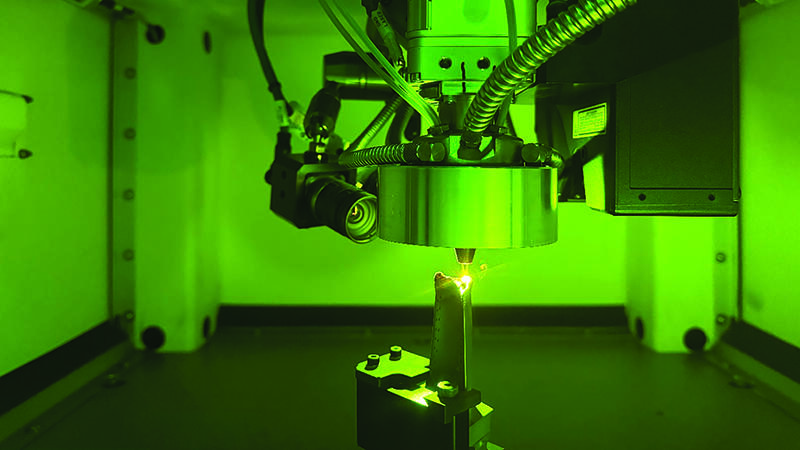
Other advanced processes at the facility are automated laser weld repairs on HP and low-pressure turbine blades. Laser welding machines have replaced 54 manual welding booths at just 13 automated stations.