This article is published in Aviation Week & Space Technology and is free to read until May 15, 2026. If you want to read more articles from this publication, please click the link to subscribe.
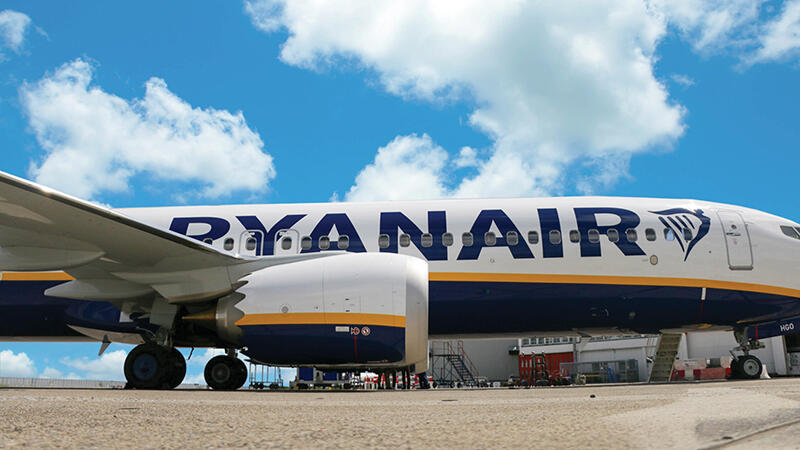
Ryanair is tapping CFM to support two dedicated overhaul shops to meet its engine MRO needs.
CFM International’s bolstering of Leap-family engine output to meet rising production targets at Airbus and Boeing is not coming at the expense of a strong aftermarket focus. If anything, the opposite is true.
The engine-maker and its joint venture partners, GE Aerospace and Safran, are pouring resources into both the Leap family and its still-dominant CFM56 predecessor. The activity includes new material production and shops as well as prompt responses to novel issues.
GE is investing $33 million in its Greenville, South Carolina, turbine blade production facility—about half of it dedicated to newer manufacturing technologies on CFM56 high-pressure turbine (HPT) blades.
The investment, part of a broader GE commitment of $1 billion across several of its U.S. sites, is to upgrade the production line that makes blades for the CFM56 Performance Improvement Program (PIP) configuration variants. Specific changes are to focus on advanced grinding, laser drilling and other machining improvements, GE says.
The technologies match those used on Leap engine blade production in the same facility. They also will help GE meet continued strong demand for PIP blades.
The number of CFM56 shop visits remains steady amid continuing passenger demand and the ramifications of new-aircraft delivery delays. GE and Safran recently upped their near-term estimates for CFM56 work through 2028. During the next three years, the two are expecting 2,300-2,400 annual shop visits.
“Compared with our Capital Markets Day 2024 assumptions, this represents more than 750 additional shop visits over the 2025-28 period,” Safran CEO Olivier Andriès said on the company’s full-year 2025 earnings call Feb. 13.
“How the dynamic will unfold after that is still to be seen,” he continued. “It’s going to be a combination of how quickly Airbus and Boeing reach their peak rate for, respectively, the A320s and the 737. . . . It’s going also to [depend on] the level of aircraft retirements.”
Retirements have been historically low since a downturn-driven spike in 2020. Total commercial jet and turboprop retirements averaged 639 per year in 2021-25, according to Aviation Week’s 2026 Commercial Fleet & MRO Forecast. This represents about 2.2% of the active fleet, compared with a historical average of 2.5-3.0%.
The pace of retirements will depend on passenger demand and whether Airbus and Boeing can meet their projected production and delivery targets.
Retirements “may well continue for one or two additional years” at historically lower levels, Andriès said. “It’s too early to say.”
Even a rapid increase in retirements would not lead to a sharp drop in CFM56-5 and -7 repair demand—at least not right away. Material availability is usually the pacing factor in shop turnaround time, with turbine blades near the top of the list.
CFM has emphasized ensuring production of both Tech Insertion and PIP-configuration blades supports demand. Its Greenville plant is the sole CFM56 HPT blade manufacturing facility.
GE’s $1 billion investment will also support Leap-family aftermarket needs. About $200 million is going toward boosting manufacturing for Leap HPT durability kits—made up of the HPT Stage 1 blade, HPT Stage 1 nozzle and forward inner nozzle support—and reverse bleed systems (RBS) that target nagging issues cutting into expected time on wing for the Leaps.
Durability kits and RBSs for Leap-1As found on some Airbus A320neo-family aircraft are approved and in production. Similar products for the 737 MAX Leap-1B engine are expected to be introduced this year.
Meanwhile, CFM and its owners are taking action to help minimize the ramifications of a new parts-related durability issue.
CFM has told operators that the life limits of original Leap-1B HPT Stage 1 disks will not be extended beyond their 10,000-cycle threshold. The manufacturer is developing a new part with a more airline-friendly 17,500-cycle limit—equivalent to 9-10 years of flying for the busiest engines. But the higher-life-limit parts will not be ready before the second half of this year.
“What we’re being told is that there will be a new disk in production by the third quarter of this year and that will be [approved] with an ultimate life of 17,500 cycles by the end of the year,” Ken Barone, Southwest Airlines’ director of fleet asset management, said at Aviation Week’s recent AeroEngines Americas in Tampa, Florida. “It’s going to take a lot of work.”
Barone is confident that CFM will deliver new 17,500-cycle-life disks in time to meet Southwest’s planned engine overhaul schedule, minimizing the threat of unscheduled groundings. But given the lack of narrowbody inventory and engine spare parts, the carrier is not taking chances.
“That is the best-case scenario, and we hope that happens,” Barone said of CFM’s timeline. “What we would look at as an operator, though, is what is Plan B and Plan C if that doesn’t happen?”
Southwest is “working closely with CFM and [GE Aerospace] and all of our partners out there to make sure that if for some reason it’s another six months, we are prepared—operationally at Southwest and as an industry—to be able to work through that,” Barone said. “That’s a concern. That’s probably our biggest focus right now, just making sure we’re communicating . . . and that the industry is going to be ready.”
CFM is confident that its material plan—which never assumed the higher life limit and factors in both production and in-service demand—plus available spare engines will limit potential operational disruptions.
“At issue is producing the new part fast enough,” Andriès said on the sidelines of the company’s annual press conference Feb. 13. “For the first operators of the Leap-1B, that is an attention point. Hence a need for spare engines.”
Safran and aircraft lessor AerCap jointly own SES, a CFM engine leasing specialist based in Shannon, Ireland. “SES owns hundreds of Leap engines,” Andriès said.
Operators in need could lease those for short periods, he suggested. “Our goal is to avoid aircraft-on-ground situations, and using SES’ lease pool is a way to achieve that,” Andriès said, stopping short of guaranteeing that no such scenarios would occur.
Aviation Week Tracked Aircraft Utilization (TAU) data suggests at least 150 Leap-1Bs will reach the 10,000-cycle threshold in the next 12-24 months. Southwest has more than 40 Boeing 737-8s with at least 8,000 cycles, including six with more than 9,500, TAU data shows.
Only two other carriers have more than five Leap-1B-powered aircraft with at least 8,000 cycles—Malta Air with 22 and Brazil’s GOL with 13, TAU data shows. A Southwest 737 MAX averages about 140 cycles per month, or 1,680 per year. GOL’s are even more active, at 150 cycles per month on average.
Engine swaps often pair higher-time aircraft with lower-time engines. But the TAU figures provide an idea of how many aircraft and which operators would be affected first.
CFM plans for the part to be approved and in production by year-end. The engine-maker would then allocate disk replacements based on scheduled Leap-1B shop visits—most of which it performs under power-by-the-hour contracts—to minimize unplanned removals.
Findings from routine shop visits prompted CFM to develop an improved Leap-1B HPT Stage 1 disk version rather than seek a life extension on the original design.
The Leap-1A, which competes with the Pratt & Whitney PW1000G geared turbofan (GTF) on the A320neo family, has its own life extension process and is not affected.
“At CFM International, we know durability and reliability are top priorities for our customers, and we are continuously looking for ways to improve time on wing to better serve our customers’ needs,” the company says.
Sources with knowledge of the situation tell Inside MRO that the Leap disk issues are not related to contaminated powder metal.
As CFM addresses early-life Leap durability issues, demand for routine overhauls continues to grow—as does the network that performs the work.
Delta Tech Ops added the Leap-1A to its capabilities list, becoming North America’s first facility approved for both Leap-1A and -1B variants. It became a Leap-1B shop in 2022.
Ryanair is partnering with CFM on a pair of engine shops that will service the airline’s Leap-1B and CFM56-7 fleet, which totals about 1,400 engines. The shops, which will open by 2030, will have capacity for about 150 annual overhauls—enough to satisfy the carrier’s needs with room for growth. Ryanair, which intends to take over management of the shops, has no plans to seek third-party work. Instead, it will focus on minimizing turn times, with wing-to-wing targets of 60-70 days.
“It’s actually the control and making sure we’re able to tightly manage our own engine turnarounds that gives us a huge benefit,” Ryanair CEO Michael O’Leary said.
—With Helen Massy-Beresford in Paris