This article is published in Aviation Week & Space Technology and is free to read until May 01, 2026. If you want to read more articles from this publication, please click the link to subscribe.
Southwest Navigates Engine Constraints And Boeing 737 MAX Transition
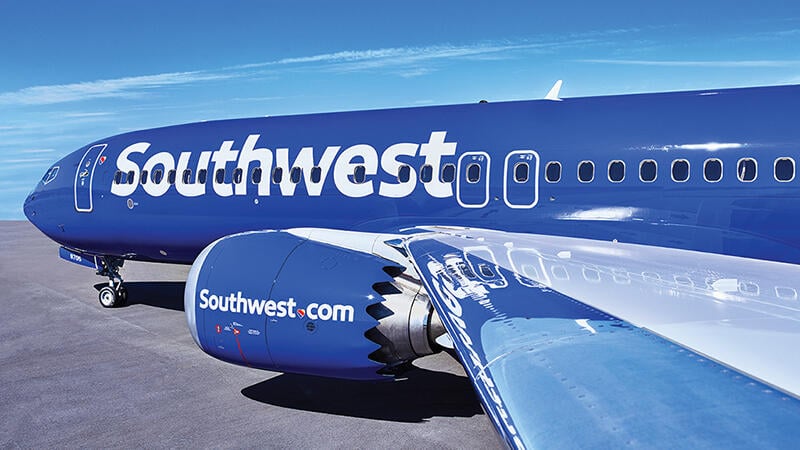
Southwest is navigating maintenance challenges and fleet modernization.
Ken Barone, director of fleet asset management at Southwest Airlines, discussed with Lee Ann Shay and James Pozzi how the airline is managing its mixed CFM International engine portfolio, why spare availability has become a top concern and how it is leveraging close collaboration with MRO partners amid supply chain constraints.
Southwest is due to take its first Boeing 737 MAX 7 aircraft this year. What is the airline’s latest expectation for the aircraft’s certification and service entry? Our expectation is certification this year, followed by entry into service once the regulatory process is complete and the aircraft are approved for operations. From our perspective, we plan to complete certification this year. Once that is complete, the next step is to finalize the regulatory authorizations and prepare the aircraft for entry into service in 2027.
Is Southwest considering extending the life of some of its older aircraft? Right now, we don’t have any big plans to extend our 737-700 aircraft. That would be the fleet that we would use to kind of meter our fleet. We’ve got more than enough aircraft, so at this point, there are no plans.
Turning to engines, what kinds of maintenance agreements do you have across the fleet? They’re under all kinds of agreements. An OEM power-by-the-hour (PBH) agreement with CFM International covers both our MAX 7 and MAX 8 fleets. Our 737-800s are under a PBH with GE Aerospace, which expires in 2031, so that covers retiring that fleet from Southwest. Our 737-700 engines are on a time-and-material basis. We manage around 800 engines. We have firm fixed-price contracts and hospital-visit contracts, and we also manage them on a one-off basis. As for making decisions on those, it comes down to economics. First, we ensure we have sufficient green time to support our operations, and then we’re opportunistic about whether to sell an engine or keep it for a future module swap.
Managing 800 engines sounds complex. How do you approach vendor relationships? On the vendor side, we place great value on long-term relationships. What I love about this business is being able to pick up the phone and call one of our MRO partners, whether it’s StandardAero, SR Technics, Lufthansa Technik or MTU Maintenance, and of course, engine OEM partners CFM International and GE Aerospace. Having those relationships in place is more important than having a contract. We have a whole portfolio of tools, but we must be very nimble and opportunistic as things come up and leverage those relationships.
Spare engines are a major topic across the industry. How big a concern is engine availability? On our CFM56 engines, we’re expecting a wave of P04 high-pressure turbine (HPT) blade replacements. That’s about half of that fleet that we have to get ready for in the latter half of this year. There will be a need for spares to support that campaign. In addition to what’s going on with the Pratt & Whitney geared turbofan and the CFM Leap, there’s also demand for that same engine. Our focus right now is working with GE, CFM and lessor Shannon Engine Support to ensure there will be ample supply for the industry six months, one year and 18 months out. Beforehand, I wouldn’t have worried about going out short-term to ensure we had coverage or that the OEMs had coverage for us, so that’s a concern now. On the Leap side, another pool is coming up. At the end of this year, the Stage 1 HPT disk will not be approved for ultimate life, and we’ll have this come off at no more than 10,000 cycles. That will just be an additional pull on the industry that will not only put pressure on the Leap spares but also on the CFM56.
Have turnaround times at engine shops improved since the pandemic? Turn times have undoubtedly improved since the COVID-19 pandemic. Is it going to continue, and is it going to get tighter? I don’t think so. I think we are where we’re going to be for a couple of years. There are three constraints on the MRO side. GE and CFM have done a great job of expanding the Leap’s networks. Licenses are being issued to shops, and they’re being prepared, and facilities are being built in both the GE and Safran networks. For labor, there’s a lot more stability than before. We’re seeing the labor force build back up to where it was before COVID-19, which has resulted in significant knowledge loss. We’re feeling better about that, but it will still take some years to get back to where we were. And then finally, everything’s going to come down to material in the supply chain. Between the workforce and the material supply chain, [the situation will remain the same] for a couple of years. Hence, if you can’t reduce your turn time, you’ve got to have spares out. You’ve got to turn your engines through. If you can’t, you’ve got to have spares.
How have maintenance spare parts costs evolved over the past year? Over the past year, there has been a lot of focus on tariffs and on the pricing escalation we saw following the pandemic. We’re now seeing that situation settle down somewhat. The very sharp increases we saw earlier are beginning to settle down, and contracts are becoming more predictable again. At Southwest, we’re fortunate because our Leap engines are covered under risk-transfer agreements that provide cost protection. The pressure we’re seeing is that the 737 MAX aircraft have higher engine maintenance costs, which affect the economics of leasing and operating those aircraft. That dynamic might feed back into the industry because operators may want to keep engines on wing longer to control costs. When that happens, it increases demand for spare engines once they do come off for maintenance.
Has your perspective on parts manufacturer approval (PMA) parts and designated engineering representative repairs shifted in recent times? We are all-OEM, so we do have agreements in place on our 737-700 fleets. One thing that’s changed is that we were planning on flying that fleet longer. For that, we had planned a significant number of core overhauls. Our current plans don’t require that. We have enough green time. So, where this strategy might have been, we were going to use PMA. That’s not a factor anymore. We’re again all-OEM right now and no plans to use PMA.
How do you determine the best balance between investing in mature engine sustainment versus accelerating support for newer platforms? It all comes down to network planning and ensuring we can meet our fleet objectives. One thing I think we’re blessed with at Southwest is we’ve got a very strong balance sheet. We own 88% of our assets [airframes and engines], but we have some lease returns coming, so that number is likely to increase further. Going forward, what we own gives us a lot of flexibility, so we’re not managing our fleets as much for lease returns, which allows us to have a little more planning time to say, “OK, do we want to keep this aircraft? And if we don’t, do we want to keep the engines and use them or not? ”
Fact File
Southwest Airlines
Headquarters: Dallas Love Field, Texas
History: The airline was founded as Air Southwest in 1967 by Herb Kelleher and Rollin King before it was rebranded to Southwest Airlines in 1971. Today, the carrier flies to more than 100 destinations in the U.S. and operates cross-border routes to destinations in Mexico, Central America and the Caribbean.
Fleet: Southwest operates more than 800 Boeing 737 aircraft, comprising NG and MAX variants. The airline expects to take delivery of its first 737 MAX 7 this year, with a planned 2027 service entry. By 2031, it expects to operate an all-MAX aircraft fleet.
MRO facilities: Southwest operates maintenance hangars in Dallas, Houston, Phoenix, Atlanta, Denver, Baltimore, Chicago, and Orlando, Florida.