This article is published in Aviation Week & Space Technology and is free to read until Feb 05, 2026. If you want to read more articles from this publication, please click the link to subscribe.

Americas’ Regional Aftermarket Plays Catch-Up With Fleet Growth
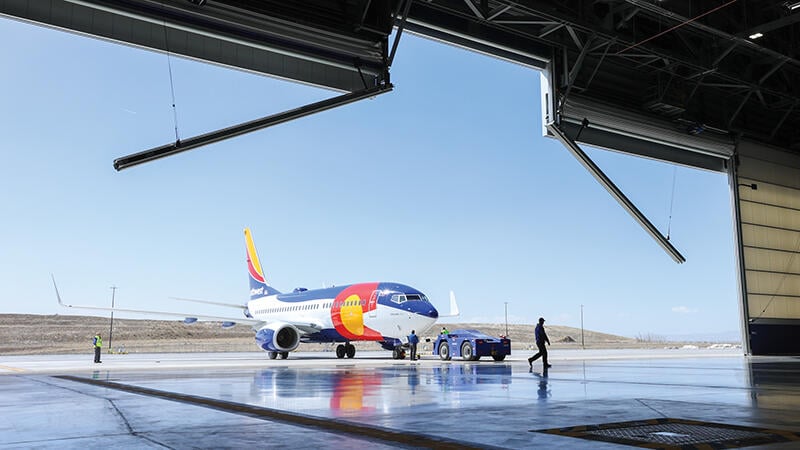
Southwest aircraft

Southwest Airlines is expected to generate the most MRO demand of all commercial airlines in the Americas over the next decade.

Credit: Southwest Airlines

The Americas region is projected to capture 26% of the global commercial aviation MRO demand over the next 10 years, according to Aviation Week Network’s 2026 Commercial Fleet & MRO Forecast. Its MRO aftermarket is expected to grow at 2.5%, slower than the rest of the world when considering the expected growth and size of the future fleet.

With more than 3,700 jet and turboprop aircraft on order with manufacturers, the 13,200-strong commercial aircraft fleet in the Americas is to receive more than 6,500 aircraft over the decade, according to the forecast. The fleet gains result in a slow 0.9% compound annual growth rate (CAGR) after retirements, freighter conversions and storage activities are tallied. While Airbus has more than 1,600 firm orders for the A320 and A220, Boeing orders outnumber Airbus by over 110 aircraft. For Airbus, the A320 family is the most popular narrowbody, while its A350 is the most popular widebody; for Boeing, the 737 and 787 are the most popular aircraft.

Overall, $419 billion in MRO demand is expected over the next decade in the Americas, with more than 90,400 major service events and a respectable 2.5% CAGR. Given the anticipated pace of new aircraft, maintenance expenditures are unlikely to keep pace with fleet expansion until late in the forecast period. Half, or nearly $211 billion, of the overall maintenance demand will be related to engine maintenance. Removing narrowbody engine durability technical upgrades, engine demand requirements climb quicker than the whole. Growing at 4% CAGR, the maintenance category climbs rapidly on a constant dollar basis through the 10-year forecast period, sharing the demand among a few manufacturers.

CFM International engines, like the Leap series, account for $73.3 billion, or nearly 35%, of engine demand over the decade, powering the 737 and A320. GE engines pull in nearly 30% of the requirements at $63 billion, reflecting the size of the fleet powered by the GE90 and GEnx. Following in third place, Pratt & Whitney engines will exceed $42 billion in requirements. Pratt & Whitney’s narrowbody engine, the PW1000G, is an option for the A320, and its PW4000 widebody engine is used as the powerplant across multiple aircraft, including the Airbus A330, Boeing 767 and 747-400. Rolls-Royce engines will drive nearly $14 billion in revenue over the 10-year period on a constant dollar basis. Rolls-Royce’s Trent series powers the A350 and A330, as well as being an option for the 787.


Christian Albertson

Christian is the Senior Aerospace Industry Analyst in the Aviation Week Network specializing in MRO activities.