This article is published in Aviation Week & Space Technology and is free to read until Mar 19, 2026. If you want to read more articles from this publication, please click the link to subscribe.
New Radome Designs Balance Performance And Protection
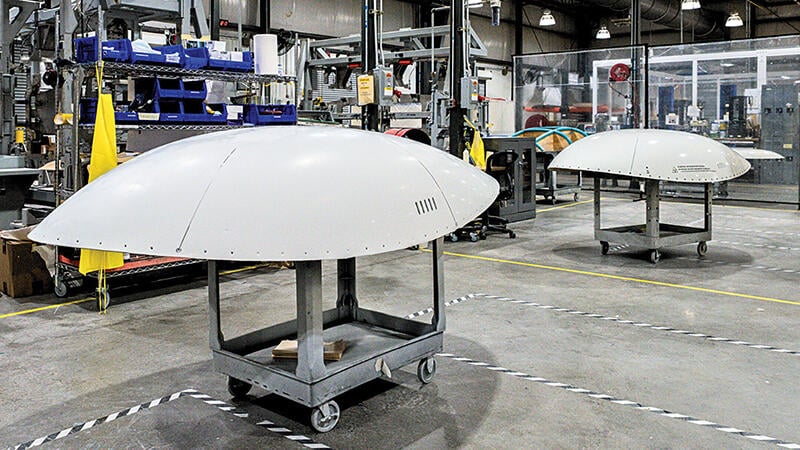
Maintaining or repairing composite radomes is challenging, since original performance may not always be restored.
To the casual observer, radomes are barely noticeable nose- or fuselage-mounted components that protect sophisticated weather radar or connectivity equipment. Yet their designs can be highly complex, given their vulnerability to bird strikes, hail, lightning and other hazards. Addressing these issues while improving functionality presents radome designers with an intricate challenge.
“For radomes, a balance needs to be made between radio-frequency (RF) performance, aerodynamics, weight, cost and structural capability,” says Daniel Herr, account manager for radome manufacturer Saint-Gobain Aerospace. “Best practices and optimization are applied, but there are always some trade-offs.”
Herr adds that for connectivity systems, radomes present unique design issues, since their RF performance requirements—especially for bands such as Ku, K and Ka—are significantly more challenging than those for nose radomes with weather radar.
“Tail-tip radomes, typically used on business jets for connectivity, present additional challenges due to the complexity of their geometry and location on the aircraft,” Herr says. “Structural requirements, such as bird strike protection, will differ from nose radomes due to their location but still require expertise to optimize them relative to the other requirements.”
Herr also points out that requirements are transitioning from the traditional gimballed antennas associated with geostationary-orbit satellites to new flat-panel or electronically steered antennas that may also use low-Earth-orbit satellites. “This has changed the size and profile of the associated radomes, but the fundamental needs to protect the antennas and allow for excellent RF performance remain,” he says.
Along that line, Saint-Gobain has developed MAXIO, a proprietary software tool that simplifies radome design, coupling RA3D—the OEM’s advanced RF analysis tool—with advanced data visualization tools to provide a tailored design solution that considers the specific RF performance, weight and price requirements, Herr explains.
NEW MATERIALS
Saint-Gobain is “continuously evaluating and developing new technologies and materials that may improve RF performance or add capability,” Herr says, pointing to higher temperatures or improved sustainability.
For example, Saint-Gobain has introduced new 3D knitting technology for its composite products. The technology was developed to improve quality and decrease costs by automating the labor-intensive traditional composite lay-up process. At the same time, it allows for the use of new materials and the unique integration of different materials to enhance performance. The process can be applied to any shape, including complex geometries, and involves zero waste.
“While we are always looking at new materials, both for the prepreg and the associated core materials to improve overall performance, it is not always just the specific material but also how they are combined with each other that is critical to optimize RF performance,” Herr says. “Cost, weight, structural integrity and the balance among those factors are very important.”
He adds that alternate production processes such as 3D knitting also enable the manufacturer to consider new materials that may not be options with manual layup—for both nose and fuselage radomes.
Christophe Bernus, nose radome product manager and technical authority at Airbus, says that a radome structure is composed of a very light sandwich panel, built with two thin skins made of special fiberglass fabrics in an epoxy resin matrix. Both skins cover an aramid honeycomb core.
Radome design is a compromise between contradictory requirements, Bernus explains, such as transparency for radar waves; the ability to withstand aerodynamic loads, lightning strikes and rain erosion; shock resistance; and manufacturing costs. “At the same time, research projects are being run to find more sustainable materials, such as those which are bio-sourced, for example,” he says. “But until now, the requested performance level remained difficult to reach.”
Regarding erosion, Bernus reports that today’s nose radomes incorporate a special paint coating with elastomeric particles, improving resistance to abrasives, such as sand and dust. “However, operators of some aircraft flying in harsh environmental conditions may apply an elastomeric-pellicle removable erosion boot to the radome, which can be replaced when eroded,” he says.
Airbus recently developed a radome design to make the external lightning protection strips “disappear,” thanks to a patented internal strips design. Suppressing the strip tips has led to aerodynamic savings and the laminar-turbulent flow transition.
“The savings on a long-range flight using the internal strips was estimated to be around 150 kg (330 lb.) of fuel,” Bernus remarks. “Moreover, this design allows easier repainting tasks and gives aesthetic improvement.” First implemented on the Airbus A350, the design has since been applied to new-generation radomes on the A320, A330 and A380, he says.
“For both commercial and defense applications, there is a lot of work being done around new materials,” says Griffin Melzer, business development manager for antennas and radomes at Axillon Aerospace Baltimore. “The aviation world is looking to go faster and farther than ever before. With more speed comes temperature increases; with further distances comes more concern with weight. In some cases, our typical material choices may no longer be compatible with the latest requirements flowed down to us. With new materials come new construction and manufacturing processes.”
Melzer also notes an interesting trend. “Since designing and qualifying new radomes is an endeavor, we are seeing some past products coming back to life for redesigning for better or new performance requirements,” he says. “That is mostly due to the fact that the original systems’ outer mold line and radome outer mold line are qualified for flight. This helps limit development costs and speeds up lead times.”
RADOME MAINTENANCE
“Composite radome maintenance or repair can be a complex and risky operation that could result in never achieving the same product performance as the original part,” Melzer says. “Any repair to the composite stackup must structurally and environmentally meet the requirements of the radome specifications. And any repair to the composite stackup or to the surface and paint of the radome must also pass the electrical requirements of the radome specifications.”
Melzer adds that to prevent premature radome removal, manufacturers are working to improve performance and reliability, including better paint processes and more damage-resistant lightning diverters.
“If the maintenance procedures provided in the OEM component maintenance manual or configuration maintenance and procedures are followed, Airbus guarantees radome transparency without additional bench testing,” says Xavier Outters, head of engineering and support at Airbus Avionics.
Outters adds that the airframer’s radomes are designed for interchangeability on the same aircraft type, such as within the A320 family. “At the maintenance level, the latest generation of radomes for all aircraft programs are designed with the same kind of material, facilitating the maintenance task at MRO facilities,” he says.
Keith Loss, executive vice president at Rock West Composites—an OEM in San Diego custom-designing radomes for both crewed and uncrewed military aircraft, plus some commercial aviation programs—points out that for accidental damage such as a bird strike, the requirement is to prevent any resulting debris that could affect a critical aerostructure aft of the radome and/or contain damage to an anetenna. For a lightning strike, one approach includes diverters, depending on the location zone as defined by military or FAA specs, as well as size and antenna interactions, Loss explains.
“Radome repairs tend to be tricky because they involve [an area] where there is an extra overlap/splice ply for structural integrity,” he says. “The extra ply often has an adverse impact on RF transmission, which is sometimes not acceptable.”
Loss notes that small general aviation aircraft radomes have more latitude because they are lower performance, so any minor degradation in transmission due to extra ply overlaps does not negate their function. But for commercial and high-performance military aircraft, the repair is often required to use the same prepreg and core as the OEM.
“OEMs are the best source for repairing their own,” Loss notes. “However, if a different company is trying to bid the repair, having the spec material could be a challenge due to minimum buy quantities, lead times and storage. Our radome approach is to collaborate with our customers to investigate solid laminate versus sandwich, versus multilayer sandwich constructions. We also look at materials that are lower-cost, like fiberglass/epoxy, versus higher-cost, lower-dielectric materials like quartz/cyanate ester.”