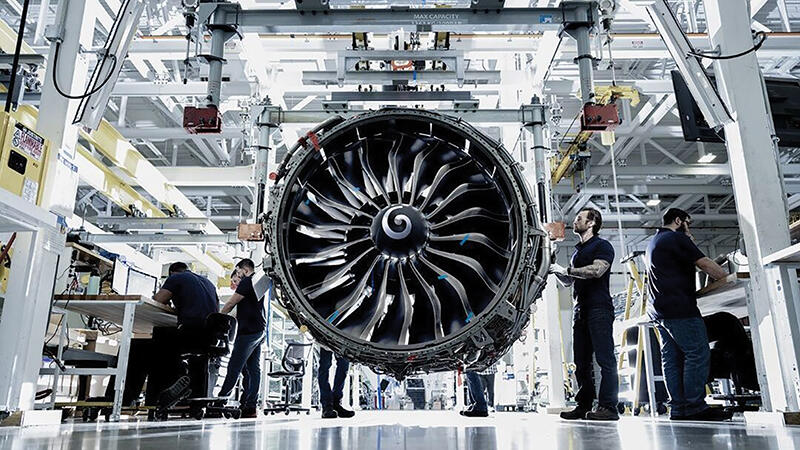
GE is investing $1 billion to increase MRO capacity, around half of which is aimed at serving the expanding Leap-1 aftermarket around its network.
Less than two years after GE Aerospace became a stand-alone entity, the company’s transformation continued into early 2026, when its technology and operations unit was folded into an expanded Commercial Engines and Services division under its newly appointed president and CEO, Mohamed Ali.
The reorganization is about much more than streamlining and a leadership reshuffle. As GE Aerospace faces fulfilling a record $190 billion order backlog and supporting an ever-growing fleet of more than 50,000 installed commercial engines, the “sum of the parts” approach to the company’s restructuring is designed to bring together know-how from across business units to enable expansion and tackle issues more quickly.

The move comes as services within GE Aerospace’s Commercial Engines and Services (CES) continue to drive higher revenues. The business unit generated $33.3 billion in returns for 2025, up 24%, with services representing 75% of total CES revenue. So how is the restructuring affecting GE’s valuable aftermarket business?
“We’ve broken down a lot of organizational silos that are driving a one-team approach,” says Farah Borges, vice president of the maintenance technology and operations organization. “We’ve seen the early fruits of this, even in the first 60 days, and we are solving problems at a different pace, with a total-value-stream thought process.”
Borges oversees a fast-growing sector of GE’s business that includes the aftermarket shops that perform MRO and services engineering. “With the recent changes, services engineering got integrated into all of this,” she says.
GE’s commercial, operations and engineering teams were previously in siloed organizations. “Last year, technology and operations came together, so engineering and our prior supply chain and manufacturing teams also came together,” Borges notes. “This year, we’ve bolted the product lines into that team as well, and so now we have a fully integrated Commercial Engines and Services organization.”
The changes create new opportunities, Borges says. “In the past, where we might have had a commercial solution to a problem, now we’re asking: Is there an operational solution? And how do those things link together?” she explains. “And if we’re making a concession on the commercial side, are we thinking about what the long-term ramifications are on the product portfolio?”
The result of embedding service engineering into the group is “we are putting more problem solvers in the field to tackle the challenges that we have,” Borges says. “And there’s not a day that goes by that we don’t have huge opportunities to continue to do better for our customers.”
But with the reorganization coming on top of GE’s $1 billion five-year investment plan announced in 2024, is this going to be enough to handle the forecast growth? “We have yet to see the peak in terms of our shop visit volume,” Borges says. “How do we make services a competitive advantage for the business? What do we need to do to provide our customers with the fleet stability they expect and make sure that when engines do come off wing, that A) they’re planned, and B) we’ve got a slot to support them and to get them back on wing as soon as possible?”
A big focus is therefore on engine turnaround time (TAT). “How do we make sure that we’ve got the right capacity in place for the network?” Borges asks. “We’re doing things to grow our network through this concept of ‘growing without growing.’ We’ve got a lot of waste in our system, and the Flight Deck is helping us uncover areas where we can continue to optimize so that we can continue to grow,” she says, referencing the company-wide lean operating system.
Additional growth will also come from partnerships, including more work with CFM International joint venture partner Safran and “our premier MRO providers,” Borges adds. GE’s aftermarket network of 22 service sites includes six dedicated engine overhaul facilities with maintenance and test capability plus five dedicated component repair sites.
The 2024 investment plan will cover much of the required services expansion, but further funding is expected, Borges says. “There’s a couple of places strategically we’re working on in terms of automation and technology,” she notes. “As you do that, there will be some incremental investments there, and as we look at our repair network and our partners, I think there’s potentially some further investments to come. The $1 billion will cover the bulk of what we need to do to be ready for the CFM Leap expansions and the growth that we see coming, but we will continue to invest in the network, both on sustaining investments that need to be made every year, as well as some additional expansions that are not yet included.”
The impact of some recent investments in new facilities on brownfield sites and test cells has yet to be seen, Borges says. “The growth that we’ve seen to date has really been through Flight Deck, process improvements and optimizing the footprint, like we have done in Singapore, where we have freed up an entire floor just based on going to flow lines.”
GE plans to implement another 80 flow lines across its network this year. “Putting that in perspective, we did 11 flow lines in 2025, so that shows the scale of this and the speed at which we’re trying to grow,” Borges says.
How does the flow line process differ from the current approach? “Traditionally in overhaul, an engine comes into a workstation, and it stays in there for its entire disassembly life,” Borges explains. “It then goes back into a workstation for reassembly, and it lives in that workstation its whole life. That means you need all the tooling to do a full disassembly. The engine sits there and is stagnant and takes up a lot of space.”
Under the flow line process, “I’m only doing whatever my takt cycle is,” she says, referring to the measure of the average time interval between the start of production of one unit and the start of production of the next unit. “If that time is 18-20 hr. of work in that workstation, I only need tooling and material for those 20 hr. I can slim down the amount of space that I use and do the same amount of work by putting in a flow line, and I can see abnormalities a lot better.”
The process speeds up problem solving and the early detection of anomalies. The focus on flow “is a huge unlock for us, not just in terms of space, but in terms of our ability to solve problems faster,” Borges says. “We can turn engines faster, and the more engines we can turn faster, the more engines we can put through the same footprint. And we’re just scratching the surface, and there’s more to do.”
Automation and advanced technology are at the forefront of the campaign to accelerate TAT. Many of these improvements are being developed and tested in the company’s new services technology sites in Cincinnati and Singapore.
A key focus is on using artificial intelligence (AI) and machine learning to improve predictive maintenance. “We live in a data-rich environment,” Borges says. “So how do we take all this data that we collect—whether it’s on wing, when we inspect engines, when we’re doing borescope inspections at shop visits or we’re capturing through maintenance records?”
One way, she says, is to develop a deeper understanding of parts material performance to enable better prediction of workscope while the engine is still on wing. With deeper knowledge, when the engine comes off wing, MRO shops will be able to pre-position material, components and equipment, she says.
“We can make sure we’ve got the right slots available, and, from a repair perspective, we know what capacity we need to plan for,” Borges says. “This idea of getting more upstream in our prediction models with higher fidelity is a big unlock.”
The second major advantage will be in improved stack and inspection technologies. “How do we detect the things that are acceptable versus not more holistically?” Borges asks. “When we bring a part into our shop, we typically stop when we detect the first defect that’s going to drive a repair. With stack, we want to collect data and feed it into the learning models so when we do a full part inspection, we can predict what this part is going to do and what the performance will look like in the future.”
GE believes improved predictive capability from advanced technology and inspections married with AI and machine learning will also enable closer coordination with the supply chain. “How do we make sure our sources and our suppliers are ready?” Borges asks. “And how do we make sure our own internal shops are ready for what’s coming?”
Better links with suppliers will help with ongoing materials hurdles, too. “The largest challenge continues to be material across the industry,” Borges says. “No surprise there, but we’ve been working with our suppliers collaboratively and making sure that the signals are clear that we’re not creating a lot of variation and that the teams know what to expect from us.”
The collaboration includes embedding engineers at some suppliers that have had challenges recovering from the post-COVID-19 pandemic downturn. “We’ve also done a lot of Flight Deck work at our supply base, and so how we bring our suppliers along with us is a big part of what we need to do,” Borges says. “If you look at our most critical suppliers, we’ve seen them deliver 40% more than the year before.”
Closer links with suppliers is “going to be a big deal,” she says. “We are trying to grow our aftermarket while our original equipment delivery is going up as well, so making sure we’ve got good signals going in [to suppliers], good partnerships to solve problems, and the right investment thesis for our suppliers is going to make a big difference. There’s a lot of work that’s being done in that space, and more is still needed to make sure that we’re ready.”

Related Content