This article is published in Aviation Week & Space Technology and is free to read until May 22, 2026. If you want to read more articles from this publication, please click the link to subscribe.

People, Factors And Stories Behind What Launched MRO 30 Years Ago

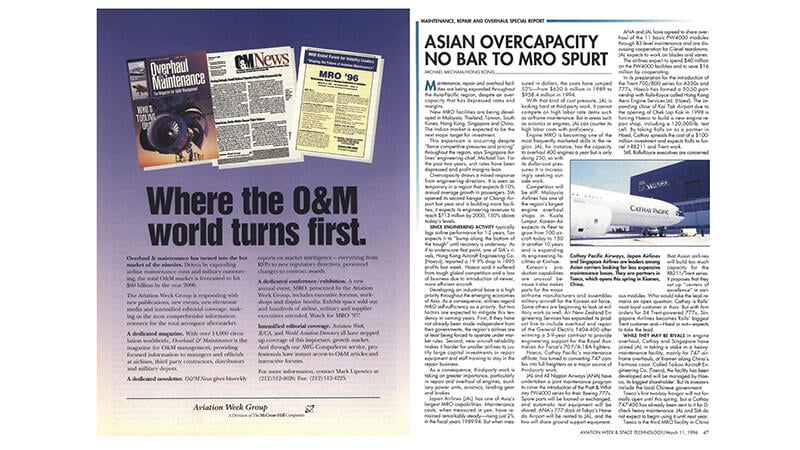
Aviation Week pages archive
Credit: AW&ST Archive

A little event held in a ballroom at the Fairmont Hotel in Dallas in 1996 launched the acronym MRO and the aviation aftermarket as we know it.

Except for ads promoting MRO ’96—the first Aviation Week MRO conference and exhibition—the acronym MRO was nonexistent. M&E or E&M (engineering and maintenance) and O&M (overhaul and maintenance) were the terms of the day used to describe the aviation aftermarket.

But MRO ’96, which brought together 540 executives from 14 countries in that ballroom March 10-12, 1996, changed the course of the aviation aftermarket—and led to the acronym MRO gradually becoming synonymous with the industry it describes.

MRO ’96 was the first time the industry came together in a forum to learn, solve problems, network and strategize about how to improve efficiency.

THE BACKDROP

A confluence of factors drew people together at the first MRO event. Economic growth buoyed air travel for business and leisure. Legacy carriers were contending with thriving low-cost carriers—led by Southwest Airlines—that forced them to examine their higher costs. New aircraft, such as the Boeing 777, which entered operation in June 1995 with United Airlines, included advanced technology and better economics for long-haul routes. Globalization and open skies expanded international travel and led to the formation of airline alliances, such as Star Alliance in 1995 (officially launched in 1997).

At the same time, maintenance labor costs were higher in the U.S. and Europe, where there also was an overcapacity of maintenance. Airlines started selling their excess capacity to grow third-party MRO revenue. Swiss­air Technical Services, United Airlines’ UAL Services, FedEx Aviation Services, KLM Engineering & Maintenance and Lufthansa Technik were some of the contenders that took on the independent maintenance providers.

Maintenance outsourcing started in earnest but with some trepidation about quality.

Low-cost and start-up airlines in particular sought MROs that could provide a range of services to maximize use of downtime. For instance, start-up airline America West contracted its airframe and component maintenance to BFGoodrich Aerospace.

OEMs—especially electronics and subsystem suppliers—were consolidating. McDonnell Douglas was looking for acquisitions to help it vertically integrate while increasing productivity to cut costs. McDonnell Douglas President Herbert Lanese told Aviation Week in early 1996 that the company expected to make a “sizable acquisition” by midyear (AW&ST March 4, 1996, p. 58).

Instead, McDonnell Douglas announced a merger with Boeing on Dec. 15, 1996.

THE FIRST MRO CONFERENCE

Aviation Week started publishing this magazine, originally called Overhaul & Maintenance, in 1993 as a supplement to the World Aviation Directory. Following market growth, Overhaul & Maintenance became a stand-alone magazine in 1994. It was the only publication dedicated to the aviation aftermarket.

Aviation Week produced defense and aerospace finance events in 1995, but research identified a market need to bring people together in the aviation aftermarket.

At the same time, George Ebbs of the Canaan Group had produced a “very optimistic report” about the aviation aftermarket that he shared with Ken Gazzola, then-publisher of Aviation Week. The report solidified Gazzola’s decision to launch MRO ’96.

Gazzola asked Lydia Janow, who was running Aviation Week’s events, to launch an MRO event. She booked a ballroom at the Fairmont Hotel.

The Canaan Group, which had pitched working with Aviation Week on the conference, ended up running it that first year.

Ebbs had consulted for several large OEMs and airlines before MRO ’96 and describes the maintenance industry in 1995-96 as “largely underappreciated and not managed very well.” While airlines were spending millions of dollars to keep aircraft flying safely, “no one ever talked about it,” he says. Line maintenance, inventory management and aircraft overhaul were siloed, Ebbs notes.

He thought it was time to bring them all together and “alert people about this part of the industry,” Ebbs says. “So I lined up the speakers, and Ken lined up the sponsors and contacted Ross [Perot, Jr.],” Ebbs adds. Perot helped develop Fort Worth Alliance Airport.

“I asked Ross to help us launch,” Gazzola says. “He came through with flying colors, helping with the venue, a special tour of the new Alliance Airport, including a tour of the new American Airlines maintenance facility within.”

Janow “budgeted 25 exhibitors and about 300 people,” she says. “We ended up with 70 exhibitors and 540 people. I had a curtain separating the exhibition from the conference. George Ebbs and team put on the agenda, and there was big excitement in the room.”

As it turns out, that curtain made an impact in several ways.

Hal Chrisman, a Canaan Group consultant at the time, remembers the curtain spanning from floor to ceiling. It was “probably 30 ft. high, but it wasn’t very soundproof,” he recalls. “While the speakers had to speak over the din coming from the exhibit hall, that first MRO set the standard for those to follow with speakers like Phil Condit, then president of Boeing, and Stephan Regulinski, president of UAL Services for United Airlines.”

Condit told MRO ’96 attendees that airlines, manufacturers and suppliers had to “shed peripheral activities, boost productivity of their workforces and constantly improve service while simultaneously cutting costs,” AW&ST reported (March 18, 1996, p. 35).

A couple of weeks later, Condit also became Boeing’s CEO—only the seventh CEO in the company’s history.

“There will be unrelenting and brutal pressure” to cut operating costs and expenditures in coming years, opined a Northwest Airlines official at MRO ’96.

While Regulinski encouraged airlines at MRO ’96 to outsource maintenance that is not of a “value-added nature,” United’s employee contracts at the time limited the airline to outsourcing a maximum of 20% of its maintenance. “As a result, it has retained overhaul of Pratt & Whitney PW2000-, PW4000- and CFM56-­series engines but outsources overhaul of CF6-50 turbofans that powered the airline’s McDonnell Douglas DC-10s, -50s and -30s,” AW&ST reported.

Continental Airlines, which had closed three of its maintenance bases, was outsourcing 65% of its maintenance, according to Gordon Bethune, president and CEO at the time.

Ebbs says the conference covered sessions on engine maintenance, aircraft overhaul, parts management and line maintenance. It was “a great success, but the nifty thing was that people felt appreciated” and wanted to do it again, Ebbs says. They felt good about being acknowledged for what they did, and it was productive to be with other people doing similar things, he says.

Frank Jackman, Overhaul & Maintenance’s managing editor, who moderated a few sessions at MRO ’96, agrees that “people were excited to be together and talking about business.”

Another thing that stood out about the first MRO event was the barbeque. Perot “also volunteered his ranch for a gala evening reception and Texas barbecue,” Gazzola says. “It was a major hit.”

INDUSTRY IMPACT

“I think the legacy of MRO Americas is the ideas that were incubated there,” Chrisman says. “Outsourcing definitely received a boost from presentations and conversations at the early MRO conferences. Similarly, [parts manufacturer approval (PMA)] derived a lot of credibility from the presentations, discussions and debates at early MRO conferences that helped transform PMA into a multibillion-­dollar market.”

“What struck me in those early years was how practical and direct the discussions were,” says industry veteran Adrian Paull, who was a Honey­well executive at the time of a very early MRO, but not MRO ’96. “It felt less like a trade show and more like a working session for people trying to solve current operational challenges.

“The scale was also very different,” he continues. “Many of the booths were quite modest by today’s standards. In some cases, it was little more than a table, a few components on display and a group of very knowledgeable engineers and operators standing around discussing reliability issues or repair solutions. You could walk the floor and quickly find yourself in conversations with airline technical leaders, repair specialists and OEM engineers all trying to solve the same kinds of problems.

“In many ways the event mirrored the aftermarket itself at the time,” Paull adds. “It was highly technical, very relationship-driven and refreshingly pragmatic. If an airline had a stubborn component problem or a repair bottleneck, there was a good chance the person who could help address it was somewhere in the room.”

“And that person would talk about the problem,” Ebbs says.

Parts suppliers were elevated as part of the industry solution.

“One small detail I remember from those earlier events was how easily conversations moved from the conference sessions straight onto the show floor,” Paull says. “The line between ‘conference’ and ‘exhibition’ often felt quite thin, which probably reflected the fact that most people attending were there for the same reason: to exchange practical knowledge about keeping fleets operating reliably.”

Even though Janow replaced that first curtain with walls in subsequent events, it did not hinder the event’s foundation—sharing knowledge, problem solving, finding solutions and networking.

“One thing that has not changed in 30 years is the pragmatic nature of the MRO community,” Paull notes. “The industry has moved from analog avionics and paper manuals to predictive analytics and connected aircraft, but the fundamental question remains the same: How do we improve safety, reliability and cost of ownership?”

The popularity of the event led to the launch of MRO Europe in 1998 and MRO Asia in 2001, which led the original event to become MRO Americas.

Lee Ann Shay

As executive editor of MRO and business aviation, Lee Ann Shay directs Aviation Week's coverage of maintenance, repair and overhaul (MRO), including Inside MRO, and business aviation, including BCA.