This article is published in Aviation Week & Space Technology and is free to read until Jul 31, 2026. If you want to read more articles from this publication, please click the link to subscribe.

Iberia Maintenance Makes Its Leap Move

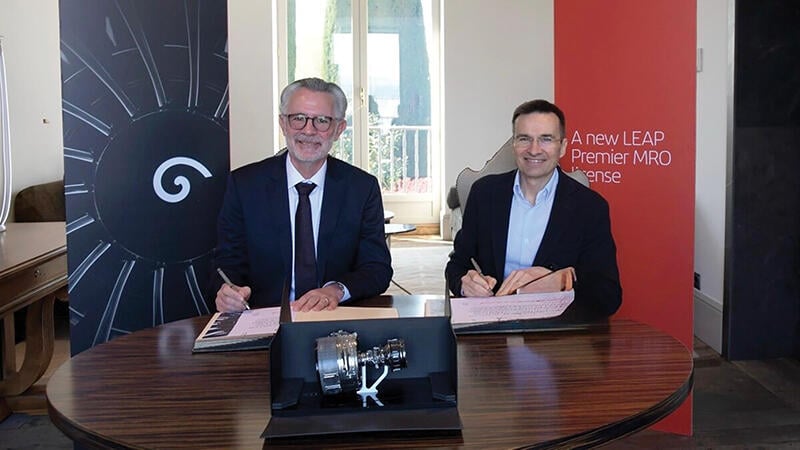
Gaël Méheust, CFM President and CEO, and Marco Sansavini, Iberia President and CEO

CFM President and CEO Gaël Méheust (left) and Iberia President and CEO Marco Sansavini signed the Premier MRO agreement.

Credit: Iberia Maintenance

Iberia Maintenance is preparing a rapid scale-up of CFM International Leap capability after being confirmed as the latest member of the OEM’s Premier MRO network for the narrowbody engine.

The Madrid-based company in April became the seventh to join the network, with coverage for Leap-1As that power the Airbus A320neo and -1Bs for the Boeing 737 MAX. The other members of Premier MRO, which CFM launched in 2024, are Air France KLM Engineering & Maintenance, Delta TechOps, Lufthansa Technik, MTU Maintenance Fort Worth, StandardAero and ST Engineering.

CFM agreed to terms with Iberia Maintenance’s parent company, International Airlines Group (IAG), which has carriers Aer Lingus, British Airways, Iberia, Level and Vueling under its umbrella. The Premier license provides enhanced OEM support for parts, repairs, tooling and engineering through an open network in which Iberia Maintenance can compete with other Leap shops for work.

Iberia Maintenance expects the Leap-1A work to come online in the first quarter of 2027, when the MRO plans to induct its first engine at its shop near Madrid-Barajas Airport. Leap-1B activity is expected to commence shortly after, likely in the second or third quarter.

“It was always our ambition to get into the Leap market,” says Fernando Comenge, director of MRO business strategy and supply chain at Iberia Maintenance, adding that the company is confident about meeting that first Leap-1A induction target. “We repair three product lines, between the CFM56, [IAE] V2500 and the [Pratt & Whitney geared turbofan (GTF)], so Leap was the last product line missing to complete the narrowbody market for us.”

Once inductions begin, the shop will have full overhaul capability. An existing on-site test cell will be conditioned for both the 1A and 1B variants.

“We are not starting with light workscopes, but instead, we will be ready for full performance restoration shop visits from Day 1, because now is the time when those workscopes are starting to happen in the market,” Comenge says. “During the early years, it was more light work, but now operators are asking for full performance restoration capability, so we want to be ready for that immediately.”

Comenge believes that the Leap—entering a decade of service this year—is perhaps the most important narrowbody engine market, given the demand that could sustain Iberia Maintenance’s business in the future. “We know that 75% of the narrowbody market will be Leap in 10 years’ time, so we are ensuring the future of maintenance not only for the IAG Group but also for third-party customers,” he says.

“The 1A aligns with the engines operated within our airline group, while the market demand from third parties is especially strong for the 1B, so we need to be ready for both quickly,” Comenge said. “The critical path is tooling, training and getting the right people in place.”

He estimates that about 15-20% of Iberia’s engine shop output is IAG Group-related work, while the remaining 80-85% is third-party MRO business. “That has grown significantly in recent years,” he says. “Our future Leap shop will be heavily focused on third-party work. We [Iberia Maintenance] may be affiliated with the airline group and will continue to service IAG-affiliated airlines, but it is very much run as a business-focused MRO operation.”

Key to this ramp-up and future growth will be Iberia Maintenance’s apprenticeship initiatives and in-house training center, which will focus on developing the next generation of aircraft maintenance professionals. The two main pillars are its vocational training program, which places about 60% of interns later hired by Iberia Maintenance, and a gas turbine engine maintenance specialization program launched formally this year.

“The program allows graduates from midlevel vocational training programs in fields such as vehicle electromechanics, machinery electromechanics, railway rolling stock maintenance, and aeronautical structures and systems assembly to specialize in aircraft engine maintenance,” Comenge says.

Aviation Week’s Fleet & MRO Forecast data projects $268.8 billion MRO demand for all Leap variants in 2026-34. An inflection point in that fleet is expected by 2030, when Leap engines will outnumber their CFM56 predecessors in service. Although Iberia Maintenance has shared no induction targets for the Leap or the GTF in Madrid, the MRO carried out 189 inductions across its engine portfolio in 2025.

Iberia Maintenance began repairing CFM engines in 1992,and although it is a newcomer to the Leap it is not the first company to enter that market segment, as Comenge points out. He believes the Leap program will require a quick capability ramp-up, given the high market demand. He sees the company’s on-site training center and apprenticeship program supporting this.

Comenge says Iberia Maintenance has undergone a similar exercise in recent years by developing its capability on the PW1100G GTF—a rival engine to the Leap-1A for A320neo aircraft. In 2023, the provider inducted its first GTF.

“It is progressing faster than we expected because these programs usually ramp up more slowly,” he says. “To date, we are meeting the OEM’s expectations. The GTF relationship is different because it is a closed network, whereas Leap is more of an open network and third-party focused.”

Iberia Maintenance plans to take its experience on the GTF program and apply the same approach to the Leap ramp-up. The MRO has identified a need for extra capacity, particularly in the Leap network, and has been carefully scaling its shop volumes, Comenge says, although he concedes that this approach has its limits.

“The new programs were originally expected to replace legacy engines, but because of the current market situation, there will be a period when we have both legacy and new-generation engines at the same time, and that means we will need more capacity,” he explains. “The transition is not one-for-one. We will continue supporting legacy engines while rapidly scaling up Leap and GTF, and that drives growth in capacity requirements.”

Iberia Maintenance sees strong demand ahead not only for the CFM56, particularly the -7B variant, but also for the V2500. Four years ago, about half the engines in its shop were V2500s, and they still account for a significant proportion today. “Although in the future, we may see more balance because CFM56 engines have very strong long-term market potential as well,” Comenge adds.

As Iberia Maintenance advances its ambitions to rank among the world’s preeminent MROs, the company is exploring long-term capacity growth in Madrid. This expansion could include a new engine shop with a test cell on land already owned by the business. Although the plan is in very early stages, Iberia Maintenance envisages a full engine shop, parts repair capability and new test capacity at the mooted shop.

James Pozzi

As Aviation Week's MRO Editor EMEA, James Pozzi covers the latest industry news from the European region and beyond. He also writes in-depth features on the commercial aftermarket for Inside MRO.