This article is published in Aviation Week & Space Technology and is free to read until Jul 03, 2026. If you want to read more articles from this publication, please click the link to subscribe.

Investments Help Pratt & Whitney Fortify GTF MRO Network

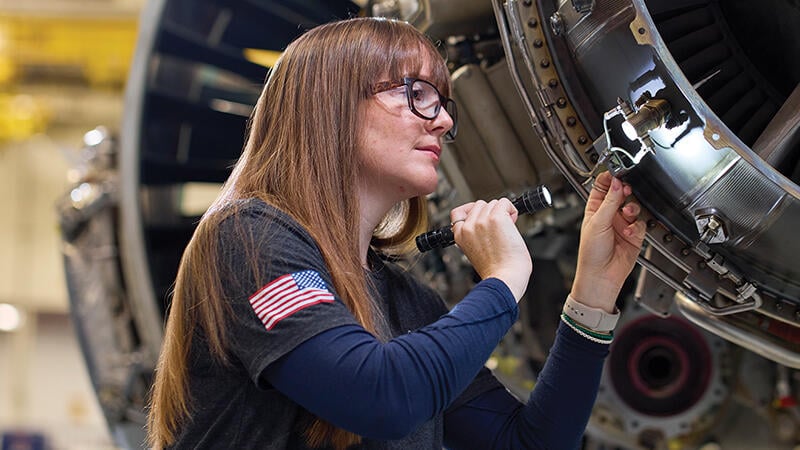
Pratt & Whitney technician at engine center in West Palm Beach, Florida

Pratt & Whitney invested $20 million into expanding its engine center in West Palm Beach, Florida.

Credit: RTX

Pratt & Whitney’s PW1000G geared turbofan aftermarket support efforts remain focused on minimizing disruptions linked to its contaminated powder-metal part inspection program, but the company is steadily building its long-term capabilities as the engine family matures.

Pratt recently unveiled its latest round of aftermarket support-strengthening investments, earmarking more than $100 million for three U.S. facilities.

The lion’s share of the funds, $78 million, went to the engine-maker’s new Commercial Serviceable Assets used serviceable material (USM) facility, which opened last fall in Irving, Texas. That investment will help boost Pratt’s USM stock 60% and expand its repair development work, the company said.

Another $20 million is going toward an approximately 50,000-ft.2 expansion of Pratt & Whitney’s West Palm Beach Engine Center in Florida. The new space will increase PW1000G geared turbofan (GTF) MRO capacity by 40% while adding new tooling.

Pratt is also putting $4.7 million into its Propulsion Systems Division (PSD) in Springdale, Arkansas. PSD specializes in engine case repairs across Pratt’s commercial and military engine product line and will add 7,000 ft.2 to its footprint.

As part of the expansion, Pratt & Whitney plans to ramp up its additive manufacturing repair development efforts, starting with GTF cases, Hamish Guthrie, vice president of aftermarket operations for North America, told Inside MRO.

“Cases on the engine are very, very critical components for us,” Guthrie said at Aviation Week’s MRO Americas in Orlando, Florida. “We have a long history of case repair at PSD. We have very, very deep technical capability at that facility. That is a huge factor in how we’re able to bring additive repair to the marketplace and find new ways of repairing components that previously you may have scrapped off. That’s only really possible when you’re leveraging decades of experience of case repair.”

The additive repairs are slated to start on the PW1000G line, but Guthrie said that could expand to other products, including military engines and legacy commercial powerplants. “Having a center of excellence when it comes to case repair, as an example, is tremendously beneficial,” he said.

Pratt is also building a new parts manufacturing facility at its site in Rzeszow, Poland. The $100 million shop will specialize in processes for isothermally forged parts, including heat treatment, sonic machining and inspection operations. The facility, expected to open by 2028, will boost output of rotating parts, including compressor and turbine disks, the engine-maker said.

This expansion comes at a key time in the PW1000G’s life cycle. Deliveries began in 2016, so the oldest engines are into their expected heavy shop visit windows. Many engines have visited shop floors already due to durability issues that required early removals, as well as the multiyear contaminated powder-metal parts inspection program (Inside MRO September 2024, MRO16).

“These investments demonstrate Pratt & Whitney’s continued commitment to lifting our airline customers’ GTF fleets,” Rob Griffiths, senior vice president of commercial engine operations, said in a press release. “Across these three U.S. facilities, we are investing to increase throughput of GTF engines and parts, adding repair capabilities and deploying new technologies to return engines to our customers as quickly as possible.”

Adding overhaul capacity is a crucial part of Pratt & Whitney’s strategy to minimize disruptions linked to the powder-metal contamination issue that has idled hundreds of aircraft since 2023. Groundings still number more than 400—the company does not disclose exact figures—but are slowly coming down as engines move through shops more quickly and capacity is added.

“We expect this downward trend to continue,” Chris Calio, president of Pratt parent RTX, said on an April earnings call. “The key enabler of this reduction is MRO output, which was up 23% year over year for the PW1100, on top of the 35% growth we saw in [the first quarter] of last year.” RTX defines MRO output as the number of completed overhauls.

The latest investments follow the recent $70 million expansion at Pratt & Whitney’s Columbus Engine Center in Georgia, which added new machinery and bolstered the PW1000G overhaul facility’s capacity by 25%.

Sean Broderick

Senior Air Transport & Safety Editor Sean Broderick covers aviation safety, MRO, and the airline business from Aviation Week Network's Washington, D.C. office.