This article is published in Aviation Week MRO part of Aviation Week Intelligence Network (AWIN), and is complimentary through Jan 10, 2026. For information on becoming an AWIN Member to access more content like this, click here.

GE Aerospace Adapts 360 Foam Wash For MRO Shops

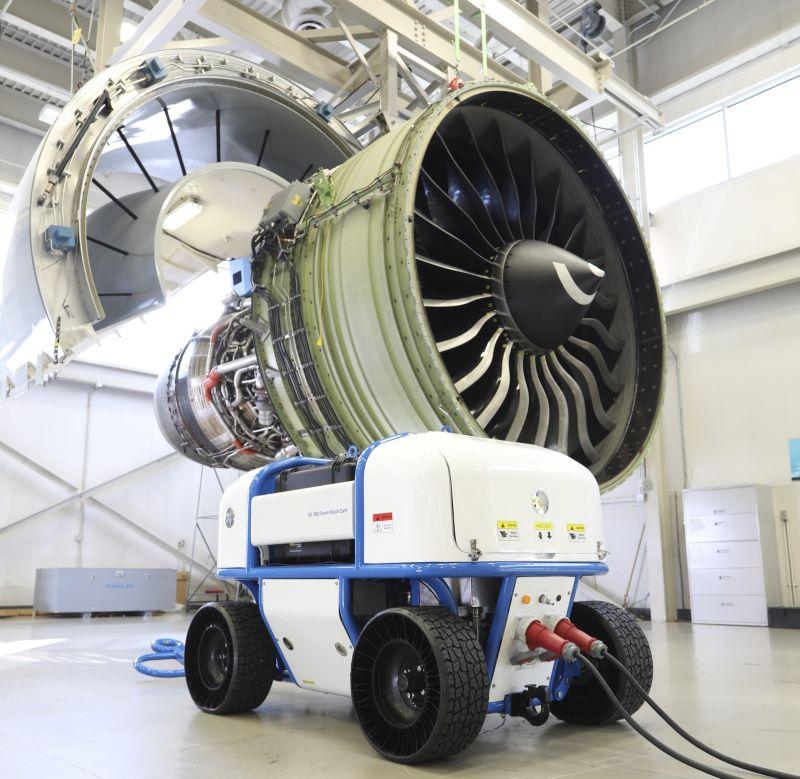
Foam wash for a GE90 engine
Credit: GE Aerospace

GE Aerospace’s airline customers have achieved considerable on-wing engine performance and efficiency gains through its proprietary engine wash system. Now, the engine manufacturer has exclusively shared with Aviation Week that it aims to industrialize the technology in its MRO shops to simplify engine maintenance processes.

Since GE began testing its 360 Foam Wash system in 2017, more than 6,000 washes have been performed, which the company says has saved up to three times more fuel than traditional water-based washes by reducing engine deposit build-ups, lowering engine exhaust temperatures and improving engine compressor efficiency.

GE estimates this has also reduced annual carbon dioxide emissions on GEnx-powered Boeing 787s by 70 tons and on GE90-powered 777s by 380 tons.

GE Aerospace Chief MRO Engineer Nicole Jenkins says initial results for the system on Leap-1A and -1B engines from “a couple hundred service evaluation requests” the company has done an even greater performance improvement over the GEnx engine.

GE now has eight licensed airline customers for 360 Foam Wash across GE90, GEnx, CF34 and GP7200 engine platforms, and the company says 100% of Middle East GEnx operators have adopted the technology. These airlines deploy 360 Foam Wash under a technical license from GE to perform engine washes on-wing, which involves injecting a proprietary solution to remove dust and dirt particles.

This year, Jenkins says GE has focused on industrializing the technology in its MRO shops. In addition to reducing the need for washes in the field, she notes that performing foam washes on engines inducted into shops across GE’s MRO network before inspections are performed provides additional benefits.

“We’ve really been able to demonstrate to ourselves that a clean engine is an easier engine to inspect, which seems pretty obvious until you try and do a complete borescope inspection of an engine that’s been operating in a hot and harsh region—you really do appreciate the fact that looking at a clean engine is much easier to disposition and work scope than one that still has residual aerosols in it from operation,” Jenkins tells Aviation Week Network.

During engine overhauls, GE has previously performed water washes after engines are tested. Now, “as soon as the engine comes into the parking lot in a transport stand, we unbag it, we clean it and then we inspect it,” says Jenkins. “That gives us an opportunity to appropriately work scope the engine and not have any late findings.” It also reduces the possibility of an engine requiring reinduction “if we find something in a clean condition post-test that we wouldn’t have seen incoming,” she adds.

GE’s MRO shops in Prestwick and Wales in the UK have been testing the use of 360 Foam Wash for incoming engines, and now it is being deployed across the company’s global MRO network, including at its partner shops.

During initial on-wing testing of 360 Foam Wash, washes took around eight hours on a widebody aircraft engine, but GE has been able to cut this to 2-4 hours—a reduction of 50-75%. “On the horizon is understanding how we get the procedure to work at rate with narrowbody operators,” Jenkins says. “Being able to turn those assets at the gate very quickly and still have optimal performance is kind of the Shangri-La. We have a Leap-1A core at the Services Technology Acceleration Center [in Springdale, Ohio] and we’re continuing to invest in process capability improvements to ensure that we have the smallest amount of maintenance burden—so less than two hours—but still maintain the same [exhaust gas temperature] margin or kind of restoration or performance of the procedure at the same time.”

GE has also developed a new foam formulation compatible with Leap engines, since its materials differ from the manufacturer’s legacy engine fleets.

Not all of GE’s customers have transitioned away from water-based washes, so the company has also been developing a new engine preservation method that eliminates the risk of contamination to oil or bearing systems after water washes, allowing engines to remain idle for more than a year before the next maintenance operation.

Jenkins says engine preservation has been a hot topic since the industry’s COVID-19 aircraft storage and 737 MAX grounding challenges, so GE has “been working toward having preservation that’s readily available across all of our engine types.” She adds, “Having that preservation capability has enabled us to launch foam cleaning into all of our ongoing support facilities.”

Lindsay Bjerregaard

Lindsay Bjerregaard is managing editor for Aviation Week’s MRO portfolio. Her coverage focuses on MRO technology, workforce, and product and service news for MRO Digest, Inside MRO and Aviation Week Marketplace.