This article is published in Aviation Week & Space Technology and is free to read until May 15, 2026. If you want to read more articles from this publication, please click the link to subscribe.

How AI’s Growing Power Grab Is Affecting Engine MRO

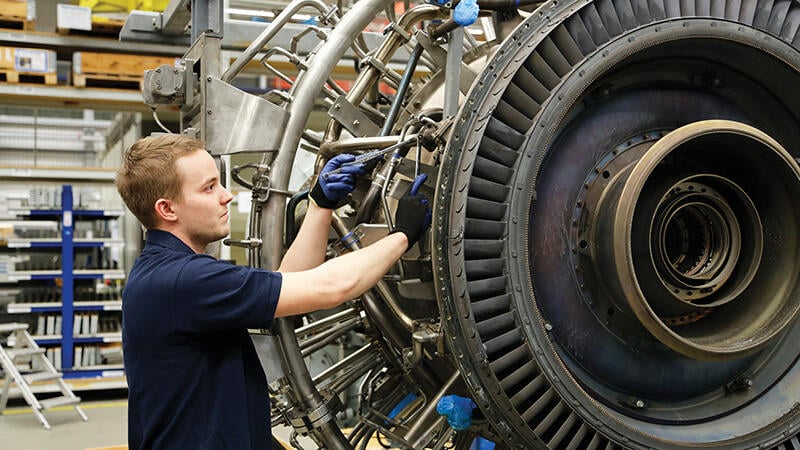
LM2500 engine

MTU is a major repair provider for LM2500 engines, derived from the GE Aerospace CF6.

Credit: MTU Aero Engines

News that engines designed to propel airframes through the sky are being grounded to power data centers is raising some aviation aftermarket eyebrows. But what might seem like a threat amid unprecedented demand for engines could emerge as a double dose of good news for these powerplant providers.

FTAI Aviation’s an­nounce­ment in December that it would expand its engine module overhaul and supply business with a land power division spotlighted a long-established trend. The new unit, FTAI Power, is following in the footsteps of companies such as GE Vernova, Mitsubishi and Siemens that have taken engines designed for aircraft and configured them for ground power generation.

However, instead of building new powerplants based on turbine aeroengine designs, FTAI is reconfiguring aircraft engines—mostly CFM International CFM56s, to start.

FTAI is not exactly competing with established gas turbine generator suppliers. Instead, it is addressing demand that current players are struggling to meet.

Electrical power demand is rising due to several factors, including the rapid expansion of data centers that support artificial intelligence platforms. But much like for Airbus and Boeing airframes, near-term delivery slots for GE Vernova’s LM2500 (a CF6-6 derivative) and other new-build gas turbines are hard to come by. Gas turbine manufacturers are boosting production, but they face supply chain concerns like their aviation peers.

“Industrial gas turbines for land-based power share a concurrent supply base with aeroengines,” Chromalloy CEO and President Chris Celtruda said at Aviation Week’s AeroEngines Americas in Tampa, Florida. “When it comes down to things like castings and forgings and coatings, all the manufacturers share the same supply base.”

Data center power needs vary based on many factors, but a good ballpark is 25 megawatts, which is enough to handle up to medium-size facilities. Narrowbody aeroderivative engines are the ideal size for these missions.

FTAI is setting up a dedicated aeroderivative turbine production line in its Montreal facility. The company’s initial targets include producing 100 land power units in 2027.

Such a production ramp-up requires inventory. FTAI boosted spares spending by $150 million in the fourth quarter of 2025 and plans to spend up to $250 million more on feedstock and a component pool that includes generators, gearboxes and control systems, President David Moreno said.

“We are intentionally building inventory ahead of demand to ensure execution certainty as commercialization advances,” Moreno told analysts on a February earnings call.

Given the CFM56 shortage among busy Airbus A320ceo and Boeing 737 Next Generation operators, the fresh demand for 100 engines and full spares pools to support them warrants close monitoring. But stakeholders close to the action see little reason to worry.

“There are 20,000 CFM engines out there right now,” an OEM engine executive told Aviation Week. “If you take 10, 15, 20 at the beginning, how big of an impact does it have vis-a-vis the impact of assets that are retiring? Last year, there were approximately 200 CFM56-5Bs and -7Bs combined torn down. Is it going to have a bigger impact than that? I don’t believe so.”

Another reason aviation is not fretting power’s intrusion: The land power environment is less demanding. Life limits that would ground aircraft engines do not apply to power generators, which tend to run at constant speeds and in less demanding environments than aeroengines. This provides de facto life extensions for aircraft engine modules and components that are no longer of value to an airline or MRO shop.

Aviation executives are confident that plenty of otherwise useless narrowbody engine cores are available to support the new demand. As Airbus and Boeing ramp up production and the aircraft retirement rate increases, the available engine pool will grow. The aeroderivative boom also will provide ancillary opportunities when aviation’s thirst for older engines and used parts eases.

GE Aerospace is getting involved, too. The aeroengine specialist reached a multiyear agreement to support FTAI Power, supplying parts, repairs and performance upgrades.

“It allows us to have more access to more parts and volume at good pricing, which means we can scale and grow our business while continuing to drive down costs,” FTAI CEO Joseph Adams said.

GE Aerospace—the industry’s largest buyer and consumer of used serviceable material (USM)—keeps its hands on some engines after they stop flying and gains another outlet for its USM.

“Our approach will be a combination of a multivendor sourcing of key components, collaboration with third-party vendors with proven track records and the build-out of in-house capabilities that will allow us to control production from turbine to final assembly,” Moreno said. “Given the scale we aim to deliver in the market, this multiprong approach will give us the flexibility and the predictability to fulfill our commitments to customers.”

Sean Broderick

Senior Air Transport & Safety Editor Sean Broderick covers aviation safety, MRO, and the airline business from Aviation Week Network's Washington, D.C. office.