This article is published in Aviation Week & Space Technology and is free to read until Jun 09, 2026. If you want to read more articles from this publication, please click the link to subscribe.
Hong Kong Aero Engine Services CEO George Edmunds says digital transformation is reshaping the business.
The Asia-Pacific region, including China, is characterized by its younger, fast-growing airline fleets. The area’s engine aftermarket is projected to account for about 36% of overall spending in 2026 and is seeing substantial investment in capacity and capabilities by MRO shops aligned with OEMs as well as by independent companies.
Scarcity Challenges
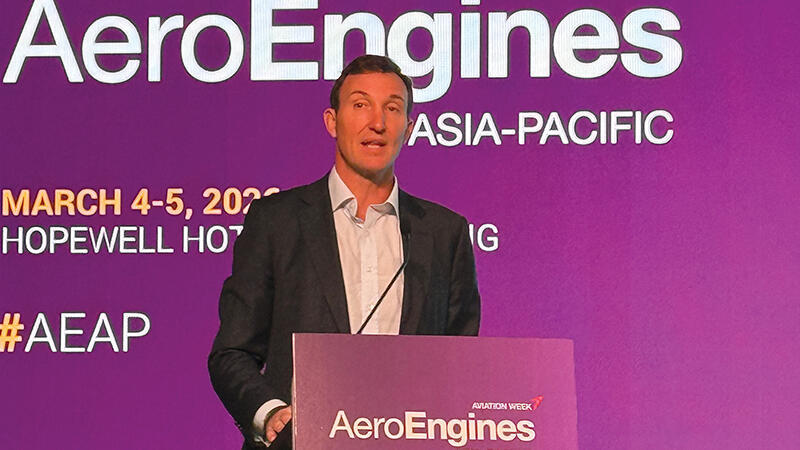
For now, engine availability, not demand, has become the defining constraint of airline operations in the Asia-Pacific, reflecting global trends. “Scarcity spans engines, MRO slots, parts and skilled labor, forcing operators to focus on keeping older engines flying,” George Edmunds, CEO of Rolls-Royce and HAECO joint venture Hong Kong Aero Engine Services (HAESL), said in a keynote address at Aviation Week’s AeroEngines Asia-Pacific here. “This is not simply a short-term disruption, and it tests our established approaches.”
Edmunds called for more cross-industry action to confront these hurdles in the engine supply chain. “Overcoming this scarcity issue requires us all to be more innovative and synergistic, providing an advantage to those companies that can deliver end‑to‑end solutions for their customers,” he said.
Edmunds cited HAESL’s two partner companies working together to enable near-wing module swaps through its global engine services network as an example of both innovation and cooperation. “These [modules] have been sent to HAECO Engine Services for repair and overhaul prior to reinstallation,” he said. “This was delivered safely and at speed because we were able to leverage existing group capabilities and coordinate internally.”
Geopolitical events—most recently the U.S.-Israel war with Iran, with its effect on global logistics—present further uncertainties. “The terrifying events playing out in the Middle East make this even more apparent, putting even more pressure on our supply chains,” Edmunds said. “The agreement now [is] that 2030 is the latest recovery date for supply chains, one year later than it was one year ago. So uncertainty looks set to continue.”
Alternative Supply
In a demand-driven and capacity-constrained market beset by engine durability and cost issues, shop turnaround times (TAT) have become a capacity differentiator—especially for next‑generation engines. One AeroEngines Asia-Pacific panel examining next-generation engine strategies discussed how unpredictable workscopes have made it harder for shops to pre‑plan parts and labor.
Another AeroEngines panel on supply chain problems also discussed how TATs are changing MRO strategies in the region. Panelists emphasized that a more localized approach is necessary to address fragilities in the global aftermarket supply chain.
Among these are Barnes Aerospace, which has engine component repair facilities in Taiwan and Singapore—the latter also has some manufacturing capability—as well as another manufacturing center in Malaysia. “One of the solutions is proximity to the end user,” said John McKirdy, senior vice president for strategy and growth MRO at Barnes Aerospace. “This facilitates managing TAT and predictability. We’re adding capabilities across fleet types and support in the region.”
Operators in the Asia-Pacific are expected to keep favoring engine module swaps over deeper overhauls to manage supply chain delays. Against previous expectations, they are becoming more open to parts manufacturer approval (PMA) parts and designated engineering representative repairs. This has also taken place in China, with perhaps the most surprising step change on alternative sourcing.
“More airlines see PMA [as a way] to control costs,” said Wilson Liu, vice president of procurement at Hainan Airlines, which operates more than 220 Airbus, Boeing and Comac aircraft. “This is just the beginning of Chinese PMA.” Liu added that the carrier has pursued module swaps to reduce costs and TATs while purchasing more spare engines due to rising costs.
OEM Capacity Ramp-Ups
Much of the engine MRO activity in the Asia-Pacific is OEM-driven. All the major commercial players have presences through designated shops or joint-venture operations with local providers. Commercial airline fleets in the Asia-Pacific are projected to grow to more than 7,500 aircraft by 2035 from around 5,500 aircraft in 2026, according to Aviation Week data. Because of that, the last decade has seen sustained investment in the region’s engine MRO despite perceived capital risks when setting up a cost-intensive engine facility.
Rolls-Royce established its latest joint venture, Beijing Aero Engine Services (BAESL), with Air China at the end of last year. Vanessa Thacker, vice president of MRO strategy at Rolls, said the engine manufacturer has focused heavily on both Europe and the Asia-Pacific due to the high volume of its engines operating in both regions. In the aftermarket, Rolls has also increased capacity at its existing sites and with its joint venture partners, including HAESL and Singapore Aero Engine Services, targeting a 40% capacity increase over the next few years.
“There’s a lot that we have to consider when looking at new MRO capacity,” Thacker said. “Primarily, all shops will need load in order to develop a feasible business case. We drive a lot of our decisions on future forecast demand and the strategies around anticipated capacity ahead of the demand horizon.”
Rolls-Royce is looking to ramp up BAESL’s operations eventually to 250 shop visits annually for Trent 700, XWB-84, and 1000 engines. “There will be three engine types coming in quick succession, so there’s a level of operational risk there,” Thacker said. “But again, we can draw on a lot of rich experience in the network to support that.”
“Any investment needs to make sense—this is a critical point,” said Lars Moeslein, senior vice president of group commercial at HAECO, which operates facilities in Hong Kong and in Xiamen, China. “Does it make sense to build another engine shop with the licensing, where we have maybe 5-6 competitors in the area? Or does it maybe make more sense to listen to our customers? What does the customer need in terms of the entire service environment?”
AeroEngines panelists also reported a gap in component repair capability, particularly for new-generation engines, in the region and worldwide.
AI’s Role In Engine MRO
An AeroEngines panel examining the role of artificial intelligence (AI) in engine maintenance suggested that current predictive engine maintenance technologies are most helpful for near‑term failures that would soon lead to an engine’s removal from an aircraft.
Low-cost carrier HK Express, which operates a fleet of about 40 Airbus A320ceo and Neo aircraft, plans its labor, slot availability and replacement engines to avoid schedule disruptions and cancellations. “What we do get from predictive engine maintenance is for near‑term defects,” said Geoffrey Hung, director of maintenance and engineering. “We have alerts on quite a few failures, and that helps.” However, he added that models are not yet reliable enough to predict long-term removals or full shop visit profiles, which limit their value for deep capacity and materials planning.
Aftermarket players are utilizing more AI-driven tools, incorporating them into tasks such as inspection and fleet planning, where AI is already being used to optimize fleet maintenance rather than just single-engine decisions.
“We had a customer we did analysis for, and their forecast for 10-year maintenance spend was around $80 million,” said Marcel de Vries, deputy head of leasing at MTU Maintenance Lease Services. “We were able to reduce it to $50 million—a $30 million saving—just because we have an AI-driven system that really analyzes every aspect.”
Hung said HK Express has developed its own in-house tool, a reinforcement-learning-based fleet engine optimizer that can simulate thousands of maintenance scenarios in minutes. To date, this has helped the airline reduce shop visit planning time by around 300 hr. per year. “We expect we can improve the yield by three percentage points across our engines on average,” he added.
While AI use cases are growing in the industry, the panel agreed that high-quality, fault‑rich data and stronger cross‑stakeholder collaboration are prerequisites for the next leap forward. “The AI model . . . really depends on the quality of data,” said Mingze Sun, market director for Greater China at Rolls-Royce. “Even in aviation, we’re getting lots of data, but actually, those truly useful and valuable data are very limited.” He said Rolls is using an AI‑enabled intelligent borescope that reduces inspection time by 75% while also creating a 3D model of inspected engine blades.
Regarding longstanding concerns about workforce replacement, the panel agreed that AI will augment rather than replace experienced engineers, especially in areas such as safety and certification. “The conclusion is quite clear,” Sun said. “AI is in a decision support role, instead of providing engineering judgment by human experts.”