This article is published in Air Transport World part of Aviation Week Intelligence Network (AWIN), and is complimentary through Jun 18, 2026. For information on becoming an AWIN Member to access more content like this, click here.

New Study Eyes Sustainability Via Latin America

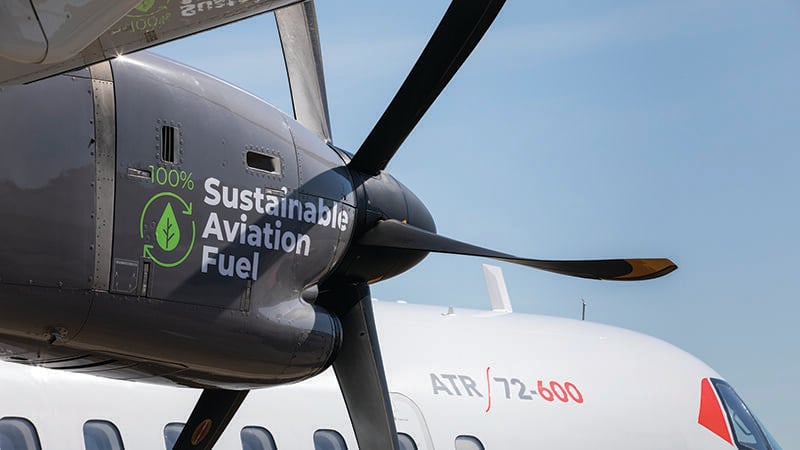
SAF aircraft
Credit: ATR

A first-of-its-kind study of how aviation sustainability goals can best be met across Latin America and the Caribbean (LAC) has produced a framework for airlines, industry and governments in the region.

The study’s findings were released in April by the Latin American & Caribbean Air Transport Association, known as ALTA, which conducted research and produced the framework in conjunction with ICF.

ALTA government affairs head Lina Quintero and ICF aviation sustainability head Alastair Blanshard provided ATW a first glimpse of the key findings. They emphasized the framework was aligned with the global industry goal of achieving net-zero emissions by 2050—a target agreed to in 2021 at the IATA AGM in Boston, Massachusetts—but was tailored to the region’s unique geography, resources and need for aviation and air connectivity to be allowed to grow.

Data
Source-ALTA-ICF

“Aviation is essential to connectivity and economic development in the LAC region, contributing 3.6% of regional GDP and supporting 2.9% of employment in 2023,” the report states in the opening of its executive summary. “The region spans nearly 22 million square kilometers with a geography characterized by mountain ranges, rainforests and deserts. This makes air transport critical for connecting communities, businesses and tourism markets. However, the aviation market in LAC remains significantly smaller than in more mature markets. One clear indicator is air travel propensity: while passengers in North America take on average 2.5 air trips per capita annually, the average in LAC is just 0.67 trips per capita. This large gap reflects lower market maturity and the wealth disparities between countries. It highlights the importance of ensuring air travel affordability in a region where connectivity is still developing and plays a fundamental role in economic and social development.”

It is therefore important, ICF notes in its summary bullets, that efforts to reduce emissions are balanced with maintaining aviation as a critical driver of growth and integration.

SAF VERSUS EFFCIENT OPERATIONS

A clear difference between the ALTA/ICF sustainability framework and those of other regions, notably Europe, is how it downplays sustainable aviation fuel (SAF) as a near-term pathway to net-zero and emphasizes the effectiveness of other tools, including fleet modernization.

Data
Source-ALTA-ICF

“Fleet is the most effective measure to reduce emissions while growing the economy. Airlines in the region have already made substantial investments and operate one of the most fuel-efficient fleets globally,” the report states. “Operations’ efficiencies represent an immediate and cost-effective measure to reduce emissions, but require collaboration from governments, airports and other stakeholders. The most ambitious global pathways are unrealistic for the region.”

In Europe, of course, the European Commission and national governments have pushed heavily towards the use of SAF, establishing mandates even though only a tiny fraction of what is needed is available and SAF refinery development has all but dropped off.

“LAC airlines operate one of the youngest and most fuel-efficient fleets globally, allowing the benefits of aviation to be realized with the lowest possible emissions. For example, the proportion of available seat-kilometers (ASKs) flown by new generation aircraft in the LAC region (38%) is higher compared to more developed economies, such as Europe (34%), the US and Canada (34%), and Asia (26%). Airlines have also made significant achievements implementing operational efficiencies (corresponding to procedures under their control),” the report continues.

Data
Source-ALTA-ICF

“However, achieving net-zero emissions for aviation in LAC requires further action and support. There are many obstacles, including economic and developmental disparities, limited infrastructure and varying regulatory capacities. The region’s GDP per capita remains significantly lower than in Europe or North America, which may limit its ability to absorb the higher costs associated with sustainable aviation measures.”

This point about the higher costs related to sustainability is another key message. IATA has said that net-zero transition costs for all airlines over the period 2024-2050 could amount to $4.7 trillion. Within LAC, where the majority of people are flying for the first time and are extremely sensitive to airfare hikes, the concern is that such costs can’t be handed over to the customer. Or if they are, they would lead to reduced air travel demand and unfairly restrict social and economic development in the region. That’s the aviation growth versus environment dichotomy that LAC airlines face.

“As [local] economies and populations grow, the LAC regional aviation industry will continue to expand, ensuring a greater number of people have access to the benefits the sector brings. Per capita travel rates in LAC are projected to grow steadily, increasing by a compound annual growth rate of 2.7% between 2019 and 2050. While this growth is crucial for developing economies, it also heightens environmental challenges that must be mitigated,” the report states.

A REASONABLE PATH

Quintero summed up the main aim of the study in the ATW exclusive briefing this way: “The goal of the study is ‘what’s a reasonable path?’ What’s a pragmatic framework for this region to decarbonize and be sustainable and to grow and how do you make it applicable to this region?” she said. “It’s a vast region with hard-to-reach places. Sixty-two percent of international tourists arrive by plane and one in 11 jobs here depends on tourism. Air travel is not a luxury here.”

Data
Source-ALTA-ICF

That’s why SAF—even less available in South America than in most parts of the world—is being regarded as more of a long-term solution and one that will need heavy government investment to develop. The survey estimates that regional investment to develop a sufficient SAF supply locally will be in the $224-$284 billion ballpark.

“If we go too fast on SAF, which is three to 12 times more expensive than conventional jet fuel, that would require an increase of $43 per seat and would lead to a 30% drop in demand,” Quintero said.

Carbon credit markets are another key pillar of the report. Over the last four years, the LAC region issued 23% of all world carbon credits, demonstrating an outsized role compared to its emissions, which the report puts at just 6.7% of global output. Also, with expansive and globally critical natural ecosystems, tropical forests and rich biodiversity, the region is well positioned to lead in the generation of high-integrity carbon credits.

This is another area where a coordinated approach would be the best way to fast-track and fully leverage the carbon credit markets. But unlike the US, Canada or even the European Union, the LAC is a mix of independent countries with governments that tend to change frequently and like to tax their airlines highly.

“Investment by governments here won’t be done one way across the entire region,” Blanshard told ATW. “It still comes back to local solutions that are much more likely to be supported.”

With SAF, Blanshard pointed out, LAC is “a great place to make SAF, but not a good place to buy it [because of the high cost versus jet fuel].”

Blanshard also said SAF mandates would produce a lot of inefficiencies. “The message is that there is a pathway [to increasing the use of SAF], but you need to work on the supply side before you work on the demand side. Our approach is more logical. There is such a reflex across the industry for mandates, but you have to recognize that in countries like the UK, they have had biofuels and biofuel-producing facilities for a long time. This region does not have that facility foundation.”

ALTA and ICF are in the process of explaining the survey and its findings to government officials across the region to get them onboard because it looks at aviation sustainability through their lens.

Persuasion, particularly when it comes to investment, won’t be easy, Blanshard acknowledges. “We have very hard challenges ahead,” he said. “But we also have huge opportunities.”

SIDEBAR

Europe’s e-SAF Dilemma Pits Mandates Against Reality

CEOs at Europe’s largest airlines are calling for the European Union’s (EU) 2030 ReFuelEU synthetic sustainable aviation fuel (eSAF) mandate to be delayed, saying it is not achievable because of the lack of eSAF supply.

With under four years to go before the mandate takes effect, easyJet CEO and Airlines for Europe (A4E) chairman Kenton Jarvis said only three eSAF plants have reached final investment decision (FID), and only two of those qualify under the EU mandate.

“It takes about four years to go from FID to the production of eSAF,” Jarvis said, urging the EU to be more realistic about eSAF availability. “This has already failed. It’s already broken, and it’s just about when we choose to wake up.”

Under the mandate, 6% of fuel supplied to aircraft at EU airports must be SAF by 2030, and 1.2% of the total supply must be eSAF. If the eSAF mandate is not met, Jarvis said it will create a “lose-lose” scenario, where up to €9 billion ($10.6 billion) in penalties could be passed on to airlines and passengers without any environmental benefit.

“That’s why, as Airlines for Europe, we’re calling for the eSAF mandate to be postponed until eSAF is actually available,” Jarvis said.

Ryanair Group CEO Michael O’Leary believes it is “inevitable” that the EU will delay the mandate to the mid-2030s over the next year or two. However, any changes to the mandate would be a disaster for the fledgling eSAF industry, according to eSAF body Project SkyPower.

“The certainty provided by ReFuelEU is single-handedly what allows us to access public support, secure offtake agreements, and move projects forward,” Arcadia eFuels CEO and Project SkyPower co-chair Amy Hebert said.

Project SkyPower acknowledges that the eSAF ramp up is “nascent and challenging,” but Hebert said more than 10 European commercial-scale projects could come online by 2030-2031 if the EU pushes for that.

The critical next step is the EU’s double-sided auction (DSA) pilot, which will bring together eSAF buyers and sellers, with public support bridging the price gap. Hebert said this will kick-start the market, bringing at least one eSAF plant to FID by early 2027 and paving the way for a wider DSA mechanism from 2028, making the mandate achievable.

KLM CEO Marjan Rintel also co-chairs Project SkyPower with Hebert, meaning she has a foot in each camp (KLM is an A4E member), but she understands the problem from the airline perspective. “It is crucial to have a regulatory framework that reflects market realities,” Rintel said. “eSAF needs to become commercially viable.”

This is the crux of the issue. Mandates and the threat of steep penalties for non-supply have not moved the supply needle enough to match EU ambitions. At the same time, motivation to get eSAF into commercial production has become even stronger, against a backdrop of skyrocketing fuel prices and potential jet fuel shortages in Europe since the war in Iran began and the Strait of Hormuz closed.

“We are witnessing the emergence of new threats every day,” European Commissioner for sustainable transport and tourism Apostolos Tzitzikostas told the A4E CEOs. “At the same time, we are asking aviation to transform, to decarbonize, digitalize, and to innovate at unprecedented speed.”

He acknowledged the pressure European airline CEOs are under, particularly when SAF is expensive and supply is still limited. “The business case—if we want to be very honest—remains difficult,” he said. “Let me also be very clear on one more point. The Commission is fully committed to ReFuelEU Aviation’s well-defined targets.”

This will come as little comfort to airline CEOs, who are also awaiting the outcome of an EU emissions trading system (EU ETS) review this summer. Carlos Muñoz, founder and CEO of Spanish carrier Volotea, named rising ETS costs as his top concern. “We paid €60 million last year. We have a turnover of slightly under €1 billion, so that’s a 5-6% penalty on the revenue, directly from ETS,” he said.

IATA director general Willie Walsh slammed Europe for its “ridiculous focus” on eSAF. “You’re trying to manufacture eSAF in one of the most expensive economies in the world at volumes that just don’t make sense,” Walsh said. “While I fully support the long-term ambition of eSAF, I think the requirement to produce these volumes in the short term makes no economic or environmental sense.”

The EU has been clear that its top priority is global competitiveness, but sustainability, global connectivity and energy security remain high on the agenda. How these ambitions will be reconciled in the EU’s new aviation strategy, due this fall, remains an open question.

–Victoria Moores

Karen Walker

Karen Walker is Air Transport World Editor-in-Chief and Aviation Week Group Air Transport Editor-in-Chief. She joined ATW in 2011 and oversees the editorial content and direction of ATW, Routes and Aviation Week Group air transport content.