This article is published in Air Transport World part of Aviation Week Intelligence Network (AWIN), and is complimentary through Aug 24, 2026. For information on becoming an AWIN Member to access more content like this, click here.
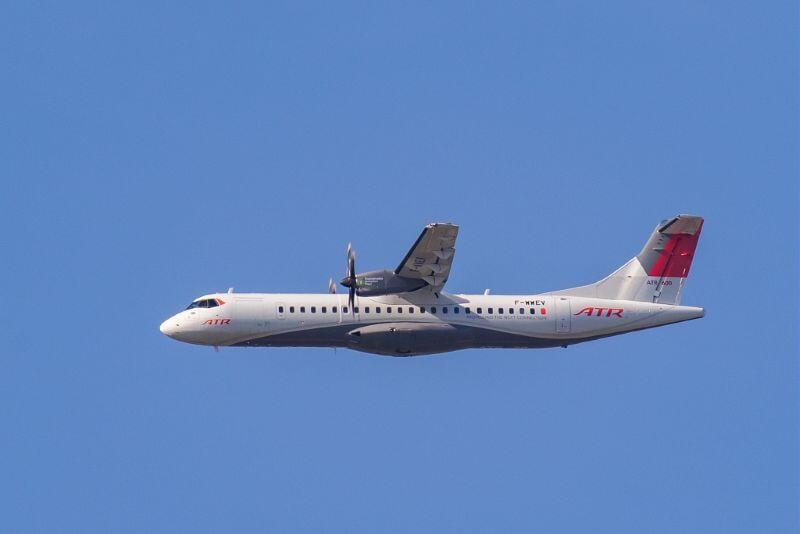
An ATR 72-600.
FARNBOROUGH—ATR is market testing a forward passenger door and a three-class cabin configuration for the ATR 72-600 along with some US-specific compliance modifications, as it seeks to attract more US airline customers.
“In terms of US market developments, one of the areas of feedback that we have had around the ATR product is the possibility of doing a forward passenger door,” ATR director and president Americas Chris Jones said in a one-on-one interview with ATW at the Farnborough Airshow.
A forward passenger door would mean the ATR 72 could hook up to airbridges at US airports, creating product continuity with mainline operations. As part of this push, ATR is proposing a three-class 50-seat ATR 72 cabin configuration, with first, premium economy and economy seats, along with a forward galley for first class catering.
Jones said this cabin could be a potential competitor to the Bombardier CRJ450 (41-seat three-class CRJ200 variant) and the CRJ550 (50-seat three-class CRJ700 variant). This would keep the ATR’s capacity within US scope clauses, while exceeding “every point of measurement” compared to a regional jet.
“We have first class, premium economy and economy with a forward passenger door. And at [US Regional Airline Association annual conference], we'll have a full-scale mock-up of the cabin, which is currently in Toulouse. We'll be shipping it over. We'll be showcasing it at the RAA conference in September,” Jones said. “We're market testing it right now. We won't launch it just for the sake of launching it. It will have to be a demand-led level of interest.”
The idea is that the three-class cabin will enable mainline airlines to extend their premium offering into smaller communities served by regional operators.
“You're still flying in a first-class seat all the way through, so you're not stepping down in your passenger experience when you're getting on a regional aircraft,” Jones said.
He estimates that the 50-seat ATR will offer 30% lower operating costs than the CRJ450 and 45% lower than the CRJ550.
For the US market, ATR will also need to introduce mandatory secondary barrier protection for the cockpit door and 25-hour cockpit voice recording (CVR25). The cockpit door standards relate to new aircraft operating in the US, so ATR does not currently have any equipped aircraft in active service. New ATR operator JSX is flying four ATR 42-600s, but it is subject to different rules as a Part 135 operation.
“[JSX]do not technically require the secondary barrier, but [JSX CEO] Alex [Wilcox] goes above and beyond some of the Part 135 rules,” Jones said.