This article is published in Air Transport World part of Aviation Week Intelligence Network (AWIN), and is complimentary through Oct 24, 2026. For information on becoming an AWIN Member to access more content like this, click here.

ATR Unveils Three-Class Cabin Concept With Forward Door

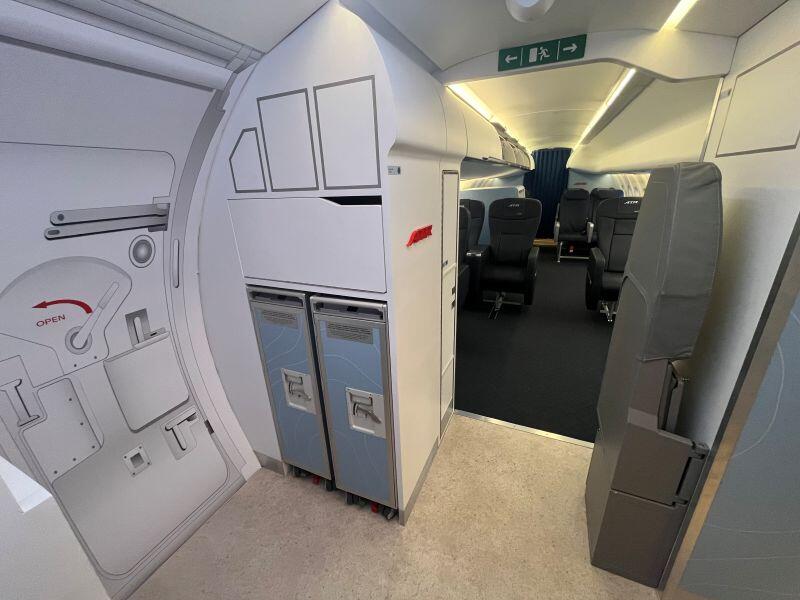
Concept of a three-class ATR 72 with a forward door for jet-bridge compatibility.

Concept of a three-class ATR 72 with a forward door for jet-bridge compatibility.

Credit: Christine Boynton

WASHINGTON—Turboprop manufacturer ATR is broadening its push for a renewed US market share, unveiling a 50-seat three-class ATR 72 cabin that is aimed at operators in a region where a wave of regional jet retirements is anticipated.

The ATR 72 concept, displayed at the Regional Airline Association (RAA) Leaders Conference in Washington DC on Sept. 23, features a forward cabin door for jet-bridge compatibility and a front galley, as well as sufficient bin space to accommodate more than 50 onboard roller bags—30 in overhead bins, and another 24 in floor-mounted receptacles. The central aisle is roughly two inches wider than the Bombardier CRJ-550 with an additional inch of cabin height.

A baseline configuration calls for 10 seats in first with a 40-inch pitch, 20 seats in economy plus with a 33-inch pitch, and 20 economy seats with a 30-inch pitch. Standard seat width is similar to a single-aisle airliner at 18 inches.

ATR’s design was developed in consultation with airlines to refine the requirements for the 50-seat market; an official launch would follow operator interest.

“We believe that by 2030, the market demand will be quite strong and that's a good timeline for us to not only design the product but also launch the program and deliver that,” ATR chief commercial officer Alexis Vidal explained on the sidelines of the event. “2030 is a good mix of where the peak of demand will start and what we can do from an industrial standpoint.”

Building on existing customers Alaska-based Aleutian Airways and US public charter operator JSX, the airframer sees growing interest in the US market. JSX, which began trialing ATR 42s last year, operates four of the type, using them in markets that its Embraer jets cannot reach.

“We're having more conversations about the timing for when an [ATR 72] solution is needed in the market,” Vidal said, nodding to regional jet replacement timelines. “That's why I come back to 2030, which I think is very realistic in terms of deploying capacity.”

ATR is unconcerned about JSX’s order announced this week with Heart Aerospace for up to 100 future 36-seat hybrid-electric regional aircraft. ATR’s own next generation roadmap aims to take a hybrid approach in the middle part of the next decade with its EVO program.

“We are enjoying new technologies that are coming to market; some of which we are skeptical about and some of which we will onboard in our plan,” Vidal said.

For now, the 50-seat three-class forward door concept for existing ATR 72-600s marks a “stepped approach.”

“This one will be on the current ATR 72-600 and then we will look at the next generation in the next decade,” Vidal said of the new concept. 

Christine Boynton

Christine Boynton is a Senior Editor covering air transport in the Americas for Aviation Week Network.