This article is published in Air Transport World part of Aviation Week Intelligence Network (AWIN), and is complimentary through Oct 24, 2026. For information on becoming an AWIN Member to access more content like this, click here.
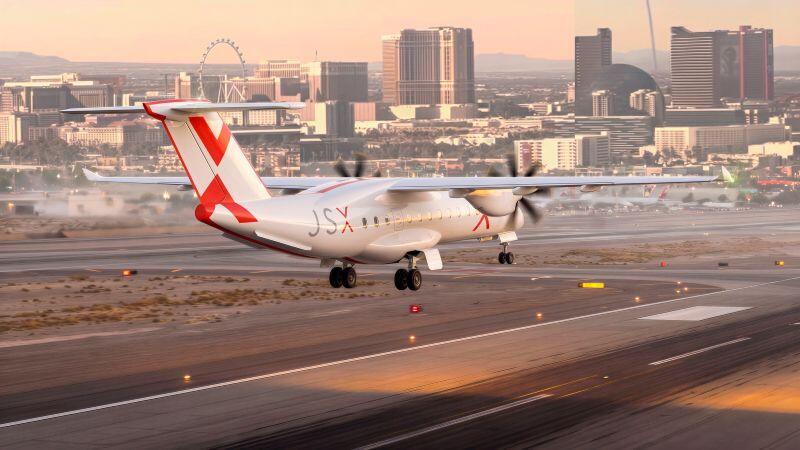
JSX plans to use the hybrid-electric ES-36 on short point-to-point routes.
Asked how US public charter carrier JSX plans to use the hybrid-electric regional airliners it plans to purchase from startup Heart Aerospace, JSX CEO Alex Wilcox recalled the “milk run” flights that connected San Diego to San Francisco via other Californian cites in the 1950s.
JSX, which operates Embraer ERJ regional jets and ATR 42 turboprops, has signed a deposit-backed purchase agreement with Heart for 50 hybrid-electric ES-36s, with purchase rights for another 50. Heart plans to fly the ES-36 in 2028 and certify in 2031.
“If you remember the old milk runs from the middle of the last century, they used to fly from San Diego to Carlsbad to Orange Country to Santa Monica to Santa Barbara to San Louis Obispo and farther up the coast until you got to the Bay Area,” Wilcox said.
The high-frequency, multi-stop flights largely faded away with the advent of regional jets. “We have a lot of markets for this airplane, a lot that are just too short to be flown by a conventional turboprop or jet; for example, Santa Monica to Santa Barbara,” he told ATW.
“With the electric motor, the cycle sensitivity is just not there the way it is with the turbofan or the turboprop,” Wilcox said. “So, the ability to fly point-to-point without worry about the wear and tear on the motor and the cycle costs are huge advantages to us.”
Heart is targeting more than 40% lower operating costs compared with competing aircraft, even with hybrid operation, and the ES-36 will take off on all-electric power, reducing noise and eliminating emissions, which is important in environmentally conscious California.
With capacity for 36 passengers but limited to 30 seats by JSX’s Part 135 certificate, the ES-36 has an all-electric range of 125 mi. plus reserves on ground-charged batteries. Hybrid propulsion using jet fuel increases range to 745 mi. plus reserves.
Charging the batteries on the ground between flights provides the best economics, but the availability of hybrid propulsion avoids any dependence on chargers at every airport. If a charger is not available or operational, the aircraft can fly on jet fuel.
With operations planned to start in California, Wilcox expects many ES-36 flights will be all-electric, but the extended range provided by the onboard turbogenerators will offer operating flexibility, allowing the aircraft to be deployed into other JSX markets.
“If I need to fly it from Southern California to Las Vegas, I can still do that,” Wilcox said. “It’s not a white elephant airplane that can only do 100-mi. markets. It can do 200- and 300-mi. markets if I want to, so I have a ton more network planning opportunities.”

Related Content