This article is published in Aviation Week & Space Technology and is free to read until Oct 09, 2026. If you want to read more articles from this publication, please click the link to subscribe.
New Digital Projects Expected To Drive Major MRO Efficiency Gains
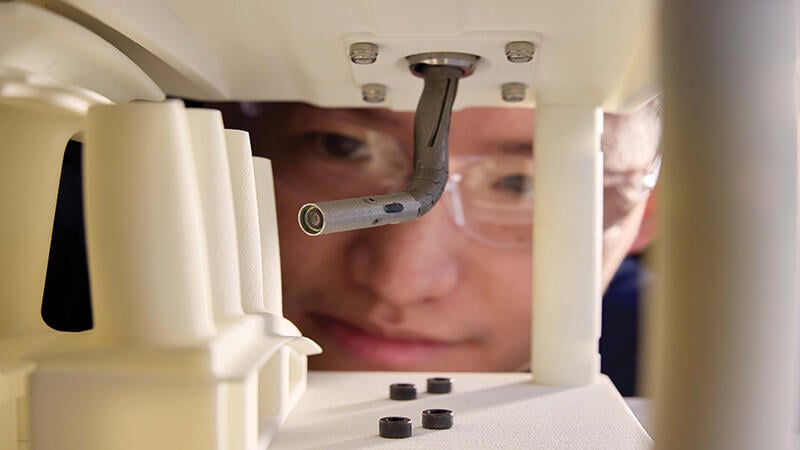
Artificial intelligence has helped GE Aerospace perform on-wing blade inspections 50% faster.
Facing pressures to reduce turnaround times, cut costs and manage disruptions more resiliently, the aftermarket is turning to digital technologies for help. From artificial-intelligence-powered tools to improve part inspection and maintenance planning to advanced systems aimed at tracking parts throughout their entire life cycles, aftermarket companies are hoping a digital boost can improve efficiency while ensuring safety.
But as companies devote more time, resources, staff and capital to developing these tools, tech leaders caution that success will depend on strategies that focus on solving real operational problems rather than chasing excitement around buzzwords.
Inside MRO spoke with experts across the aftermarket—ranging from engine OEMs and airlines to MRO providers, parts suppliers and logistics specialists—to cut through the hype and find out which technologies are providing promising, tangible results for their businesses.
CUTTING TURNAROUND TIMES
GE Aerospace, under its lean proprietary operating model, Flight Deck, is pursuing a transformation road map to build digital capabilities that can bolster its engine overhaul output capacity and turnaround time efficiency by 2028. Over the past few years, the engine manufacturer has been prolific in developing a range of artificial intelligence (AI) and robotics tools to improve inspection processes and simplify the administrative work across engine life cycles. GE Aerospace has doubled its investment in AI this year, and the results are already bringing considerable operational gains across its services business.
For instance, GE says technologies such as its AI-Enabled Blade Inspection Tool, which uses AI to improve inspection consistency and flag images showing potential damage, have made on-wing blade inspections 50% faster.
A little over a year ago, the company began developing a tool at its GE Celma MRO facility in Rio de Janeiro to synthesize the various sources of technical data involved when an engine is inducted for a shop visit. For an engine shop visit, “there’s actually a confluence, I don’t think people realize, of five different types of technical data that have to come together,” GE Aerospace Chief MRO Engineer Nicole Jenkins says.
The company must first ingest a customer’s engine maintenance records, which include everything that has happened to the asset since it was last serviced, “because you need to know the bill of materials and all of the different configuration that’s in the asset,” Jenkins says.
This is one of the most challenging parts for GE. “We have multiple configurations flying simultaneously due to midlife upgrades and other performance enhancements that we offer our customers,” she adds. “There’s a significant amount of work that goes on behind the scenes in terms of conformance and certification of the engine configuration.”
These customer records are captured into GE’s enterprise resource planning (ERP) system to provide “the fingerprint of the engine that’s coming in,” Jenkins says. They must then be compared with the customer’s requested workscope, “and then that workscope is modified based on any of our inspection findings once the engine is ingested.”
GE then needs to cross-reference records and workscope data with its shop manual and service bulletins for the engine type and finally cross-reference this with its illustrated parts catalog to demonstrate conformance.
Jenkins says the Digital Records Conformance (DRC) tool synthesizes and digitizes these data streams using machine learning and AI to save time and improve quality by identifying and correcting errors up front. Before the DRC was introduced, GE Celma had four people dedicated to manually ingesting and reviewing this data. Now two of these people have moved on to what GE says are higher-value functions, while the other two are dedicated to validating the DRC to make sure it is working as expected.
With the DRC, Jenkins says inspectors at GE Celma are saving around 7 hr. per engine serial number. Beyond efficiency, GE wants the technology to ensure a “zero-defect culture” that avoids passing defects farther down in the shop visit process, she says. The company seeks to catch defects by the close of “Gate 1,” when cleaning and inspection have been completed for all materials and routing has been applied for all parts, to avoid any rework or nonconformance going into the build and launch stage.
After its initial success in Rio de Janeiro, GE is working to scale the DRC to other shops in its MRO network and to standardize processes. “I think there’s an aspect of our industry that’s genuinely overlooked in terms of the complexity and the life cycle [of engines] relative to some others,” Jenkins says. “There needs to be a more structured approach and the synthesis of multiple types of data across different sources that come together to provide truly transformational productivity.”
AI ACCELERATION
International Airlines Group (IAG) is tackling AI on multiple fronts. It established an AI center of excellence a couple of years ago, opening labs in Barcelona and London to develop technology, while it also scouts for and partners with AI startups through its IAGi accelerator.
For instance, IAGi-backed startup AISmartPlan is working with Aer Lingus to generate optimized maintenance plans based on operational data such as flight schedules, aircraft availability and workforce constraints and then automatically allocate tasks to technicians. Aer Lingus says the technology has reduced time on the task to minutes from hours.
Internally, IAG’s AI center of excellence has developed several promising tools to drive greater maintenance efficiencies across its airlines. Last year, the group began rolling out its Engine Optimization System (EOS), which uses algorithms to assess millions of different operational scenarios to identify optimal fleet maintenance schedules.
“[Aircraft] engines are complicated,” says Ben Dias, IAG’s chief AI scientist. “It’s not like a car engine, [which goes in for maintenance] once a year, and that’s it. . . . Each component of the engine has a different cycle, and if you keep going to the hangar every time you need to check a specific part, you won’t fly much because you’ll always be in the hangar.”
Dias says EOS’ algorithms work out how to group various factors together “so that you’re putting the engines in the shop . . . for as little time as possible” to maximize utilization while still factoring in safety and ensuring checks happen on time. While he says some off-the-shelf tools have similar functionality, IAG decided the best option was to build a system in-house to meet the requirements of multiple operating companies with a shared pool of engines.
Aer Lingus was the first airline in the group to roll out EOS, and the AI team is working with other IAG carriers to deploy the tool. “They all want it as soon as you show it to them,” Dias says. He notes that the improvements from EOS have been a “significant step change, even from the first version of the algorithm,” and present potential cost savings of more than 20% over a 6-8-year period.
IAG’s AI team is developing two other tools that show promise for MRO efficiencies. The first is a Technician Copilot to help staff diagnose aircraft on ground (AOG). “The copilot is kind of like an all-knowing, all-remembering colleague who understands the stuff that’s going on as well as the stuff in the manuals, so it can help you diagnose the problem quicker,” Dias says. The process is “still led and diagnosed by a person . . . but this copilot helps it to get there faster,” he adds. “So it can sometimes stop an AOG, because they can fix it within 15 min. and still get the aircraft out.”
IAG’s Task Interval Escalation (TIE) tool uses AI to search for patterns in the outcomes of scheduled maintenance checks so its airlines can work with regulators and manufacturers to extend the time required between checks. “[If] we’re doing this check every six months, but we’re not finding anything, then you’re allowed to escalate that to the regulator or the manufacturer and say, ‘We’ve done this now every six months for the last two years and nothing’s come up. Can we do it every 12 months instead?’ ” Dias explains.
TIE uses generative AI to process maintenance records from these checks, then generates reports that can be submitted to regulators and manufacturers, which Dias says is around 10-15 times faster than the previous manual process.
DEFECTS AND DESIGN
Lufthansa Technik’s (LHT) Aviatar digital platform has been driving digital efficiencies for nearly a decade, providing capabilities such as aircraft health monitoring and engineering analytics to identify technical issues earlier and enable more effective troubleshooting. LHT says the technology has helped airlines reduce unscheduled events, handle disruptions more quickly and reduce aircraft downtime, among other benefits.
Last year, LHT rolled out its first AI tool for Aviatar: Technical Repetitives Examination (TRE). Part of Aviatar’s Reliability Suite, TRE analyzes defects from technical logbook write-ups to identify repetitive defects automatically. Its AI algorithm can recognize identical components even if logbooks contain misspellings, different language-based phrasing or incorrect assignments to Air Transport Association chapters. The tool aims to reduce engineering workload, improve reliability and prevent unnecessary maintenance events.
“Airlines using [TRE] report that they identify up to 66% more repetitive defects than they would detect without it,” says Jan Philipp Graesch, product lead for LHT’s Aviatar Reliability Suite. “At the same time, the workload of the team can be reduced from a full-time task to approximately 1 hr. a day.” This reduces the workload to identify repetitive defects by around 80%. Graesch says that for a fleet of 100 aircraft, this could mean eliminating up to 200 unnecessary repeated maintenance actions per year and result in about 50 avoided flight interruptions.
Beyond AI, LHT reports substantial efficiencies from additive manufacturing and its Alternative Parts Solutions (APS) approach, which combines digital design capabilities and engineering to develop approved replacement parts. A representative for LHT says the APS is “a strategic approach to increasing operational resilience by reducing dependence on single-source suppliers, improving cost predictability and securing long-term fleet operability.”
The German MRO giant points to several examples of alternative parts that have demonstrated considerable benefits. The company says its alternative Boeing 787 window dimmer buttons reduce replacement costs by approximately 70%, while its certified alternative armrest covers for long-haul economy seats lower costs by about 40%.
PARTS INTEGRITY
When it comes to parts, GA Telesis is using blockchain and AI to validate integrity and determine demand.
The company began working on its parts provenance and records platform, the Worldwide Integrated Lifecycle Blockchain Unified Registry (Wilbur), in late 2024. The platform is scheduled to go live internally at GA Telesis by September. After that, the company plans to focus on ensuring that everything is working correctly before its first pilot customer, an undisclosed North American carrier with a fleet of around 300 aircraft, deploys the technology in the late fall.
“The airline operation is the last piece of the puzzle to learn,” says Jason Reed, president of GA Telesis’ Digital Innovation Group, noting that the company has been able to tackle the other pieces in its role as an MRO, lessor and parts specialist. The learning curve will include connecting Wilbur to an external ERP system for the first time; in the pilot case, that will be Trax.
The idea behind Wilbur is to ensure safety and compliance in the aftermath of the AOG Technics parts fraud scandal while maximizing asset value. Wilbur uses blockchain to log a part’s entire history and create a digital twin, converting documentation to secure digital tokens.
“Anybody with Adobe Acrobat Pro can go in and edit an [FAA] 8130 [Authorized Release Certificate and Airworthiness Approval Tag],” Reed says. “That’s what happened in 2023 [with AOG Technics]. And that is a serious problem. Fifty-million dollars’ worth of engines—150 engines—had to be removed from fleets around the world because of that paperwork fraud.”
In addition to Wilbur’s potential safety and compliance benefits, the registry could have saved one leasing customer millions of dollars, Reed notes. The customer returned five aircraft to GA Telesis with a substantial amount of missing documentation, and the company issued them a $15 million penalty for violating the contract’s lease return conditions.
“They had a choice: Find the paperwork, recertify all the components, mail us new components that would replace the ones that are on the aircraft or buy the airplanes,” Reed says. “They bought the airplanes because they didn’t want to pay the fine.” The customer knew the aircraft and its components were safe and certified, but it simply did not have the paperwork, he explains. “If you don’t have the paperwork, the plane is truly devalued,” he adds.
Reed cites another case in which, after an unnamed operator went bankrupt, the lessor had to repossess an aircraft, but the paperwork was missing. “[The unnamed carrier] said, ‘Send us a check for $750,000 per aircraft, and we’ll be happy to go search for your records for you,’ so a lessor was held hostage for paperwork for a fee,” he says. “None of those scenarios will happen anymore [with Wilbur].”
Reed says Wilbur can “create an entire history tree” for a part in milliseconds based on paperwork and ERP information, including the age of each component, when it was installed or removed, and all subassemblies and their hierarchies.
The Aviation Suppliers Association will likely become the first validator node for Wilbur in the next 6-12 months, “which means they will be the first independent governance body that will be able to maintain the agnostic ability for trace to be managed in the industry,” Reed says. “No one wants GA Telesis to have the data, and we never will because the product we have enables security, safety and data privacy so that we can never see it in the blockchain.”
On the AI side, GA Telesis is working on a tool that combines nine machine learning models in a daily sprint to determine when, where and by whom a part will be needed based on industry data.
“[Mean time between unscheduled removals] is a generic figure that people try to figure out if they need a spare for something, but it’s not the most accurate,” Reed says. “Our team, within 90% certainty, has figured out when we’re going to need to have a product in stock now, and which shelf we should put it on. Now, within a 90-day period, we can forecast out the next 90 days. And if we want to change the parameter, we can change that to six months.”
Reed says he recently saw a similar product developed by a competitor that uses its own internal data. “But it doesn’t use the modeling that ours does with industrywide data,” he notes. “Once you get more data factored in, the models get smarter via machine learning over time.”
While the tool, which Reed describes as “the secret sauce,” is only internal for now, he thinks it could be the first “data-science-as-a-service product” that GA Telesis offers to customers.
TRACKING AOG SHIPMENTS
Tracking a part’s history is key for compliance, but tracking its live location is also critical in AOG scenarios. Logistics provider Kuehne + Nagel (K + N) has rolled out Smart Label technology to help customers keep track of components during these types of crucial shipping scenarios.
The Smart Labels incorporate cellular chips and Bluetooth Low Energy technology to provide real-time tracking of critical cargo, including factors such as location, temperature and humidity. The data is sent to K + N’s software, which monitors shipping milestones—such as pickup, delivery to the airline, arrival at destination and final delivery—and sends alerts when a shipment deviates from the intended route.
Marcelo Riso, vice president and global product manager for aerospace at K + N, says Smart Labels can help companies take more proactive action rather than respond reactively when an AOG shipment goes awry. He cites an example in which K + N was tracking an AOG shipment that should have been on the tarmac waiting to be loaded onto an aircraft but saw that it was still sitting in a warehouse. The company contacted the airline and discovered there had been a delay that would cause the shipment to miss the flight, and K + N was able to pivot and quickly get the shipment placed on the next flight.
“In that case, having that proactivity gives us a huge amount of agility,” Riso says. “There’s a huge value of information [in knowing that] it will not catch this flight, so [customers] can deploy their backup options sooner, even if it’s not with us.”
K + N has deployed similar technology to track aircraft engine stands in shipping scenarios. The principle and software backbone are the same as regular Smart Labels, but these larger tracking devices feature rechargeable batteries that can last 3-6 months; regular Smart Labels batteries last around 15 days.
The company is working with Rolls-Royce and Safran to track engine deliveries and other shipments using the technology. Riso says K + N has an online inventory of all of Rolls-Royce’s engine stands around the world, and it is monitoring this to provide the engine-maker with “better visibility of their assets and minimize purchasing new ones unnecessarily.”
K + N is actively trying to build up its software functionality and tracking data so that eventually all AOG shipments could have digital “monitoring by exception,” with “software managing this and activating the humans whenever something is deviating from the intended route plan and potentially even sooner than that,” he says. “At the moment, we’re still slightly reactive, so we know when the label gets to the airport, but what we are discussing now is whether we can actually predict if the label will make it on time to the airport based on other sources of information and how it’s progressing on the road or if it was really deployed at the right time.”
To help train its software models, Riso says K + N is encouraging customers to deploy the technology on a wider scale to learn from trial and error. “There needs to be a lot of use cases to train our software,” he notes. “Every airport is different, and every operation is different. Don’t buy 10 labels—buy 100. Buy 1,000. You need to have them . . . and you need to make that transition, because once the hardware catches up and it improves and gets more precise, you will benefit because you will have the infrastructure set up for this.”
Riso says K + N also needs OEMs and MROs that are deploying AOG shipments to get on board to help it overcome infrastructure challenges in applying Smart Labels before materials ever leave the warehouse or hangar.
“We want to have at least 2,000 labels deployed in our organization by the end of the year to have this [technology] embedded in our AOG product in the future,” he says.
PRODUCTIVE PARTS PICKING
Within the warehouse, Satair is deploying a variety of automated technologies to make part storage, picking and transport more efficient.
Satair has implemented AutoStore, an automated storage and retrieval system that densifies small parts into vertical grids across its warehouses in Hamburg, Germany; Singapore and Washington. The system uses robots to retrieve parts bins and deliver them to parts-picking workstations. Warehouse employees previously had to hunt down parts in storage aisles and racks across the wider facility.
“Now [employees] are standing in front of the system, and the parts are coming to them,” says Marcus Schwarz, global head of logistics and repair at Satair. “Their way of working is changing completely. They are producing much higher quality, and they can focus on picking the right parts and not walking around and searching for them.”
While this has led to faster and more consistent order processing, Schwarz says the biggest benefit has been optimizing and densifying storage for small parts. He says 70-80% of Satair’s part orders are smaller parts that can be stored in the system, and in Hamburg, where the company has its largest AutoStore, this translates to 100,000 bins that take up comparatively little floor space due to their vertical orientation. At its Singapore warehouse—which just added the system in March—around 80% of Satair’s small-to-medium-size parts are stored in 60,000 bins, which has increased the facility’s storage capacity.
To transport larger parts more efficiently, the company is running pilots of Autonomous Mobile Robots and Automated Guided Vehicles at its Washington warehouse.
The robots are designed to increase part-picking accuracy by helping staff identify the correct parts. “That’s very much at the beginning, and maybe for the future, AI will come into place with optical recognition of parts,” Schwarz says.
Meanwhile, he says the self-learning vehicles can be programmed with parameters to operate like a taxi that stops at a location where a worker can load it with a part that it can then automatically transport to the next location.
“That’s a technology that provides us a lot of value-add because it’s more flexible,” he says. “The people can focus on the value-added work, and this transfer work is done by these vehicles.”
CAUTIONARY TALES
Regardless of the types of digital efficiencies an aftermarket company hopes to achieve, IAG’s Dias cautions that the approach to implementation should be purposeful.
“I think the biggest thing to avoid . . . is to not start with the technology and say, ‘I’ve got a hammer; let’s look for a nail,’ and everything looks like a nail,” he says. “You have to start with the business problem, not the technology or the data.”
At LHT, close collaboration with customers has been key to ensuring the success of digital products. Frank Martens, senior director of global sales and key account management for Aviatar, says many of the platform’s attributes were developed in partnership with airlines, and the company has invested in building user communities to ensure products evolve with their operational needs.
“Agile development and continuous customer feedback help validate ideas early and ensure solutions solve real operational challenges,” Martens says.
GE Aerospace’s Jenkins says interoperability will be crucial for digital success. “If you look across our MRO network, you may have 5-10 different systems of record and multiple generations of those,” she says. “As opposed to looking at a 10- or 20-year journey with multiple millions of dollars of investment required to get on a common standard, how can you look to other technologies . . . where it doesn’t matter [how] the data is presented to the system? I think the biggest impact in our industry and for these applications is going to be those technologies that are fully transferable or allow data to be presented to other systems in a standard way.”
Reed at GA Telesis stresses that data quality can make or break a digital transformation project. “Most people think data science just works,” he says. “It’s the opposite. You fail so much more before it works. It takes so much data and so much modeling. It takes time and patience to get there.”