This article is published in Aviation Week & Space Technology and is free to read until Aug 14, 2026. If you want to read more articles from this publication, please click the link to subscribe.
Opinion: How Vertical AI Helps More Flights With Fewer Hands And Parts
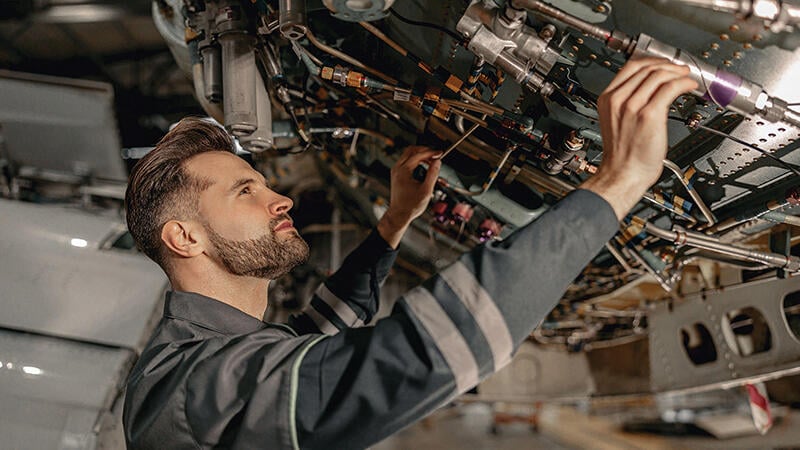
MRO operations are governed by an intricate web of technical documentation and requirements that regularly change.
The commercial aviation industry is navigating a paradox. Passenger demand is breaking records, fleets are expanding rapidly, and the global MRO market is on a trajectory to nearly double in value by the end of the decade. Yet the industry faces structural deficits that threaten its success: It does not have enough qualified mechanics and available parts.
Boeing’s 2025 Pilot and Technician Outlook projects demand for 710,000 new maintenance technicians in the next 20 years, a scale that would require a new certified mechanic to enter the industry roughly every 4 min. just to keep pace. The Royal Aeronautical Society identifies a deficit of almost 4,000 engineers annually; 27% of the certified workforce is already over the age of 64.
At the same time, the industry has entered a permanent new supply chain reality characterized by chronic material shortages, escalating costs and deteriorating performance. Bain & Co. reports that engine shop turnaround times are up more than 150% versus levels before the COVID-19 pandemic. Parts that once carried 4-6-week lead times now routinely quote 30 weeks or more, leading to bloated inventories and aircraft-on-ground events. A joint study by the International Air Transport Association and Oliver Wyman estimated the total cost of these supply chain bottlenecks at more than $11 billion in 2025.
On-condition monitoring, extended service intervals and advanced materials have meaningfully reduced the per-unit maintenance burden. But this is overwhelmed by the mathematics of fleet growth: The number of commercial aircraft in service is set to grow to 41,000 by 2036 from 30,000 today. Total maintenance volume grows regardless of per-unit efficiency. The industry cannot buy its way out of this crisis.
Limits of Generic AI Tools
Many industry insiders are referencing artificial intelligence (AI) as the route to efficiency, but most are focused on using generic tools. The general-purpose large language models capable of drafting marketing emails or building revenue models are not tools that should be trusted to help technicians find maintenance information or provide complex effectiveness data across competing technical requirements. Yet in the race to adopt AI, the industry is deploying horizontal, consumer-grade tools, when what matters is precision, nuance and regulatory understanding.
The distinction matters profoundly. MRO operations are governed by an intricate web of technical documentation and requirements that regularly change, that vary by tail number and that are constrained by authority approvals. On top of this, the nuances of languages, procedures and methods developed over decades of safe flight are vast. A generic AI application trained on broad data might confidently produce plausible-sounding answers that are technically incorrect. In an environment where a maintenance error can cascade into an airworthiness event, “plausible” is not an acceptable standard of accuracy.
Domain-specific AI for MRO operates differently in several important dimensions. It ingests and reasons using MRO-specific information—from colloquial language to documentation and operator-approved data—rather than drawing on generalized knowledge. It understands document hierarchy and part number differences. It understands supplier capabilities as much as differences in lubricant types. It understands the regulatory and compliance basis under which operators maintain aircraft.
In practice, this specialized approach translates into measurable productivity gains at all levels in the maintenance organization. When a mechanic conducting a complex scheduled check can query a conversational AI, the compounding effect of speed and accuracy across hundreds of technical staff members is significant. For example, a mechanic can instantly locate the correct aircraft maintenance manual procedure, cross-reference the relevant illustrated parts catalog part number and confirm the applicable service bulletin. They can research insights on the last 25 times the task was completed and order the required part in seconds. This process used to take at least 30 min.
The same principle extends to quality and compliance functions. AI grounded in the specific format and logic of quality records can pre-validate documentation before it reaches a quality check, flagging likely errors before they generate compliance issues. Applied to audit trails and scheduling, vertical AI can perform the continuous pattern-matching, spotting nonconformances, anticipating resource gaps and optimizing work package sequencing that no human workforce has the bandwidth to conduct at scale.
The conversation about AI in aviation maintenance should not be framed as automation displacing workers. The workforce shortage data alone makes that framing absurd. The industry desperately needs more skilled people, not fewer. The more accurate lens is capability multiplication: making every staff member (experienced or inexperienced) significantly more productive through purpose-built AI.
An industry that deploys AI to understand better when parts are needed, managing the 3D chess game of getting parts on dock at the right time and at the right cost, can create value for the sector that is well beyond marginal gains.
The capabilities of these tools to transform the speed, competence and cost of how operators execute MRO is immense and can structurally reshape the sector while going a long way toward addressing the shortage of people and parts.
Robbie Bourke is a cofounder of Zymbly, an AI platform purpose-built for aviation MRO operations. He previously headed aircraft maintenance at Virgin Atlantic Airways.