This article is published in Aviation Week & Space Technology and is free to read until Dec 05, 2026. If you want to read more articles from this publication, please click the link to subscribe.
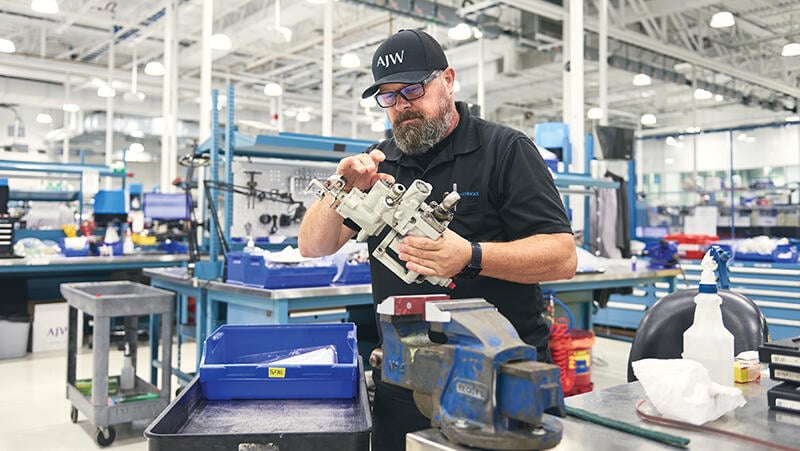
Reliance on OEM repairs can increase costs and turnaround times for airlines.
Access to repair capabilities is becoming a more important issue for the independent MRO sector as aircraft systems become more complex and are increasingly dependent on proprietary data, software and specialist tooling. Industry experts point to a growing role for OEM-controlled information and licensing arrangements, particularly on newer aircraft and sophisticated components.
For independent MROs, the concern is that fewer approved repair sources can mean higher costs, longer turnaround times and greater supply chain risk. OEMs contend that proprietary data, type design responsibility and regulatory requirements can require greater involvement in certain repairs. The result is a changing aftermarket in which technical data access can be as important as the physical capability to perform the work.
AJW Technique says the change is most evident in newer avionics, electronic control units, software-driven systems and composite structures, where OEM control over repair processes and technical data can be tighter than on mature platforms.
“In some cases, the question is not whether a repair can be performed, but how access to approved data, tooling and licensing arrangements influences who is able to provide that repair and under what conditions,” CEO Louis Philippe Mallette says.
That represents a different challenge from the traditional requirements for maintaining independent repair capability. AJW says mature platforms have generally benefited from established repair documentation and multiple approved providers, while Airbus and Boeing agreements have historically enabled access to technical data through airline customers. The company says OEMs increasingly seek to control technical data access, specialist tooling, test equipment and software.
For AJW, this makes licensing more important to maintaining access to the information required to support customers. “OEM licensing is therefore becoming the only reliable way to secure ongoing access to the latest data and to ensure the available data can then be used to support any customer,” Mallette says. He adds that on platforms without the underlying Airbus or Boeing agreements, including the Airbus A220 (which is based on the earlier Bombardier supply agreements) and business jets, obtaining the required data can be almost impossible without an associated OEM license.
AerFin sees a similar shift on newer technology platforms. According to the company, OEM-controlled repair data, software access and licensing arrangements can determine who can carry out maintenance and repairs on aircraft such as the Airbus A320neo and Boeing 737 MAX. It also cites the Embraer 190, where lower market volumes can make capability development less attractive for independent MROs.
“The result is greater reliance on OEM repair routes and less competition across the aftermarket,” says Alastair Johnson, vice president for repairs at AerFin.
The issue is therefore not just whether an MRO can perform the repair, but whether it has access to the data and tools required.
Boeing makes a distinction between repair access and repair approval. It says the requirements for an MRO undertaking a specific repair depend on the aircraft model, affected part or structure, nature of the repair and applicable regulatory framework. Repairs must use approved or otherwise acceptable data, which can come from Boeing or other regulator-approved sources.
Boeing says its involvement might be required where a repair relies on proprietary design data, is covered by its intellectual property rights, affects the aircraft’s approved type design or falls outside existing instructions for continued airworthiness.
That qualification is important because the three companies do not suggest that all repairs are becoming OEM-controlled. Instead, the level of OEM involvement varies depending on the aircraft, component and repair complexity.
Boeing also recognizes the role of independent MROs and that a broad repair ecosystem supports fleet availability, operational resilience and customer choice. Its position is that routine work can be handled by capable MROs, while OEM expertise is retained for more complex or highly proprietary repairs.
At the same time, the increasing importance of software and aircraft data could add another dimension to the issue. Boeing says data ultimately belongs to the airline, and the OEM provides infrastructure to gather, store and disseminate it securely. The airframer points to a substantial increase in the volume of aircraft health data—its Airplane Health Management system, for instance, contains more than 160 billion records now, compared with 9 billion in 2019.
For independent MROs, maintaining relevance on these newer platforms will therefore require more than traditional repair expertise. AJW anticipates increasingly software-driven systems that will require highly skilled engineers, advanced diagnostic capabilities and continued investment in training and specialist equipment.

COMMERCIAL IMPACT
For independent MROs and their airline customers, the commercial impact of restricted repair access can extend beyond the repair itself. AerFin says that when access to OEM data, software or component maintenance manuals is limited, the number of approved repair sources can fall, which could cause costs and turnaround times to grow and might raise the risk of material shortages.
“These impacts are often more pronounced on newer technology platforms and lower-volume product lines, such as Embraer and A220 families, where OEM licensing, approved data access and setup costs can make independent capability development more challenging,” Johnson says.
AJW Technique similarly sees a trade-off between reliability, cost and turnaround performance when the OEM becomes the only repair option. The company says airlines generally want multiple repair pathways because they reduce dependence on a single source and provide greater flexibility when capacity constraints emerge.
“AJW’s preference, as with airlines, is to have multiple options to avoid the challenges that a monopoly brings,” Mallette says. He warns that if an OEM were to control both repair capability and access to spares, operators could face higher repair costs and longer turnaround times with no alternative provider.
Mallette notes that OEMs have a legitimate interest in protecting their intellectual property and ensuring repairs are carried out to approved standards. “These factors are important for safety, reliability and long-term product support,” he adds.
The implications also extend into the used serviceable material (USM) market. Kyle Goodfellow, vice president for portfolio management at AerFin, considers repair access an important consideration when assessing aircraft and component value for teardown and USM.
Components with multiple repair sources can be repaired, returned to service and traded more efficiently, while restricted repair capability can introduce higher costs, longer turnaround times and greater supply chain risk.
“These considerations are particularly relevant on newer technology platforms, where OEM-controlled repair networks and proprietary data can have a direct impact on the economic value of individual components,” Goodfellow says.
Both AJW and AerFin see licensing as a potential route to maintaining independent repair capability while protecting OEM interests. AJW says it works with OEMs and, where appropriate, enters into licensing agreements to provide an independent repair option while maintaining OEM-level quality and reliability.
AerFin similarly notes that controlled access to OEM data through licensing could allow independent MROs to develop approved repair capabilities and increase network depth. “This would allow independent MROs to develop approved repair capabilities, increase network depth and support products as they mature into later-life and legacy phases,” Johnson says.
A BALANCING ACT
Boeing recognizes that a broad, capable MRO industry supports fleet availability, operational resilience and customer choice. This ecosystem benefits from the participation of airline, OEM and independent MRO providers, the company says.
Further, the airframer says it is bringing its breadth and depth of expertise in aviation and managing complex systems into the MRO space. For example, Boeing is moving carefully in the artificial intelligence (AI) space, focusing on data governance to ensure its data is AI-ready.
By 2050, the Boeing 787 fleet alone is set to produce about 4 exabytes of telemetry data, according to Boeing. To put that in perspective, the company says some technologists estimate all the words ever spoken by humankind would amount to about 5 exabytes.
Boeing insists some level of OEM-controlled repair data has always been necessary in modern aviation and is provided as a matter of course to operators via OEM documentation that forms the basis of individual airline maintenance programs. In some areas, greater OEM involvement is necessary for the industry to reap the benefits of new technology while still maintaining safe and compliant operations.
Boeing highlights its active engagement in multiple projects to provide greater access to OEM-controlled data in a way that enables MROs to do what they do best while protecting both the OEM and the airline’s regulatory obligation to show compliance—and ultimately, safe operation.

Related Content