This article is published in Aviation Week & Space Technology and is free to read until Nov 07, 2026. If you want to read more articles from this publication, please click the link to subscribe.
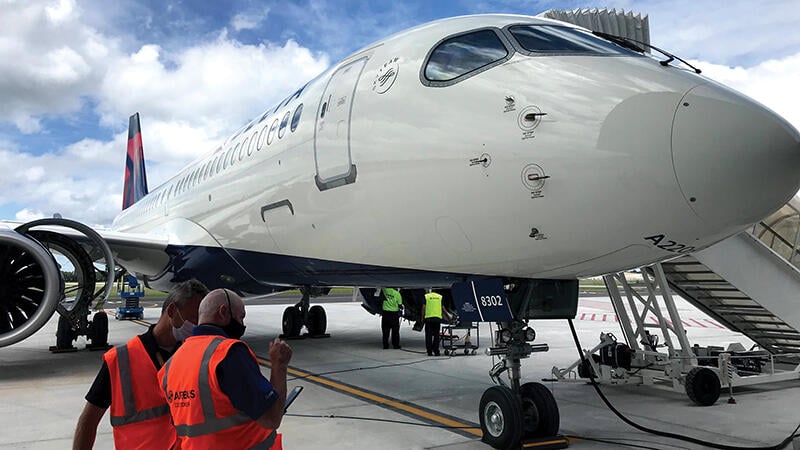
Delta TechOps evaluates predictive models using performance metrics that measure precision and effectiveness.
Predictive maintenance has moved beyond simply using technology to forecast faults—it is helping engineers make more informed maintenance decisions. Maintenance has evolved from a siloed, reactive discipline into an integrated, end-to-end operational capability, and the predictive element is becoming an increasingly mainstream part of technical operations.
“It is encouraging to see that, apart from technological progress, the organizational structure and mindset have evolved as well,” says Rob Stolk, project manager of AFI KLM E&M’s engines product Prognos. “Operators are establishing dedicated teams, developing their own capabilities and joining forces with other players in the ecosystem.”

“Early on, the focus was on what the algorithms could detect,” says Alice Belcher, director of predictive technology engineering at Delta.
TechOps. “Today, the emphasis is on how we ensure those predictions are accurate, reliable and actionable.” Predictive maintenance can provide meaningful value when it is continuously measured, validated and improved, she says.
BUILDING TRUST IN THE SYSTEM
Delta TechOps evaluates predictive models using performance metrics that measure precision and effectiveness, and it regularly assesses whether the analytics are accurately identifying emerging issues.
“When predictions do not perform as expected, the industry does not treat algorithms as static tools,” Belcher says, noting that Delta TechOps has capabilities to refine and retrain models based on new operational data and real-world outcomes. She emphasizes that predictive maintenance is an iterative process in which every success and missed prediction can help improve future performance.
“Our objective is a disciplined process that continuously increases the reliability and value of the insights being provided,” Belcher says.
Meanwhile, for most equipment covered by AFI KLM E&M’s Prognos predictive maintenance system, engineers can perform a physical inspection or an on-wing test before taking a more intrusive maintenance action, such as swapping a line-replaceable unit. “That makes predictive maintenance practical even when predictions are not perfect, because the first follow-up step is often quick and low-cost,” Stolk says.
He notes that this “trial-and-error” process creates an important feedback loop: Each field inspection helps refine the models and improve future predictions. In that sense, a predictive alert does not have to be the final decision—it can be the starting point for a targeted verification step.
Some false alarms can be acceptable as long as the system is also effective at detecting the real issues, Stolk says.
When predictive alerts are wrong, the problems usually fall into two buckets, says Peter Golibrzuch, Lufthansa Technik’s senior engineer for predictive maintenance from the Aviatar digital platform team. Sometimes a part is removed and assessed but shows no fault found, even though it may fail again soon after. Early data suggests no-fault-found rates are actually lower for predictive removals than for traditional unscheduled ones when airlines have a solid predictive maintenance setup. At other times, fixing or swapping components does not restore the system’s health, which means the model might need adjustment, or the issue has multiple root causes.
Even so, as Golibrzuch notes, predictive maintenance still gives airlines better insight than waiting for faults or crew reports, and operators generally accept these limitations because the alternative is flying “blind” on aircraft system health. “In the end, acting on a predictive maintenance alert is always optional,” he says.
Mia Witzig, product lead for predictive health analytics at Lufthansa Technik, stresses the need to stay grounded in reality. She notes that predictive maintenance will never foresee every failure: “There will always be failures that cannot be predicted. The value of predictive maintenance therefore extends beyond simple failure prediction.”
A notable advantage of predictive maintenance, Witzig says, is the ability to perform data-driven root cause analysis. She points to aircraft bleed systems as a typical example, highlighting how some aircraft systems are so intertwined that traditional troubleshooting can be inefficient and misleading.
By leveraging operational data and advanced analytics, predictive maintenance can narrow the most likely root causes, considerably reducing troubleshooting effort, avoiding unnecessary component exchanges and ultimately lowering operational costs.
CONNECTING INSIGHTS
Through Skywise, launched in 2017, Airbus no longer monitors aircraft health in isolation. The objective is to provide a digital backbone that connects technical, flight and ground operations.
“This allows us to correlate diverse data—engineering logs, inflight performance and operational events—to give operators a holistic view of their fleet’s reliability,” says Fabrice Villaumé, head of products portfolio at Skywise.

Villaumé highlights two critical factors that have had the biggest effect on improving prediction accuracy: the depth of the OEM’s engineering expertise and the scale of its data ecosystem. Considering that the models are rooted in the physical design and engineering specifications of its aircraft—not just historical maintenance trends—he says the algorithms understand the “why” behind a system’s behavior.
With more than 12,000 aircraft connected to the Skywise platform, the sheer richness of that data allows for continuous training and refining of models. “The more customers we have, the more feedback we get, the easier it is to improve and adjust our models and focus on new issues to tackle,” Villaumé says. “This scale ensures that the predictions provided to maintenance teams are actionable and reliable.”
Airbus—via Skywise—validates its predictive maintenance models through a step‑by‑step process that starts with internal simulations against known failure modes, then moves into controlled field trials with airline partners. Within the Digital Alliance, this runs from testing ideas on real operational data through feasibility studies, development and early‑adopter evaluation before wider rollout. The team measures precision, recall and overall predictability, along with the usefulness of the supporting information provided to operators.
What truly strengthens the system, Villaumé notes, is the OEM’s “field‑to‑factory” feedback loop, in which real‑world performance data is continually fed back into engineering models to keep predictions calibrated and improving.
MEASURING RESULTS
Miguel Sosa, vice president and head of innovation at maintenance software specialist Trax, discusses how effectively predictive maintenance alerts from OEM systems translate into actionable maintenance tasks within MRO systems.
“This is often where the benefits of predictive maintenance fall short,” Sosa says. OEM systems can identify early signs that a component may need attention, he explains, but maintenance teams often cannot act on these alerts alone: “Teams need specific work orders, engineering instructions, available parts, qualified technicians and sufficient aircraft downtime to perform the work.”
Sosa says that in many organizations, predictive maintenance alerts are still converted into maintenance tasks through manual processes. Engineers must evaluate the alert, determine the necessary action and fit it into an often busy maintenance schedule, meaning that even accurate predictions might not always lead to prompt maintenance.
Sosa reports that Trax has developed capabilities that automatically translate predictive maintenance alerts from OEM systems into the appropriate engineering tasks within the maintenance management system. By factoring in available resources and operational constraints, the process is intended to help maintenance teams plan and schedule work more efficiently.
Additionally, Sosa thinks one of the most important and often overlooked elements of the process is how real maintenance findings are fed back into digital systems to improve future predictive maintenance alerts.
“The information gathered when a technician performs maintenance is the best indicator of whether a prediction was correct,” he explains. “It reveals whether a fault actually existed, whether the issue was a no-fault-found case, what corrective action was taken and whether the work was deferred.”
Sosa says this real-world feedback provides critical information to improve future predictions. “The challenge is that this information is not always captured in a way that digital systems can use,” he explains. “In many cases, findings are recorded in paper logbooks or entered as free-text comments, making it difficult for analytics platforms to process and learn from the data.”
To close the loop, maintenance findings need to be captured as structured data at the point of work through tools such as electronic task cards and digital logbooks, Sosa says.
HUMAN VALIDATION
A pivotal consideration going forward is the extent to which predictive maintenance can become reliable enough to support maintenance decisions with less human intervention.
Belcher from Delta TechOps does not expect that predictive maintenance will ever eliminate the need for human accountability in maintenance decisions. “Aviation maintenance will always require trained professionals to perform the work, verify that it was completed correctly and sign off on the aircraft’s airworthiness,” she says.
Similarly, Stolk at AFI KLM E&M says the process still involves multiple human touchpoints, from analysis to planning and execution. “As confidence in the technology grows, I can imagine some alerts becoming—
or perhaps already being—reliable enough to reduce the amount of human validation required,” he says. The objective is not to remove the human from the loop but to support better decision-making by providing the most complete view of an issue across multiple sources of information, Stolk emphasizes.
Technical observers at Lufthansa Technik say that for some aircraft systems, automation of maintenance decision-making is a realistic goal, specifically for nonsafety-critical tasks. As Golibrzuch notes, such systems will eventually be able to trigger maintenance actions automatically, enabling engineers to step back into more of a supervisory role. Humans will still shape and periodically adjust the models, especially as aircraft age or systems change, but in day‑to‑day operations, their involvement will shift from validating every alert to overseeing the automated decisions.
Witzig says the industry’s willingness to embrace more autonomous decision-making will ultimately depend on building trust in these systems. “The technology is advancing rapidly, but adoption ultimately depends on the confidence airlines place in predictive models and their transparency,” she says. “At Aviatar, we believe in this vision.”

Related Content