This article is published in Aviation Week & Space Technology and is free to read until Jun 19, 2026. If you want to read more articles from this publication, please click the link to subscribe.

New Tech Drives Greater Functionality For Aircraft Lighting Systems
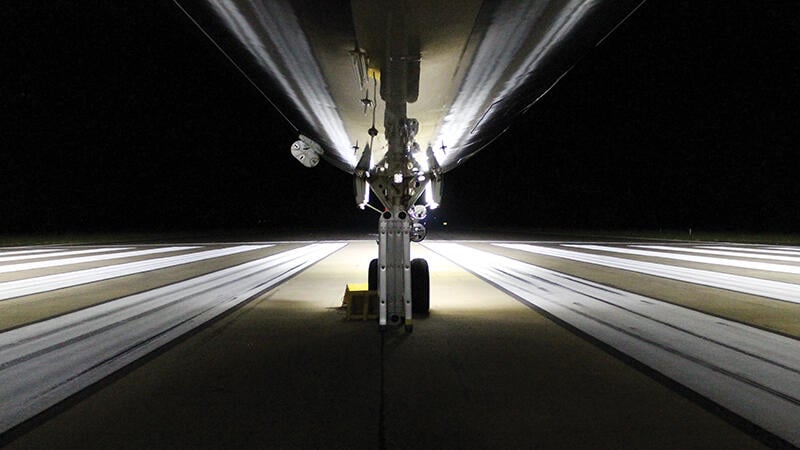
lit view underneath aircraft on runway

Multifunctional LEDs provide more optimized lighting scenarios during ground operations, such as taxiing and runway turn-off.

Credit: Collins Aerospace

As light-emitting diode technology continues to displace legacy interior lighting on commercial and business aircraft, it is also moving outside the cabin, replacing older systems including halogen and high-intensity discharge units. Recent applications include navigation, position, anti-collision, logo, landing and taxi lights.

“Customers want increased reliability, which is what [light-emitting diodes] provide,” explains John Lundberg, senior portfolio manager for lighting controls at Honeywell Aerospace. “At the same time, traditional lighting, such as incandescent/halogen products, are becoming obsolete, so there is a definite need for replacement.”

As a specific example, Lundberg cites parabolic aluminized reflector lighting, which he says is becoming difficult to find. “It’s similar to film for cameras,” he notes. “The technology has changed and legacy products are no longer being produced.”

Along with greater availability, Lund­berg says light-emitting diodes (LED) afford longer time on wing—30,000-50,000 hr. compared with 2,000 hr. for older halogen lights.

Richard Herring, associate director of business development at Collins Aerospace, cites LEDs’ numerous advantages. “Newer LED systems provide marked size, weight, power and efficiency improvements over legacy systems,” he says. “Replacing halogen systems with LED assemblies can save a few pounds across an aircraft, which can result in significant fuel savings over an aircraft’s lifetime.”

Herring also explains that halogen lights convert much of the energy they use into heat, which contributes to the shortened useful life of an aircraft’s headlamps. “LEDs remain operationally cool and conservatively draw around 60% less electrical power than similar halogen lights,” he says. “In short, LEDs are far more efficient at converting power into illumination while exponentially extending product life cycles, easily remaining in service 10-50 times longer than the typical xenon and halogen bulbs of the previous-generation headlamps.”

João Fadigas, head of electrical generation, energy storage and exterior lighting systems at Airbus, says that the latest high-power LED lights can produce the same output as filament and halogen products, but with a significantly smaller footprint. “This allows us to think of new, more innovative concepts where we can have multiple lighting functions in a single location, saving weight and having a lower installation impact on the aircraft,” he says.

The most recent example Fadigas cites is the multifunctional runway light installed on some Airbus A321LR and A321XLR narrowbodies. “In this application, we were able to design a light installed on each side of the belly fairing that is replacing all the lights we currently have on the nose landing gear, as well as the retractable landing light installed on the underside of the wing,” he says. “The light provides taxi, takeoff and runway turn off functions.”

Asked about digital monitoring of external lighting system maintenance status, Fadigas explains that this has been implemented on the Airbus A350, alerting pilots or maintenance crew when equipment fails or falls below required performance levels.

“On older platforms, and partic­ularly for functions having strict minimum performance requirements (navigation and anti-collision lights), we have developed self-hosted mechanisms that can visually inform the ground personnel when equipment is not meeting the expected performance,” Fadigas says. “This function is what we call near-end-of-­life indicator.”

ice light
PWI’s Ice Light is designed to enhance visual detection of on-wing ice accumulation. Credit: PWI

VISUAL AUGMENTATION

Augmenting pilot visibility has been a critical area in which LED technology has proven helpful, according to Collins Aerospace’s Herring.

“Pilots are always open to more optimized lighting scenarios to enhance their vision during ground operations,” he says. “The implementation of multifunctional lights that can modify beam distribution for different phases of flight and ground operation can assist this. When combined with enhanced optics, LED technology can provide a much more evenly distributed light output, avoiding areas of shade present with earlier technology.”

To illustrate, Herring notes that an adaptive taxi light can adjust its light output to provide runway turn-off capabilities within a single installed unit.

Collins’ LED systems, Herring says, also contain optical lenses that produce tighter beam control with less spill than legacy systems.

“This is particularly critical when operating in adverse weather, where spill—lighting falling outside the intended beam area—can cause glare, unwanted reflection and halation, [which is] the glowing or halo effect appearing around bright lights,” he explains.

External lighting can also play a critical role in detecting ice accumulation. A case in point is Ice Light, an LED product of Wichita-based PWI, marketed as a direct replacement for 7079B24 halogen lights. Certified on a wide range of business jets and turboprops built and supported by Textron Aviation, as well as the Beech 99 regional airliner and Cessna Caravan utility transport, Ice Light was designed to enhance visual detection of on-wing ice accumulation. But according to Eric Dahlinger, PWI vice president of corporate communications, the Citation Model 750 (Citation X) business jet also uses it as a pylon work light, wing downwash and tail floodlight. Over 750 units have shipped since its introduction in 2023.

Dahlinger says that on most aircraft, the Ice Light is installed on the fuselage and aimed at the wingtip, although on some twin-engine turboprops, installation is on the engine cowling/nacelle. “This highlights the leading edge fully,” he notes.

As designed, the mounting socket is dictated by the 7079B24 light specification. The “head” of the Ice Light contains and protects the LED and functions as a heat sink.

“The LED Ice Light puts out more light (lumens) and at a higher 5,000K [(8,540F)] color temperature,” Dahlinger says. “This combination makes ice easier to see before it becomes a problem.”

He adds that the Ice Light is powered by 28 volts, supplied directly by the aircraft, with no ballasts or separate power supplies required. “Some pilots also use the Ice Light at night to enhance ground operations in low light, or weather-related reduced visibility situations,” he says.

person sitting at desk with one laptop and two monitors
Thales has developed a lightweight core module that can adapt to any kind of platform. Credit: Thales

RETROFIT CHALLENGES

While new aircraft are nearly always fitted with LED systems today, a massive number of older commercial aircraft in service still fly with legacy external lighting systems, increasing the potential for LED retrofits.

“Halogen systems will continue to be popular in coming years, as parts availability is still high, and the cost to replace them is relatively low,” Collins’ Herring says. “But we are beginning to see more operators opt to replace existing halogen systems with LED, with the expectation that this trend will continue to incrementally grow.”

Illustrating a current development in LED retrofits, MHI RJ Aviation is offering an LED one-for-one replacement of halogen and incandescent external lights for its CRJ family.

“The nose landing light has an increased intensity and improved light distribution, which reduces the risk of collisions and runway incursions while enhancing pilot visibility,” says Herman Bijl, the company’s senior director of customer and product support. In terms of weight savings, he notes that there are no significant changes for the nose landing light or the logo light, but the navigation lights are up to 3.2 lb. lighter, depending on the aircraft model.

For all its promise, the LED retrofit process is not always straightforward. Honeywell’s Lundberg cautions that LED installations can be complicated because, unlike a conventional light bulb, LEDs must be mounted on a circuit board that is custom-made to work as a system with the power supply and reflector. Typically, he says, the design is such that the entire light assembly must be replaced if the light is at the end of its life, or if there was an event that caused the light to fail prematurely.

In that regard, Nicolas Bonleux, vice president for aero­space communications at Thales, says that the challenge with LED retrofits is to adapt the design to be “replaceable in form,” meaning that the retrofitted unit will fit in the installation footprint of the unit it replaces. In other words, the external dimensions and attachment points must be the same.

“Every individual light is specifically adapted to the platform it is installed on,” Bonleux points out. “Thales has developed a core module that is compact, lightweight, versatile, highly reliable, easy to install and highly adaptable to any kind of platform. This enables the adaptation effort to be kept to a minimum, from the cost, scheduling and engineering work perspectives.”