This article is published in Aviation Week & Space Technology and is free to read until Apr 05, 2026. If you want to read more articles from this publication, please click the link to subscribe.

LATAM’s Extensive Data Collection Bears Fruit

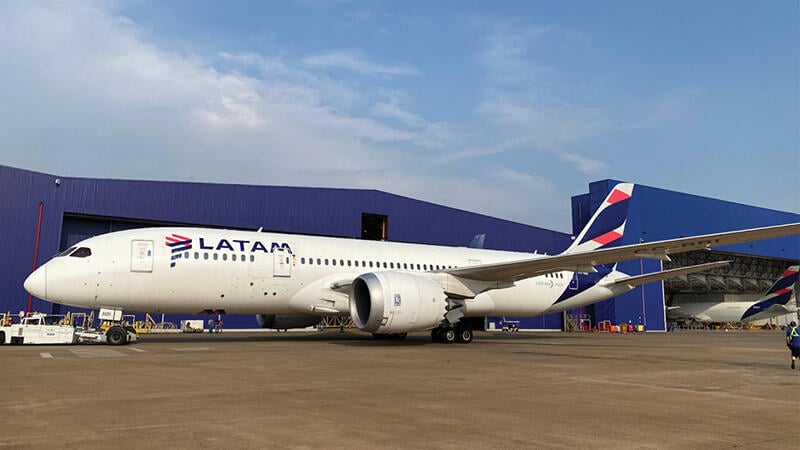
 LATAM aircraft on tarmac

LATAM collects 90,000 min. of flight data every day in a push to achieve more efficiency with its fleet.

Credit: LATAM

Airlines around the world routinely tout their technology toolboxes, but LATAM is going a step further—using its scale as Latin America’s largest airline group to harness massive volumes of data and improve efficiency across all facets of the business.

CEO Roberto Alvo has a particular favorite project: a two-year program that has generated nearly 1,200 days of aircraft availability, equivalent to the purchase of four aircraft. That drove a 1% increase in incremental capacity for LATAM in 2025.

During the company’s annual investor day in December, Alvo explained the initiative. LATAM created a 12-person team to understand how relationships with certain tasks are optimized. He noted that the opportunity costs of LATAM’s fleet are $100-150 million, and the $4 million investment on that project generated a fortyfold return.

LATAM passenger
Almost 70% of LATAM’s fleet is equipped with Wi-Fi. Credit: LATAM

By combining the knowledge of LATAM’s maintenance department with information technology teams, “we let the guys that run maintenance understand how the digital teams work,” Alvo said.

Next up for the group is identifying opportunities in the 72 hr. prior to a flight—“the operational window where you have to mix airports, ground handling, passengers and everything into a single place,” Alvo stated.

The volumes of data that LATAM collects are key to unlocking efficiencies in that time frame. “We operate the largest data ecosystem in the region,” Chief Digital and IT Officer Juliana Rios told investors, adding that the company collects 90,000 min. of flight data every day.

“Our data-to-action cycle is 10 times faster than our peers in the industry, which allows us to get marginal gains from 0.1-1% that can compound into millions in measurable value,” Rios said.

LATAM has more than 14,000 different types of sensors in its fleet, and every aircraft features a range of 2,000-4,000, she explained. Access to that amount of information results in enormous data sets—4.5 petabytes.

LATAM aircraft in flight
LATAM will also begin adding Wi-Fi to widebody, long-haul aircraft this year. Credit: LATAM

More than 5,000 employees in LATAM Group have access to that data for better real-time decision-making to improve efficiency even before a flight takes off, Rios said.

Once particular information is added to LATAM’s “data lake,” the company can analyze 100% of that information, explained Rios. LATAM can combine those models with weather data, then send real-time information to pilots if flight conditions change en route. “They can even predict unexpected turbulence before crossing the Andes Mountains, in which we have 90 flights everyday,” she said.

LATAM has reduced 10% of its standby crew costs and estimates that it avoided 300 unplanned aircraft maintenance issues annually through enhanced predictive efforts. Rios also cited fuel efficiency gains from leveraging data, including using advanced analytics to save 10-20 kg (22-44 lb.) per flight. “If you multiply that for 1,600 flights per day, it’s extremely powerful,” she added.

“We don’t think in silos anymore,” Alvo said, offering insight into LATAM’s philosophy regarding technology. “Data actually travels horizontally.”

Multifunctional teams are supported by shared platforms to avoid duplicating work. “We build it once and use it everywhere,” Rios said. “A lot of it is already enabled by AI.”

As carriers around the globe retain older aircraft amid continuing supply chain challenges, improving efficiency “makes our older fleet better in terms of return on capital,” Alvo said, adding that the company does not need to rush a fleet renewal if costs remain low. LATAM projects an adjusted passenger unit cost excluding fuel this year of 4.30-4.50 cents and an adjusted operating margin of 15-17%.

LATAM’s widebody fleet features Boeing 767-330ERs, 777-300ERs and 787-8/9s, and the group operates a mix of A320 current- and new-generation narrowbodies. At the investor day, the company’s executives said that LATAM expected to end 2025 with 371 aircraft.

Alvo has previously cited the nimbleness of LATAM’s Airbus A319s. As the company faced delivery delays from Airbus in 2024, it extended leases on those narrowbodies.

Alvo said the A319s require low capital expense and have nearly 100% variable costs, offering flexibility to compensate for fluctuations in demand and enabling lower utilization of those low-cost capital assets.

LATAM spent $40 million to upgrade 37 aircraft in its A319 subfleet with improved storage space, new ports for electronic devices and Wi-Fi. The group is retrofitting the aircraft at maintenance bases in Sao Carlos, Brazil; Lima, Peru; and Santiago, Chile. LATAM expects to complete the work between late 2026 and early 2027. The company said each upgrade takes roughly 2-3 weeks.

“I don’t think that we will see in the next 15 years the next generation of narrowbodies,” Alvo said. “I hope the engine manufacturers realize that they need to fix the problem they have today before really embarking on a new risky adventure.

“You can probably do 5-10 times better return on investment if you focus on how to take technology and change the way that you are organized,” Alvo added. While the industry has not done so in the past, he noted that “there’s no reason why we can’t aspire to do that.”

Lori Ranson

Lori covers North American and Latin airlines for Aviation Week and is also a Senior Analyst for CAPA - Centre for Aviation.