This article is published in Aviation Week & Space Technology and is free to read until Nov 14, 2026. If you want to read more articles from this publication, please click the link to subscribe.
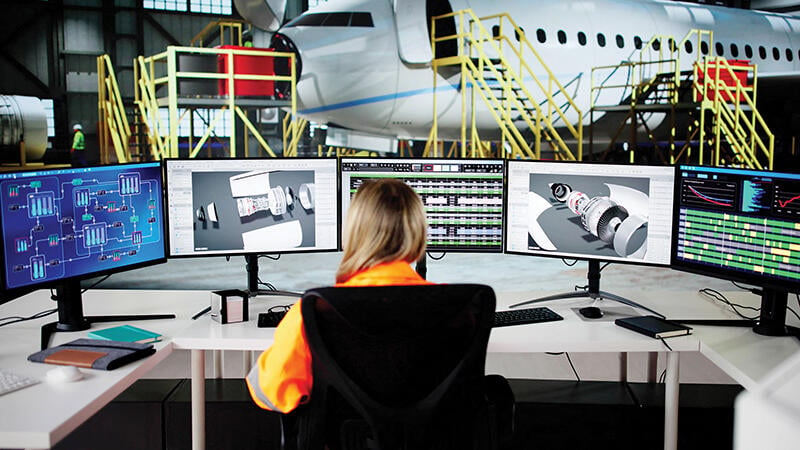
Dozens of software startups have developed artificial intelligence tools for aviation maintenance.
I recently added a folder to my email inbox for the many press pitches from artificial intelligence software companies that say their technology will “disrupt” or “revolutionize” the MRO industry.
By my count, at least two dozen artificial intelligence (AI) software companies have created applications specifically for the MRO industry. AI specialists such as Palantir and Amazon Web Services have begun developing AI tools for MRO, while major software players such as IFS and Veryon are building more AI functionality into their platforms. Most OEMs, airlines and large MRO providers have talked about the AI tools they are building internally.
Undoubtedly, MRO industry leaders believe that AI can drive significant change. According to Oliver Wyman’s 2026 MRO Survey, the industry’s adoption of AI has risen to 67% this year from 58% in 2024. Respondents ranked the adoption of generative AI among the top industry disruptors, and two-thirds said the technology is delivering as much or more value than expected.
Are we at a point of oversaturation, similar to the early stages of the advanced air mobility (AAM) segment? Early this decade, it seemed as though new AAM players sprang up every week, but the segment has since consolidated to a handful of leading companies.
We have even begun to see consolidation among some of the more mature MRO-focused AI startups. In July, Pratt & Whitney acquired Aiir Innovations, a Dutch startup founded in 2016 that offers AI-powered automated engine borescope inspections. Last year, AAR acquired Aerostrat, an AI-enabled maintenance planning software company founded in 2015.
International Airlines Group’s (IAG) chief AI scientist, Ben Dias, recently spoke with Inside MRO about AI build-versus-buy strategies. While IAG regularly collaborates with AI startups through its IAGi accelerator, he noted that one of the big tests for these companies is whether they can handle the size of IAG’s fleet and overall operations. “Sometimes they’re good for one airline, but they can’t manage the whole group situation,” he said.
Dias said that he might buy tools from AI software providers in the right scenario, but if “everyone else can buy the same thing,” then IAG loses “the competitive advantage piece.” In those cases, he said IAG usually tries to add its “secret sauce” to the product’s algorithm to bridge the gap.
However, Dias noted that IAG does not use generative AI for everything just because it is “a new, shiny thing.” He added: “I think the biggest thing to [avoid] getting caught with the hype is to not start with the technology and say, ‘I’ve got a hammer; let’s look for a nail,’ and everything looks like a nail. You have to start with the business problem, not the technology or the data.”
With some exceptions, most AI applications that have emerged for MRO seem to fall generally into these categories: predictive maintenance, inspections, parts traceability, “technician helper” tools, maintenance planning, and simplifying documentation and records searches. As Dias noted, each company has its unique needs, but I wonder about redundancy when I see new third-party applications that offer functionality strikingly similar to others I have already written about.
Livia Hayes, director of digital at Oliver Wyman Vector, has also noticed overlapping AI tools. “I think there’s a lot of noise right now and maybe some lack of understanding exactly how to get the value out of everything,” she said. However, she stressed that her company sees AI as a “game changer” for the MRO industry. “When you see software fail is when a business process doesn’t change or keep up with it, so the neat thing about AI is that you can build it to fit your process and not the other way around,” she said.
Hayes has heard from some clients who are frustrated that they are not seeing deployments fast enough or the types of results that are being promised. “So now there’s even more scrutiny around budgeting for any sort of new software innovation or tools,” she notes, because companies are “a little leery about not getting what was promised the first time around.”
She pointed out an “interesting contradiction” in the Oliver Wyman MRO Survey. Respondents said that “investment in IT infrastructure is low [but that] they want AI innovation and leadership,” so Hayes thinks there may be a “fundamental mismatch” about what type of investment is required to make AI projects work.
Oliver Wyman noted that about 75% of respondents expect AI to be used across most or all of their organizations’ MRO activities within five years. Will this lead to even more players in the space, or can we expect the bubble to burst and more consolidation as clear leaders emerge?

Related Content