This article is published in Aviation Week & Space Technology and is free to read until Jan 15, 2026. If you want to read more articles from this publication, please click the link to subscribe.

MRO’s AI Development Efforts Begin Paying Off

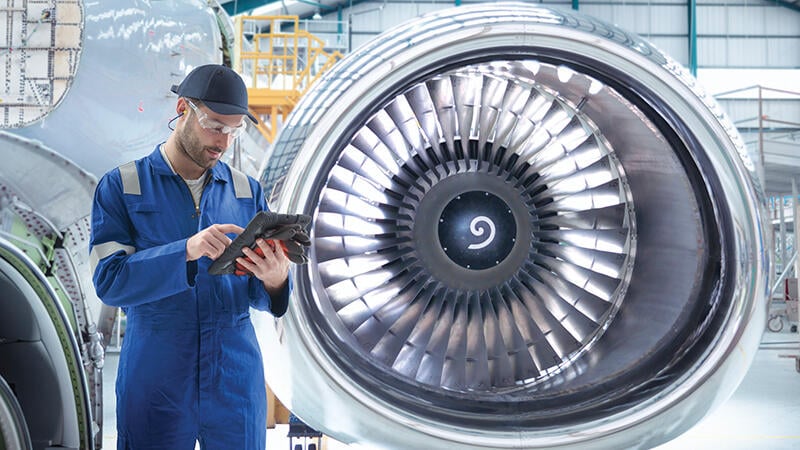
person standing in front of aircraft engine

Boeing has boosted productivity 70% in some areas by using GenAI for tasks that are repetitive or require interpreting large amounts of text.

Credit: Boeing

The push for artificial intelligence adoption has permeated most industries, and the aftermarket is beginning to see its initial efforts yield tangible results.

Artificial intelligence’s (AI) potential use cases, benefits and challenges have dominated technology discussions at MRO industry events this year. Whether aftermarket businesses have invested substantially in its development or cautiously dipped their toes in with the intention of becoming a fast follower, most are now investigating how the technology can make MRO easier, safer and more efficient.

Oliver Wyman’s 2025 MRO Survey found that 64% of respondents reported adopting AI, up from 58% the previous year. The percentage that say their value expectations from AI investments are being met or exceeded shot up to 58% from 20% last year. And nearly a third of responding organizations reported forming dedicated MRO AI teams.

AFI KLM E&M tech using internal AI to teach staff how to use the technology
AFI KLM E&M conducted internal AI road shows to teach staff how to use the technology. Credit: AFI KLM E&M

For instance, AFI KLM E&M tells Inside MRO that it recently added new analytics translator roles that will focus on bridging gaps between the company’s data, information technology (IT) teams and business; GA Telesis launched a Digital Innovation Group last year that includes a team focused on AI initiatives; and International Airlines Group (IAG) has some 70 AI specialists working in nine teams and has established an AI lab in Barcelona, Spain.

“I think we’re seeing a slow but steady increase in the number of requests and conversations we’re having about how to deploy AI within technical operations,” says Sam Sargent, principal in Oliver Wyman’s transportation and operations practices. “Rewind to a year or two ago, and everyone was talking about it, but not much was actually getting done. Over the last 12 months, people are starting to stand up more realistic projects around AI.”

Some of the most widely reported use cases from Oliver Wyman’s survey include materials and inventory forecasting and planning; maintenance programs, reliability and predictive analytics; and maintenance planning. Many respondents also report using AI for general productivity and support functions.

Sargent says traditional types of machine learning, such as those that power inventory forecasting, were likely reported as the most common use case in the survey because they have been used for such a long time. He says some of the most interesting use cases he is seeing with clients relate to generative AI (GenAI), which can create original content based on user prompts, and agentic AI, which is designed to make decisions and act autonomously based on relevant data.

For instance, Sargent sees considerable traction in the potential for AI to automate and shorten the research time “where someone would be poring over PDF documents and sorting through manuals and files [to] analyze a repair and look up if there are precedents for how to approach [it].” He notes that these types of AI concepts are gaining interest in the aircraft-on-ground (AOG) space, where maintenance staff must search for relevant information in multiple locations to optimize decision-making about staffing, tooling and spares.

DISCOVERING APPLICATIONS

In the past year, many OEMs, airlines and MROs have announced new AI-powered products or reported using the technology to boost efficiencies.

On the popular inventory planning side, several companies have reported benefits from using AI. GA Telesis Digital Innovation Group President Jason Reed said during the Aviation Week Network’s AeroEngines Americas in Fort Worth in January that AI has “been a transformation, to have the right stock at the right location at the right moment.” He elaborated further at a virtual Aftermarket Summit hosted by Jefferies investment bank in June about how the company is using AI to leverage its internal data with the goal of growing 35% year over year.

Technician demonstrating AI on Lufthansa Technik Aviatar digital platform
Lufthansa Technik released the first AI tool on its Aviatar digital platform in March. Credit: Lufthansa Technik

“With an ecosystem our size, we’re able to command data internally and externally with all of our operators, suppliers, procurement suppliers and repair suppliers so we can create a warehouse of data . . . and modeling that drives that space,” Reed said. “We’ve already driven everything from procurement models, repair models, tiering models of parts, pricing levels of parts and fair market values.” On the MRO side, he said GA Telesis is using AI to forecast shop visits to procure and provision the right parts in advance and thus reduce turnaround times.

Setna iO Partner and Chief Commercial Officer Hunter Edens noted at the Jefferies summit that AI is helping the company assess aircraft value quickly using the text recognition functionality built into its inventory management system.

“We’re able to take a PDF of [on-condition/condition-monitored components] or a hard-time component listing—the two most predictive documents that tell you what components are installed on an aircraft—and drop them into our AI text recognition tool,” Edens explained.

“Within 15 min., we will be able to pull out a Microsoft Excel spreadsheet that tells us what our last sale price for each individual part was, our blended average of the past four times that we’ve had each individual part repair, what that average cost was and what the net value of each part is,” he continued. “This allows us to have, at a line-by-line level, a very accurate idea of what the value of the aircraft is going to be based on our inventory, which we use to process sales orders and repair orders on a daily basis.”

Sarah Klein, senior vice president of operations at Setna iO, shared further details about the company’s AI-powered inventory and optimization tools at the Aviation Week Network’s MRO Latin America conference in Panama City in February. “Where we’ve seen the biggest value is actually the simplest execution,” she said, such as repetitive, administrative-level work, where text and image recognition can be used to process work orders instantaneously instead of 10 min. or more to process manually.

GE Aerospace, HAECO, SIA Engineering and ST Engineering shared some of the AI applications they are prioritizing during the Aviation Week Network’s MRO Asia-Pacific conference in Singapore in September.

David So, senior vice president for corporate planning and continuous improvement at SIA Engineering, said the company is looking at how GenAI can analyze historical data to predict defects and optimize maintenance planning.

Alex Chen, group general manager of digital at HAECO, said his company is using AI to analyze work packages and is now moving into the planning aspect to help schedule more effectively and “basically orchestrate our people, our material and our tooling in the hangar in the most effective way.” Chen added that AI can reduce the time required to understand a work package to a couple of hours from the days or weeks previously needed.

Kenneth Low, chief technology officer, senior vice president and head of innovation and sustainability at ST Engineering, said one of the biggest challenges in the company’s airframe MRO business is dealing with copious documentation across six global repair stations.

“Each repair station has to deal with 5-10 million pages of documentation in order for them to generate the task cards to maintain the aircraft,” he said. “One of the biggest challenges about this is that it is always a very manual process,” which is complicated by human errors. Combing through documentation to induct an aircraft for a maintenance project typically takes about 15 days, but Low said AI has helped cut this time about 90%. However, he noted that ST Engineering is still working on improving the model’s consistency and accuracy, so additional effort is required to double-check its work.

David Harper, GE Aerospace’s fleet support director for customer service, noted that the engine-maker has been using AI for more than a decade in areas such as monitoring and diagnostics to avoid disruptions and unplanned maintenance. The company developed a GenAI tool in partnership with Microsoft and Accenture last fall to help airlines and lessors access assets’ critical maintenance records more quickly. The OEM said the tool could reduce maintenance record searches to minutes from hours.

Harper also highlighted GE’s extensive use of AI in engine inspection. The company told Inside MRO during a press event in May at the GE Aerospace Research Center in Niskayuna, New York, that visual inspections account for the largest share of work performed in its global network of aftermarket facilities. The research center is developing and testing various AI-enabled inspections, including one that pairs a robot with a borescope to collect images, which are then analyzed using AI, including machine learning. Similarly, GE has paired a camera system with machine learning for fluorescent penetrant inspections, which it said is approximately 15% more accurate than human visual findings.

Within the hangar, FEAM Aero is evaluating how an AI system can analyze camera feeds to identify potential safety issues, such as technicians not wearing proper safety equipment or ground support equipment parked too close to an aircraft.

IAG recently developed an AI tool to determine the most effective engine maintenance schedules for its fleets by assessing millions of different scenarios that consider operational, financial and technical factors. Aer Lingus has rolled out the system on some of the CFM International CFM56-5B engines powering its Airbus A320s, and IAG expects other airlines in the group to start using it before year-end. IAG’s AI team has a variety of other engine-related projects in the pipeline, and it expects to roll them out over the next year or so.

Lufthansa Technik (LHT) debuted its first AI tool for the Aviatar digital platform in March. The Technical Repetitives Examination tool analyzes technical logbook write-ups for defects, such as misspellings, incorrect Air Transport Association (ATA) chapter assignments or different language-based phrasing. For example, a logbook entries might describe a broken “coffee machine,” “coffee brewer” or “espresso-maker,” which the tool recognizes as identical components and automatically assigns the entry to the correct ATA chapter, ensuring the defect is correctly documented. The tool also can identify early issues that are recurring, with the eventual aim of generating troubleshooting recommendations automatically.

MRO software provider AireXpert also is considering how to break down language barriers using AI. The Aire-Xpert platform focuses on facilitating real-time communication and collaboration among parties involved in aircraft maintenance. The company recently rolled out an AI-powered translation feature to help teams in different countries communicate more easily. According to Head of Product Kamal Patel, AireXpert also is using AI to make maintenance planning calls more efficient.

“Every single airline on the planet has an hour-long call [in the morning] with about 80-150 people on the line, all just trying to gather the facts from each other,” Patel tells Inside MRO. “They’re listening for an hour, but they might be speaking for 30 sec., and that’s an hour of payroll times 150 people just to get the facts, and it’s not necessarily time spent finding the solution for problems. AireXpert can provide that information through an AI summary instantly so [participants] don’t have to go look for the facts.”

AireXpert is working with several AI software developers to integrate their functionality into the platform. The company has integrated AIXI’s ATA AutoCoder tool, which uses AI to understand technicians’ maintenance log entries, generate detailed descriptions of problems, automatically assign correct ATA codes and identify maintenance fix probabilities. Patel says the idea behind integrating more AI tools is to simplify life for customers that are trying to juggle multiple software platforms.

Marc Van Leeuwen, AI lead at AFI KLM E&M, tells Inside MRO that the company has developed three core GenAI tools so far from the more than 80 GenAI-focused projects across all Air France business sectors. The first is the Transparent Reliable Accessible Knowledge System (TRAK), which is dedicated to solving AOG cases. Although experienced senior engineers may know the right fix for an AOG situation immediately, Van Leeuwen notes that this expertise is not always available due to staffing scenarios and retirements, so these situations often require many hours of searching through documentation. With TRAK, AFI KLM E&M consolidated tens of thousands of relevant documents into a single tool, making searches easier.

“The really smart part of GenAI is summarizing the title and description of the document because now, for example, the document may only be a number and the description only one page long, so you have to . . . search through all these pages for hours,” Van Leeuwen says. With TRAK, “[the document] is one short summary and one title, so you can skim through it way faster.”

On the other end of the paperwork, AFI KLM E&M developed its Voice to Admin AI tool, which uses speech-to-text technology to ingest maintenance documentation, eliminating the need for handwritten notes and data entry. Van Leeuwen points out that the process of handwriting notes, in addition to being time-consuming, can lead to incorrect entries—such as the coffee machine example highlighted by LHT—and confusion when work is passed to colleagues on the next shift.

Voice to Admin asks engineers to review potentially confusing entries—such as describing something as “broken” instead of specifying that a component is dented or scratched—and proofreads to ensure data is input in a standard format. In addition to improving data quality and productivity, the tool has increased employee satisfaction because engineers can focus on fixing aircraft instead of dealing with paperwork, Van Leeuwen says.

In cases of broken components, AFI KLM E&M’s Charlie tool helps engineers find correct part numbers in airline and OEM documentation and order spares more quickly. The company says Charlie saves more than an hour on average in the process of repairing or replacing parts.

INDUSTRIALIZATION STRATEGIES

GenAI systems are ideal for text-heavy use cases, Michael Williams, associate technical fellow in data and AI strategy at Boeing, said at the Aviation Week Network’s MRO Systems Integration Summit in Atlanta in April.

“Things that are very repetitive, things that have high cognitive load for understanding or generating large amounts of text, are often good,” he said. So are use cases in which large amounts of textual or multimodal data require visual inspection and analyses, because GenAI systems “never get tired or bored,” he explained. “They’re happy to keep looking at the same contract over and over and over.”

panel on AI at MRO Systems Integration Summit
A panel on AI at the MRO Systems Integration Summit included (from left): Lindsay Bjerregaard (moderator), Vinayaraj Khuba, Marc Van Leeuwen, Michael Williams and Maddie Wolf. Credit: Aviation Week Network

By using GenAI in these types of use cases, Boeing has seen productivity improve about 70%. “One of the biggest benefits that we also see is a reduction in calendar time, because we can do the same task with fewer handoffs,” he said. “A lot of times, you’ll have a task where somebody’s working on a document, and they’ll pass it to somebody else for review, and then they have to check it, and they’ll make a comment, and then it gets passed back to somebody else. That’s a small amount of labor, but there’s a lot of calendar time spent passing things back and forth.”

An internal chatbot, Boeing Conversational AI, allows employees to use the company’s proprietary information to come up with “limitless use cases,” Williams said. “We put a good amount of effort into trying to come up with use cases and business cases for AI applications in products and services . . . but probably the most value and the most use cases have just come from making a chatbot that people can use with proprietary information and letting them go wild with it.”

Joseph Hernandez, vice president of technology at FEAM, said at MRO Latin America that the company is doing something similar by letting employees explore many different AI tools while ensuring guardrails are in place so “nothing’s deleted or there’s a violation of some contract or whatnot.

“For us, it’s about providing a sandbox for our employees or departments and teams to build those different use cases and test them out,” Hernandez explained. “But once those are vetted, we find that then we can put the tech support behind it. We can bring in different parties to help evolve that idea. What we’re really doing is pushing a lot of the development into the hands of the employees . . . to show us where that value is.”

Van Leeuwen said at the Aviation Week Network’s MRO BEER event in May in Prague that AFI KLM E&M did “a lot of road shows within the organization” when ChatGPT began gaining traction a couple of years ago “to make sure that people knew how to leverage [AI], but also how to not misuse the technology.”

After developing promising use cases, the MRO partnered with Google to industrialize them. “There, we have a dedicated platform where we get the data into one central place and then process it there and build our general models there,” Van Leeuwen said. “We’re also very open to selecting the different models so we’re not stuck with one model.” He noted that AFI KLM E&M is able to benchmark different models, such as ChatGPT or Google Gemini, against each other.

Following that point, Sven Taubert, head of corporate strategy and market analytics at LHT, weighed in on the benefits of bringing in a technology partner for AI. “In the past, I think many of us were used to doing everything in-house, and I think people really now understand that with these large language models [LLM], for example, it doesn’t make sense to train your own model, but it makes sense to have maybe a back end, which is then exclusively accessed by an on-premise version of ChatGPT, for example,” he said. While this requires internal IT departments to trust an outside entity, Taubert said this speeds up AI development processes and enables live prototyping.

Maddie Wolf, general manager of enterprise at Yurts AI—recently rebranded as Legion Intelligence—weighed in on the benefits and drawbacks of outsourcing AI development at the MRO Systems Integration Summit. “There are a lot of people building AI themselves,” she said. “I don’t think most of them should.”

While some reasons for doing that “are very understandable,” she says, such as needing integration with older systems, wanting to avoid a vendor locking them into a specific AI model or concerns about data security, privacy and deployment, “what I would say is: Don’t think about it as ‘build or buy.’ It’s a bit of both,” she noted. “Build the stuff that you really feel like you need to build and that you need to own. Own those components, and buy the stuff that you don’t want to build. Because when you build something, you’re not only spending the time to build it, the people to build it, but you’re also choosing to maintain it in perpetuity.”

Williams raised the cost considerations of building in-house. “If you’re going to build something, make sure that you’re willing to put in the money to compete with the tens of billions of dollars that the frontier model developers are doing,” he said. “Because if you’re not, you’re going to be out of date in six months or a year, and all your money will be wasted.”

“Building in-house, if you have the resources, is always going to be best because you’re going to be able to customize it to where you’re at in your business and where you’re situated in terms of your AI progression,” Setna iO’s Klein noted. “That said, if you don’t have the resources in-house, there are plenty of third-party applications that you can plug into. What I think is imperative is having that tech-enabled person on the inside, because where AI goes wrong is when the preprocessing and the pipes are not set up correctly. You have to have somebody . . . who not only perceives the business on a really intimate level but also understands the implementation and the AI hookup so that, ultimately, it can be a successful third-party partnership.”

FEAM’s Hernandez endorsed partnering with large AI specialists, such as Google, Microsoft and OpenAI, noting that “attempting to build an LLM internally is quite a feat to accomplish.” However, he stressed that the value ultimately resides in a company’s own data, so establishing an internal data governance program is essential before venturing into the AI space.

Chen said HAECO had felt confident in its many decades of historical data when it first started with AI but quickly discovered gaps created by differences in how various parties had collected and interpreted data over the years. The company is undergoing a learning process to correct this, focusing on modernizing its back-end systems and aligning processes, systems and data in a standardized manner.

Low said AI is helping ST Engineering reorganize its unstructured historical data in a more usable way. However, he noted that this is a learning process because it involves determining which data is truly essential and requires “the whole organization to look at their master data management.”

Williams echoed this point, noting that Boeing has more than a century of data, including “on paper, microfilm and stacked up in warehouses, [so]the biggest challenge with data governance is figuring out what data is important to govern”—namely, strategic data that makes a key difference in operations, products and services or that is required for safety and compliance.

IS AI ALWAYS RIGHT?

Although the aftermarket is clearly investing substantially in AI, most experts advise a methodical approach that carefully considers system accuracy and whether the technology is even necessary in all use cases.

computer monitor showing GE Aerospace GenAI website page
GE Aerospace developed a GenAI tool to speed up maintenance record searches for airlines and lessors. Credit: GE Aerospace

Taubert said LHT conducted internal tests comparing the performance of structuring data using AI versus doing it manually. The tests showed that AI performed about 10% better than humans with some 90% accuracy, but “if you’re talking airworthiness topics, you have to be near 100% right or, optimally, 100% right,” so it is important to always have humans checking AI output, he said.

“You have to be a little bit cautious about throwing everything at AI,” Taubert said. “AI is not always the best solution. It’s also very energy-consuming, for example. So it has a cost, and it’s not always better than other technology that is more efficient.”

“One of the biggest pitfalls that people have is not understanding what a certain type of AI is good for and what it’s not,” Williams said. “AI is great at some things. It’s not as good at other things, and you want to have a human keeping an eye on it all the way through. Learning what it can do and what it can’t do will really help with a lot of the adoption problems that people see—things like hallucinations or seeing a very obvious mistake and saying, ‘I would have never made that mistake with a calculator.’ Well, you probably should have used a calculator, then, instead of an AI.”

While Wolf noted AI’s utility for prescriptive maintenance, she highlighted how even small wording changes can spell disaster in an MRO context. “One thing you need to be really careful with is that most LLMs are inherently creative,” she said. “If you’re actually thinking about taking generative AI or an LLM and applying an MRO use case, it’s going to tweak your stuff a little bit. Instead of saying, ‘tighten it this amount,’ it’s going to say, ‘tighten it a little bit.’ I would caution people to be very careful about making sure that it’s not paraphrasing or having fun when you’re [using it for troubleshooting], but that it’s spouting back exact text in the exact order that you want and that it’s verifiable.”

Low said utility and user adoption have tended to drop as AI moves from individual use of ChatGPT or Microsoft Copilot for administrative help to the business unit level, where staff must deliver aircraft and engines. “That’s where the numbers start to drop to maybe about 15%, and . . . from OEM business to MRO to asset management, it can drop further down to about 5-10%,” he said. “I think the reason is because they see it as assistive rather than really helping them to do the job. So I think we are trying to introduce AI as a form of assistive technology at the moment, because it is not going to magically solve our problems, but we do see that the future is [being a] company with AI versus a company without AI.”

Lindsay Bjerregaard

Lindsay Bjerregaard is managing editor for Aviation Week’s MRO portfolio. Her coverage focuses on MRO technology, workforce, and product and service news for MRO Digest, Inside MRO and Aviation Week Marketplace.