This article is published in Aviation Week & Space Technology and is free to read until Dec 13, 2025. If you want to read more articles from this publication, please click the link to subscribe.
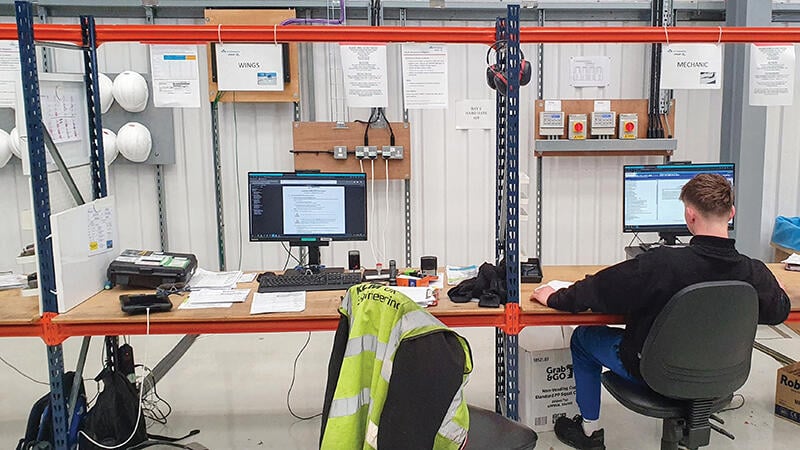
KLM UK Engineering operates a hybrid model, with a sizable number of workflows already digitized.
Digital tools are reshaping MRO, but without common standards, open application programming interfaces and real collaboration, the industry may struggle to make its systems truly speak the same language. Several recurring themes highlight both the progress and the persistent barriers to achieving a seamless digital environment.
The conversation about going paperless in aircraft maintenance has been ongoing for years. Yet a walk through many MRO hangars reveals technicians still filling out job cards by hand or juggling paper, spreadsheets and partially digitized systems. Despite considerable investments in digital tools and the wave of acquisitions by major software providers, the challenge of making these systems truly interoperable remains unresolved.
PERSISTENCE AMID CONSTRAINTS
At KLM UK Engineering in Norwich, England, Mark Walker, information technology and innovation manager, paints a picture of incremental progress but also deep-rooted limitations. “We operate a hybrid model, with a significant portion of our workflows already digitized,” he says. However, its core MRO platform, PMI, originally introduced in the early 1990s, was not designed with today’s mobility and automation capabilities in mind, he says.
This reality means that while some parts of the operation are modernized, “certain processes—particularly around production tasks and work package integration—still rely on paper,” Walker says.
It is a stark reminder that digital transformation in aviation maintenance is not simply a matter of rolling out new software. Decades-old core systems often underpin operations, and just ripping them out is rarely feasible. Instead, operators patch and extend them with in-house development to “modernize and enhance functionality,” Walker says. The result is steady but incremental progress, rather than the clean break for which many industry observers hope. For its part, KLM UK Engineering continues to make steady progress toward achieving a fully digital operation.
INTEGRATION DIFFICULTIES
Even when newer systems are adopted, the question remains: Do they actually connect with each other in practice? The answer, across the board, is often “not really.”
“Interoperability is limited,” Walker says. He says that PMI does not natively support modern data exchange standards, which affects integration with customer systems and suppliers. “Manual intervention is often required to align work packages and reporting tools, impacting efficiency,” he adds.
This frustration echoes across the industry. Trax, now part of AAR, has been explicit about building an “open, collaborative ecosystem” with cloud-native infrastructure and an expanding application programming interface (API) library to support plug-and-play interoperability with a wide range of software-as-a-service-based maintenance, planning and logistics platforms.
“Trax is committed to fostering an open, collaborative ecosystem across the aviation technology landscape,” says Rajan Bindra, vice president of business development. “Our strategy centers on enhancing interoperability through strategic partnerships and technical innovation, enabling customers to derive maximum value from integrated, best-in-class solutions.”
Trax’s mobile applications are also designed to integrate seamlessly into existing and future customer ecosystems, ensuring flexibility and scalability, according to the company.
IFS, which acquired EmpowerMX in 2024, also acknowledges that the industry’s patchwork of systems requires openness as a guiding principle. “The IFS Cloud platform is built with an open API architecture,” explains Hugh Revie, EmpowerMX’s vice president of sales for Europe, the Middle East and Africa. “We’ve found, though, that open APIs aren’t enough on their own, as understanding how to properly engage with so many APIs can be challenging. As such, we continue to offer our long-standing standard business APIs serving the common integrations in the aviation maintenance domain.”
Additionally, IFS software products are designed to work in an open, connected ecosystem to enable seamless integration to third-party systems.
Technical solutions seemingly exist, but real-world interoperability largely remains slow to achieve due to fragmented standards.
CONSOLIDATION AND ECOSYSTEMS
One response to the integration problem has been consolidation. Larger players are buying or bundling software tools in an attempt to build end-to-end ecosystems. The logic seems straightforward: If one company controls multiple platforms, it can engineer interoperability between them.
IFS is suggestive of this trend. “IFS Cloud for aviation maintenance and EmpowerMX are the two best airframe heavy maintenance planning and execution systems available on the market,” Revie says. “At first glance, there is a lot of overlap, but EmpowerMX offered several key capabilities that complemented IFS Cloud.”
For now, the company is keeping EmpowerMX as a standalone application but is in the process of consolidating all maintenance planning and execution capabilities onto the IFS Cloud platform. “Until we’ve achieved parity in the platform, EmpowerMX will continue to be available as a separate application,” he adds.
Similarly, AAR’s acquisition of Trax represents a bold gamble to combine digital forecasting with physical parts supply, enabling a synergistic “software-meets-hardware” model. “Trax’s digital tools help airlines forecast and manage parts requirements, while AAR delivers those components with precision in quality and cost,” Bindra says.
He believes this integration creates new opportunities to bundle parts and services, enhancing value for Trax’s customer base.
However, consolidation is not a cure-all. As some operators perceive, the risk is that interoperability works only within a single vendor’s ecosystem, creating new forms of lock-in rather than industrywide openness.
MODULARITY AND FLEXIBILITY
Operators want the ability to adopt new tools without tearing up their entire digital landscape. Walker at KLM envisions a modular system with real-time data exchange via APIs, mobile access for technicians, automated workflows and predictive maintenance, and seamless integration with OEMs and suppliers, among other standards.
Revie makes a similar case. “IFS is focused on providing our customers with choice, and fortunately our modular system allows our solutions to fit our customers’ landscapes, allowing customers to deploy only the portions they need, powering the composable enterprise.”
Even under AAR ownership, Trax has been careful to maintain independence and flexibility. “Crucially, AAR has preserved Trax’s entrepreneurial culture and operational autonomy,” Bindra notes. “The core Trax team remains in place to ensure continuity in product vision and customer relationships.” This is coupled with a commitment to integrating with complementary platforms such as Aerostrat’s Aerros and Rolls-Royce’s Blue Data Thread.
Collectively, these perspectives show that MROs and airlines are wary of one-size-fits-all solutions. They want interoperability, but not at the expense of being locked into an inflexible or single provider.
REMAINING READY
Another noticeable theme is the industry’s focus on not just catching up but leapfrogging into predictive and mobile-enabled operations.
KLM UK Engineering has evaluated several next-generation maintenance platforms, including EmpowerMX, Swiss-AS AMOS and Veryon. “These offer smart quoting, mobile applications and digital work cards,” Walker notes. While adoption is pending, the business case for improved efficiency and reduced turnaround times is strong. “We’re actively reviewing options,” he says.
At Trax, artificial intelligence (AI) and machine learning are already being deployed. AAR has accelerated investment in Trax’s product road map, with a focus on deploying AI and machine learning technologies to automate and optimize maintenance and engineering workflows, driving measurable gains in operational efficiency and reliability.
Revie at IFS also stresses the growing importance of scalability and cybersecurity as digital tools become more central to profitability. “As businesses depend more on their digital solutions to drive their profitability, the solutions become critical and the ability of an organization to provide adequate support, technology modernization, scalability and cybersecurity becomes much more significant,” he explains.
The common theme is that mobile tools, predictive analytics and AI are now essential for staying competitive. However, they will deliver full value only if they are built into systems that connect smoothly across the supply chain.
Cloud-native platforms, mobile applications, AI-driven forecasting and ecosystem partnerships are all moving forward, but the day-to-day reality in many MRO facilities remains stubbornly hybrid, with paper and manual processes still common.
The gap between ambition and reality is clear in Walker’s view. “The biggest hurdles to achieving full digital integration often lie not in the technology itself but in the ecosystem around,” he says.