This article is published in Aviation Week & Space Technology and is free to read until Jul 10, 2026. If you want to read more articles from this publication, please click the link to subscribe.

Collaborative Combat Aircraft Surge Drives New Engine Concepts
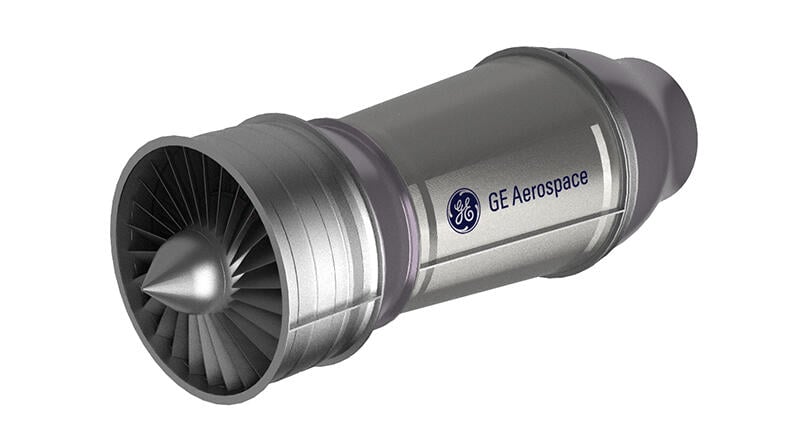
GE CCA engine

GE intends to reduce redundancy and complexity to deliver a CCA engine as quickly as possible.

Credit: GE Aerospace

Activity is burgeoning in a long-neglected portion of the turbofan engine sector with the rise of a new category of jet-powered, autonomous warplanes.

In the past month, the U.S.' GE Aerospace, South Korea’s Hanwha Aerospace and Germany’s MTU have revealed plans to offer new propulsion systems crafted for the unique requirements of large collaborative combat aircraft (CCA). Those projects emerged publicly after previous CCA engine developments by Honeywell Aerospace and U.S. startup Beehive Industries.

  • The pace, cost structure and business model for CCAs challenge engine-makers' traditional operations
  • CCA powerplant designs could be steppingstones to commercial engines

As companies jockey for position to power the emerging CCA class, several of these projects offer a steppingstone to developing new turbofan engines for the market of small business jets that has been dominated for three decades by Williams International and Pratt & Whitney Canada.

For now, the incumbents remain the leaders in the CCA field. The 3,600-lb.-thrust Williams FJ44 powers both operational prototypes funded by the U.S. Air Force for CCA Increment 1: the General Atomics Aeronautical Systems Inc. YFQ-42 and the Anduril Industries YFQ-44. A similar-size member of the Pratt & Whitney Canada PW500 family powers Northrop Grumman’s self-funded YFQ-48 Talon Blue.

But those CCA manufacturers and others around the world could soon have new options. GE Aerospace unveiled the GE426 engine project on May 19, aiming to establish a new turbofan architecture that could support CCAs with a propulsion requirement for 4,000-9,000 lb. of thrust. A week later, Hanwha Aerospace announced a partnership with the Korea AeroSpace Administration to develop a 4,500-lb.-thrust engine for CCAs. Finally, MTU also confirmed that it has begun talks with potential customers about engines for CCAs and other uncrewed aircraft systems.

The market for CCAs presents unique challenges for the traditional design mindset behind commercial engines—high up-front costs justified by thousands of flights with minimal maintenance. By contrast, keeping costs under control will be important, says Ottmar Pfänder, MTU head of programs.

Unlike crewed platforms, drone engines might require far fewer flight cycles—in some cases, just a test flight followed by a single operational mission. That could transform design parameters. Supply chain approaches and design iteration cycles are also different. In addition, the engines must withstand long-term storage yet function immediately once the system is pulled out of the box.

“What you now do in the civil market is maximum performance and maximum safety,” Pfänder says. “This is a different business. We have to start with a different mindset.”

The pace, cost structure and business model in the CCA market have forced traditional engine manufacturers to change the way they operate. The customers want production engines available within a few years, not a decade or longer. The engines must be sufficiently powerful and reliable to support a combat aircraft but affordable enough to be expendable after perhaps dozens of missions instead of hundreds or thousands. Finally, CCA engines are expected to be lost or retired before major maintenance work is necessary, depriving engine manufacturers of the decades of sustainment work that traditional military aircraft engines generate.

“There’s not a huge sustainment tail for a cruise missile or a low-cost or small CCA by design,” says Steve Russell, head of GE Edison Works.

Another difference for the commercial engine market is the pace of development. To compete in the CCA market, engine-makers must find ways to avoid the decade-long cycles to design and certify new products. The GE426, for example, is expected to be delivered within 2-3 years.

“It’s not your typical big-engine design cycle,” Russell says.

GE and Hanwha also view the CCA engine projects as potential steppingstones to new turbofan engines for small business jets.

“The engine developed under this program is a high-bypass turbofan designed for fuel efficiency and both military and civil use,” Hanwha said in a May 28 statement. “It could also be adapted for small business jets and other commercial aircraft.”

To meet commercial certification requirements, GE’s architecture for the GE426 could be adapted, Russell says. The commercial design could use a similar architecture, but the component materials must be changed for durability, he adds. The commercial engine would also require additional redundancy for certain components, such as fuel-metering computers and cooling systems.

Steve Trimble

Steve covers military aviation, missiles and space for the Aviation Week Network, based in Washington, DC.

Robert Wall

Robert Wall is Executive Editor for Defense and Space. Based in London, he directs a team of military and space journalists across the U.S., Europe and Asia-Pacific.