This article is published in Aviation Week & Space Technology and is free to read until Aug 14, 2026. If you want to read more articles from this publication, please click the link to subscribe.

UK Defense Spending Plan Bolsters Royal Air Force Combat Fleet
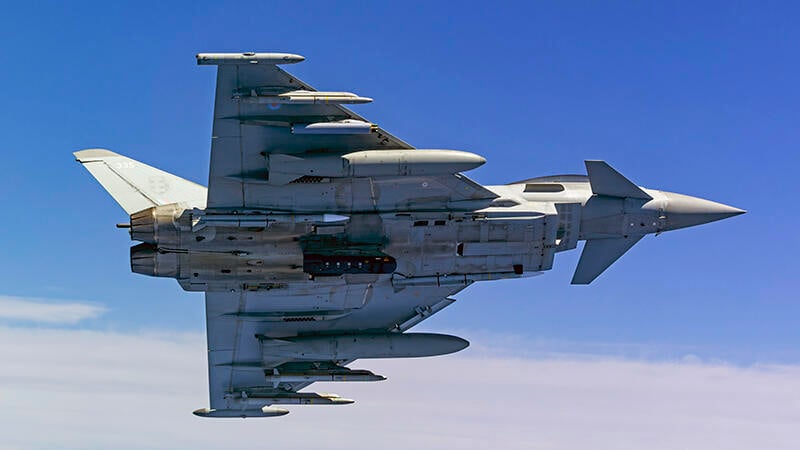
Royal Air Force Eurofighter

The Royal Air Force is embracing low-cost weapons to defend against one-way attack drones and equipping its Eurofighters with the Advanced Precision Kill Weapon System.

Credit: Joshua Whiting /Royal Air Force

If there is a winner from the UK government’s long-delayed Defense Investment Plan, it is the Royal Air Force, which walks away from the funding saga with the money to modernize and expand its combat capabilities.

The 10-year blueprint, built around last year’s Strategic Defense Review, places the Global Combat Air Program (GCAP) on firmer footing, while paving the way for additional Lockheed Martin F-35 purchases and upgrades to the Royal Air Force’s (RAF) Eurofighter Typhoon fleet and advanced jet trainer fleet. It also promises a new collaborative combat aircraft.

  • London embraces low-cost missiles
  • Space control moves up the agenda

The spending plan, published just before NATO members meet in Ankara, Turkey, for their annual summit, evokes many of the themes reshaping Western militaries: a focus on rapidly building up munition inventories with more affordable weapons, a need for deep-strike systems—and drones, drones, drones.

The commitment to several high-profile programs also comes with cuts, including to relatively young fleets. The British Army’s fleet of Leonardo AW159 Wildcat battlefield utility and reconnaissance helicopters will be withdrawn beginning in 2027 after a mere 12 years in service, while the Royal Navy will keep its version. The RAF will lose its Raytheon Shadow R1 intelligence, surveillance and reconnaissance aircraft.

Aging Boeing Chinooks will also go when they reach major maintenance milestones. That comes on top of the 14 Chinooks the UK Defense Ministry earmarked for retirement 18 months ago. The cuts will be partially offset by the introduction of Boeing MH-47Gs starting next year. Plans to field a narrowband element of the future Skynet 6 military satellite communication system have also been scrapped.

Some of these capabilities will be replaced by uncrewed systems; London has committed £5 billion ($6.7 billion) to such programs. The money will fund a new hybrid air wing for UK carriers, armed drones to support the British Army’s Boeing Apache attack helicopters and new reconnaissance systems to replace the retired Thales Watchkeeper drones. The RAF’s collaborative combat aircraft program has been allocated £300 million, with the goal to have something flying by 2030 to complement the service’s F-35s and Typhoons.

Although last year’s strategic review recommended additional purchases of Airbus A400M airlifters and Boeing E-7 Wedgetail airborne early warning platforms, neither materialized in the funding plan unveiled June 30.

British Prime Minister Keir Starmer, who has said he is stepping down once his successor is chosen, said the plan would “reverse” what he called the “corrosive hollowing out of our armed forces.” Critics say the plans have already begun to unravel, contending that they are not fully funded.

The spending plan took a tortuous route to publication, arriving months late as the government wrestled with balancing security needs and challenges to the public purse. The government eventually added £15 billion to the Defense Ministry’s spending plan. Defense chiefs had sought a larger spending boost of about £28 billion. The settlement prompted two defense ministers to resign in protest. They argued that the UK Treasury is unwilling to step up and spend on defense even with the growing threat from Russia.

UK defense spending is set to rise to £80 billion a year by 2029-—the equivalent of 2.7% of GDP—from £54 billion in 2024. The government said it kept Britain on pace to fulfill a NATO pledge to meet the spending target of 3.5% of GDP on core defense matters by 2035, although the funding is heavily backloaded, and critics said the plan is not credible.

The government’s desire to avoid increasing its debt burden and an unwillingness to raise taxes drove it to ask other departments to contribute 1% of their capital budgets to boost defense spending. Still unclear is whether the plan has the backing of Britain’s next prime minster. Starmer’s likely replacement—Andy Burnham, the former mayor of Manchester, England—has said he would work to fund the plan fully and strengthen the country’s military power.

British Army Wildcat helicopter
The British Army’s 34 Wildcat helicopters will be removed from service after just 12 years of operation under the Defense Investment Plan. Credit: Tony Osborne/AW&ST

Industry has broadly welcomed the publication of the investment plan, perhaps more a sign of relief that the waiting is over than enthusiasm for its content.

Expanding munitions in numbers and capabilities, almost as much as drones, are a hallmark of the new document. “What the plan does is it injects an increase into the lethality of the front line, especially in long-range precision strike, far sooner than we were previously planning to do,” a UK Defense Ministry official said.

That translates into investments in affordable munitions that can be fielded at scale. The UK, for instance, may use the Brakestop program to develop weapons for Ukraine to build up its own inventory of long-range strike systems. MBDA, MGI Engineering and Rotron Aerospace have all successfully demonstrated their munitions under the initiative. The UK will also spend £1.4 billion on the Stratus missile program with France and Italy to develop a future, high-end cruise and anti-ship missile capability.

The government said it plans to spend £770 million on deep-strike weapons, too, including working with Germany on a weapon with a range of more than 2,000 km (1,243 mi.), while another £190 million will be invested in joining the U.S. Precision Strike Missile program.

Also set to grow are stocks of air defense interceptors, including MBDA Asraam, Common Anti-Air Modular Missiles and Thales Lightweight Multirole Missiles.

About £790 million will go into other air and missile defense capabilities, such as command and control and funding for homeland counterdrone capabilities at “a significant number” of fixed sites.

The government has earmarked £880 million in the current legislative period for space intelligence-gathering as well and put a larger emphasis on dealing with threats in space. “Space control, particularly, is an area that we want to find to put more funding into,” a defense official said.

To support defense exports, the government also announced a £50 billion defense export loan facility established by UK Export Finance to help British companies secure contracts overseas.

Editor's note: This article was updated to include comment on the DIP by Andy Burnham, who is likely to become the next UK prime minister. 

Tony Osborne

Based in London, Tony covers European defense programs. Prior to joining Aviation Week in November 2012, Tony was at Shephard Media Group where he was deputy editor for Rotorhub and Defence Helicopter magazines.

Robert Wall

Robert Wall is Executive Editor for Defense and Space. Based in London, he directs a team of military and space journalists across the U.S., Europe and Asia-Pacific.