This article is published in Aviation Week & Space Technology and is free to read until Aug 14, 2026. If you want to read more articles from this publication, please click the link to subscribe.
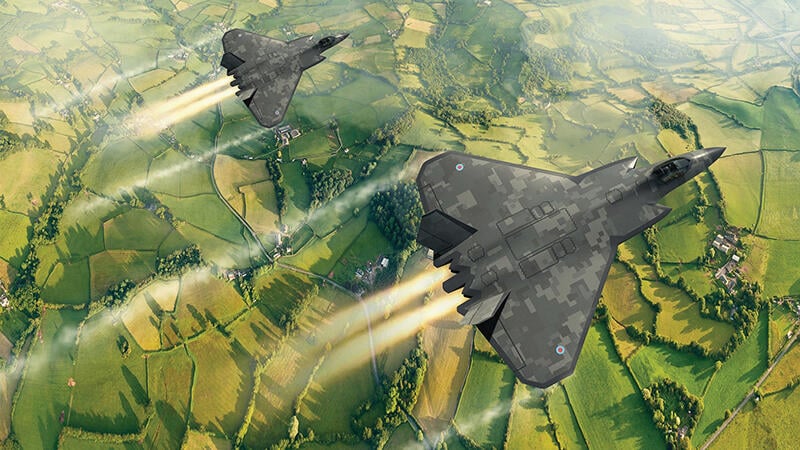
Japan has set a firm 2035 deadline for the start of its GCAP fighter operations.
After months of uncertainty over the UK’s long-delayed Defense Investment Plan, the Global Combat Air Program is finally back on firm footing.
With multibillion-pound funding now committed and contracts signed, the governments of Italy, Japan and the UK are preparing to move the project into its next phase while also opening the door to future partners.
- BAE Systems is advancing demonstrator development for a 2027 rollout
- Excalibur 757 testbed has been modified for sensor and communication system trials
The governments have approved a framework allowing additional nations to observe the development of the sixth-generation combat aircraft, potentially widening its future customer base. The first of these observers could be announced at the Farnborough Airshow.
The Global Combat Air Program (GCAP) now stands as the only sixth-generation platform program genuinely open to allies, following the collapse of the Franco-German-Spanish Next-Generation Fighter project and continuing uncertainty surrounding the wider Future Combat Air System (FCAS/SCAF).
GCAP has had a challenging 2026, too. A first contract—worth £686 million ($916 million)—awarded to prime contractor Edgewing in April was little more than a bridge to carry the program through to June 30, when the UK government revealed the long-awaited Defense Investment Plan (DIP).
Delays to the DIP not only caused headaches for the UK defense industry but also consternation in Rome and especially in Tokyo, where the Japanese have set a hard deadline of 2035 to bring the first examples of the GCAP fighter into service.
The allies feared further DIP delays could endanger that timeline. But GCAP emerged as the winner in the DIP, with the government allocating about £8.6 billion to the program over four years, enabling a second contract, worth £4.6 billion, to be awarded to Edgewing on July 3. That deal allows for completion of the advanced concept and assessment phase and continuation of the trinational team’s detailed design and development work.
The Italian and Japanese governments have already allocated GCAP funding; documents published in January show that Rome alone allocated €8.8 billion ($10 billion).
The program’s schedule is ambitious. In roughly half the time it took to bring the Eurofighter into service, industry has been tasked with developing a fighter capable of replacing the Eurofighter Typhoon in UK and Italian service and Japan’s Mitsubishi F-2.
The new combat aircraft also will need to work alongside the Lockheed Martin F-35 Joint Strike Fighters flown by all three countries. But unlike with that platform, the nations are demanding levels of freedom of action and modification unachievable with the U.S.-made aircraft.
Col. Antonio Vivolo, the Italian Defense Ministry’s GCAP director and senior technical representative, told the International Fighter Conference in Rome last year that the need for such freedom was not just a “political mantra.” He characterized it as a requirement that would enable customers to integrate a new sensor or upload new algorithms to deal with radar waveforms and to do so in “months and not decades.”
The tenet is driven in part by experience with the F-35. Customer nations cannot make changes to their aircraft independently without the approval of U.S. authorities. And the process of adding new weaponry is taking considerably longer than anticipated when the platform was first acquired.
The GCAP aircraft will also be substantially larger than current combat aircraft, closer in size to a General Dynamics F-111 or Dassault Mirage IV than a Eurofighter Typhoon.
Agility, at least in the traditional fourth-generation sense, is no longer the priority. The emphasis now is on signature management, range and payload. The three militaries want a large internal weapons bay and what officials have previously described as near-transatlantic range.
The targets on which the program will focus will not be “those launching the arrows”—such as cruise missile-launching bombers or ships—but “those making the arrows,” Air Vice Marshal James Beck, Royal Air Force (RAF) director of capabilities and programs, tells Aviation Week (page 81).
The GCAP fighter is designed to operate with other fighters and collaborative combat aircraft, bringing “big compute” to the fight and orchestrating those other assets, Beck says. Unlike in the European Future Combat Air System program, the collaborative assets are not part of GCAP.
Significant efforts are going into the development of GCAP’s Integrated Sensors, Non-Kinetic Effects (Isanke), which render traditional within-visual-range air combat increasingly irrelevant. The future dogfight will be in the electromagnetic spectrum, where the new fighter will have “insane levels of agility,” Beck says.
Despite the DIP-induced uncertainty, the GCAP aircraft development and technology maturation, as well as the creation of its government and industrial apparatus, have moved swiftly and smoothly-—at least compared with that of the failed sister program across the English Channel.
Edgewing, the joint venture of BAE Systems, Leonardo and the Japan Aircraft Industrial Enhancement Co. has been operating for a year. It is establishing engineering offices in Turin, Italy; Nagoya, Japan; and Warton, England. Each will be fully equipped to do all tiers of engineering on the project. The GCAP International Government Organization (GIGO)—now known as the GCAP Agency—represents the three governments and shares an office with Edgewing in Reading, England.
What each Edgewing site will do has not yet formally defined. It is unclear whether each will build different major assemblies of the aircraft—as the Eurofighter partners do now—particularly as the fighter will be so much bigger and the distances between the three factories are considerably larger. This presents new logistical challenges for the airframers, which will be addressed in the next major round of negotiations.
“GCAP is one of the most strategically important partnerships that we’re going to see over the next 50 to 80 to maybe 100 years,” RAF Air Cdre. Simon Joy, GCAP Agency head of engineering governance and resource, told the Royal Aeronautical Society in May.
The program is currently considered to have two halves: delivery of the program and final production and ensuring the digital system is in place to enable those.
In parallel, BAE Systems is progressing with development of a Future Combat Air Demonstrator (FCAD), which is preparing both the company and supply chain for GCAP. Japanese industry has already produced such a demonstrator, the Mitsubishi X-2 Shinshin.
First announced in 2022, the FCAD will be a supersonic, low-observable testbed to derisk engineering and manufacturing processes as well as to validate key UK technologies in stealth and weapon release from a bay in flight.
“It is a critical derisk program for GCAP—it gets us early testing and generating real-world data that we are leveraging in the design process,” Tony Godbold, BAE Systems’ UK Future Air Combat Systems delivery director, said at the company’s facilities.
Aviation Week was one of a small number of trade publications allowed to see the front, center and rear fuselage sections of the demonstrator taking shape at Samlesbury, England. The huge double-delta wings are being built at Warton. Frames for each fuselage section have been aligned on jigs. The center fuselage section the most revealing—it shows two deep internal weapon bays positioned ahead of the main landing gear.
Their size suggests the demonstrator could carry about twice the internal weapon volume of the F-35’s relatively shallow bays and even accommodate larger-diameter stores. Individual ducts for the two Eurojet EJ200 engines that are to power the FCAD wrap over the weapon bays and run the full length of the center fuselage.
About 75% of the demonstrator by volume has been manufactured. Major structural sections have been in production for 12-18 months, and the airframer targets a rollout by the end of 2027.
The FCAD is estimated to be at least at least a third larger than a Eurofighter and will be the largest aircraft assembled in the UK since the Nimrod MRA4. Production models of the GCAP fighter are expected to be larger still. “The demonstrator is allowing us to shift risk,” Godbold said. “It is better we trip up on things now that we don’t want to trip up on when we get into the main program.”
Godbold said work is underway to secure military airworthiness certification—the first time the UK military airworthiness authority and BAE have undertaken the process together from scratch. The company is also exploring how the demonstrator can support additional research objectives. In readiness for first flight, BAE says its test pilots have accumulated more than 300 hr. in the simulator, and automated coding tools are generating much of the flight control software for the fly-by-wire system. The aircraft will be flown using a sidestick controller and a large-area cockpit display.
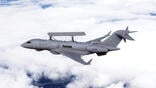
The FCAD is one of a trio of demonstrators being developed in the UK. Others include the Excalibur, an adapted Boeing 757 that will test the Isanke suite of sensors in the airborne environment. Rolls-Royce will lead the testing on a demonstrator engine, in conjunction with Japan’s IHI and Italy’s Avio Aero. The Excalibur has been fully modified and is finalizing flight testing before it begins to receive the Isanke systems. Taken together, the demonstrators and funding progress underline that GCAP is no longer a paper program.
The challenges have shifted from securing political commitments to delivering the technologies, industrial capacity and organizational maturity needed to field a sixth-generation fighter by 2035.


Comments