This article is published in Aviation Week & Space Technology and is free to read until May 20, 2026. If you want to read more articles from this publication, please click the link to subscribe.

Opinion: The Pricing Problem In Commercial Aerospace

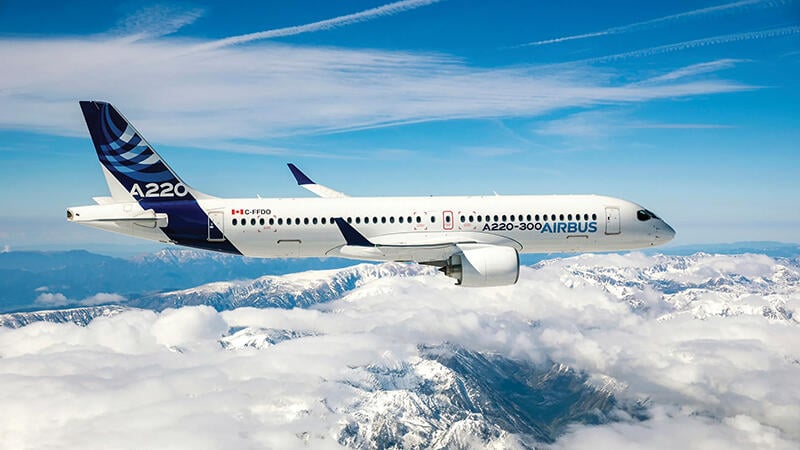
Airbus A220 in flght
Credit: S. Ramadier/Airbus

Most large commercial aircraft programs destroy economic value for airframers. Individual aircraft programs fail to deliver a positive return on investment for many reasons, but a common theme is that airframers do not implement value-based pricing. As a result, the few large aircraft programs that have been financial successes, such as the Boeing 737 and Airbus A320, have spanned more than five decades and required high production volumes. History suggests that airframers have not given enough consideration to pricing their products properly to account for the high-risk nature of launching a commercial aircraft program.

Overly optimistic volume forecasts to justify launching an aircraft program can have long-term consequences. After decades of boom-and-bust cycles, today’s large commercial aircraft industry has become a duopoly between Boeing and Airbus. Still, both airframers have had their fair share of programs that did not live up to expectations. Airbus’ A340 was an inferior product to the Boeing 777, and the A380 was built for a hub-and-spoke model at a time when travelers preferred point-to-point travel. Boeing has not done much better. The 747-8, 787 and 777X programs all experienced delays, cost overruns and forward-loss charges. The 737 MAX’s issues are also well documented. Today, Airbus loses money on the A220 program and barely breaks even on its widebody programs, meaning it depends on the A320 family for nearly all of its commercial profit. Similarly, Boeing’s recovery and long-term financial health are largely dependent on boosting 737 and 787 delivery volumes back to pre-COVID-19 levels.

When analyzing businesses, investors assess the pricing power that a company can wield. Commoditized businesses that operate in industries with low barriers to entry typically lack pricing power and earn low margins. By contrast, businesses and industries with pricing power are often supply-constrained, have high barriers to entry, benefit from economies of scale, possess significant intellectual property or institutional knowledge and serve fragmented, risk-averse customer bases.

The large commercial aircraft manufacturing industry is not a commodity industry. Designing, certifying, manufacturing and servicing aircraft globally is extremely challenging. Even with the backing of the Chinese government, Comac has made little headway against Boeing and Airbus. Despite limited competition, the intensity of the Boeing-Airbus rivalry has led to excessive discounting of new aircraft and profit margins that are much lower than those of their suppliers.

Simply put, Boeing and Airbus do a poor job of capturing the value they create for the world through pricing. It is hard to think of another duopoly with high barriers to entry in which both participants are supply-constrained but heavily discount their products. Both airframers have fragmented customer bases and backlogs that extend into the 2030s. When demand outstrips supply for a good, businesses typically raise prices. Yet both airframers fight tooth and nail for orders by offering aircraft at discounts of 50% or more to list prices.

A 737 MAX 8, for example, was listed at $125 million when Boeing last published its list prices several years ago. Recent appraisals value a new 737 MAX 8 at approximately $56 million, while a pair of spare CFM International Leap-1B engines can sell for about $40 million, or $20 million per engine. If you were to strip out and sell the major systems and subsystems—such as avionics, landing gear, wheels and brakes—it would be apparent that Boeing is effectively giving the airframe away for free. To be clear, $125 million for a narrowbody aircraft is probably too expensive for airlines, but selling them for $56 million undercuts the value that the airframers provide.

By heavily discounting aircraft, Boeing and Airbus are also increasing the cyclicality of their own profits and cash flow. Most airlines and lessors are rational buyers of aircraft, and lower selling prices encourage them to overorder and rapidly expand their fleets. But inevitably, downturns occur, and airlines find themselves with excess capacity. Cash-strapped airlines then defer or cancel deliveries of new aircraft, which pressures the airframers’ profits. Higher prices would help curb speculative ordering during periods of exuberance and reduce cyclicality.

Businesses have three main levers to boost earnings: increase volumes, reduce costs and raise prices. For too long, airframers have built their business cases for new programs by focusing on volumes, which has contributed to destroying the value of most aircraft programs. In the 2000s and 2010s, Boeing and Airbus became overly focused on reducing costs by squeezing suppliers through such programs as Partnering for Success. To ensure the financial success of their next aircraft programs, Airbus and Boeing might want to give value-based pricing a shot.

Scott Mikus is director of aerospace and defense research at Melius Research.

Scott Mikus

Contributing columnist Scott Mikus is director of Melius Research covering aerospace, defense and space.

Comments

1 Comment
To the best of my knowledge Boeing made money on all of their commercial aircraft up to 2000. Since then I don’t think they have made money on anything launched since.

What happened? I can think of two things.

One they merged with McDonnell Douglas in the late 90s. MD overall lost money on their commercial aircraft. Yet the financial management post merger came from MD.

Two. The Robinson Patnam Act of 1936 prohibited manufacturers from selling at different prices to customer. This act has not been actively enforced since the 1980s.