This article is published in Aviation Week & Space Technology and is free to read until Jul 14, 2026. If you want to read more articles from this publication, please click the link to subscribe.
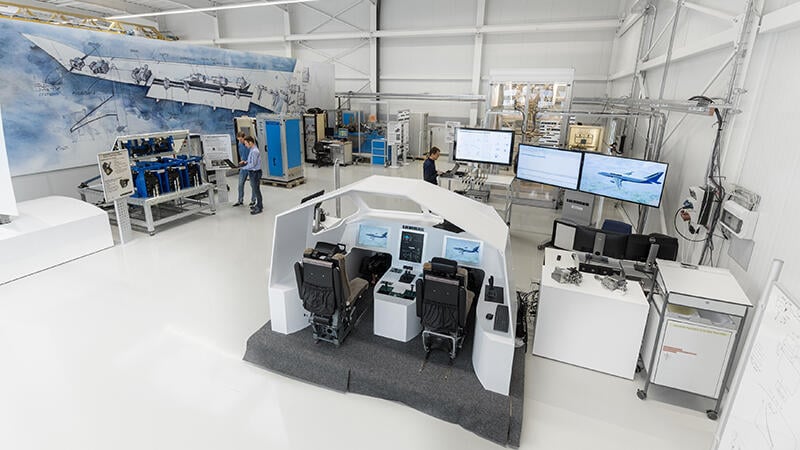
Liebherr is exploring new actuation concepts at its Lindenberg facility.
The recent news flow must have felt scary for the German aerospace industry. Airbus’ commercial aircraft ramp-up, the sector’s key growth driver, is slower than hoped for, owing mainly to a myriad of supply chain constraints, including engine shortages and quality lapses. But these problems pale against the more acute crisis that has emerged from the U.S.-Israel war against Iran: skyrocketing fuel prices, concerns about actual jet fuel shortages (even in Europe), much higher rates of inflation and a potential structural realignment of the global industry, among other geopolitical factors.
Yet as the German aerospace sector assembles for this year’s ILA Berlin Air Show, players are still optimistic about their business prospects, even though navigating these complexities has become still more challenging. Preparing for much higher production rates in the Airbus supply chain is a key priority that requires a lot of attention. At the same time, the sector is beginning to get ready in earnest for the launch of Airbus’ next-generation single-aisle (NGSA) aircraft, due to be formally launched around 2030. That milestone will require a lot of preliminary design work that will take years to complete.
- Tier 1 suppliers urge new narrowbody design decisions
- Supply chains remain a major concern as production rates increase
THE RATES RACE
Airbus plans to raise A320neo-family output to 70-75 aircraft per month by the end of 2027. But the company delivered only 136 A320neo-family aircraft in the first four months of this year, or an average of 34 per month. That shows the severity of the engine shortage and the effect of rework needed on forward fuselage panels due to a supplier quality issue discovered in late 2025. For comparison, Airbus’ monthly average of A320neo-family deliveries was just above 50 last year.
In addition to the main narrowbody family, A220 output is slated to grow substantially to 13 per month. Airbus is looking at much higher rates for the A350 as well—initially to 12 per month in 2028 and potentially much higher later.
“We want to support the targeted rates,” Liebherr-Aerospace Linden-berg Managing Director Philipp Walter says. But he warns that his company’s own supply chain is still struggling and adds: “Smaller players are looking at us to help, but we can only do so much.”
The Iran war has raised further questions about production rates, and Walter is concerned that some players will come to their own conclusions. “One is taking the risk,” he says. “Another one is not.” He says the industry might not be talking enough about how prepared it is to operate in an even more challenging environment and what needs to be done to increase resilience.
Walter’s worries largely center on small suppliers that are perfecting specialized processes on which the industry depends; not all of those companies are financially stable. “In some cases, we have to fully finance them so that business continues,” he notes.
“We need a realistic conversation around whether we need to adapt [rates] or not,” Walter says. “If we don’t adapt, then we want to deliver [to Airbus].” Liebherr-Aerospace is a major provider of landing gears, flight controls, actuators and electronic components, among other things.
The situation is similar at Diehl Aviation. “The reality is the rates will come, mostly with some small delay,” CEO Jörg Schuler says. “Demand is still very high.” The company, which has a large cabin interiors business, is “prepared to meet Airbus’ future demand,” he says, particularly since rates are still low. Diehl’s installed industrial capacity is actually still not fully utilized.
But like at Liebherr, the company’s own supply chain is creating headaches. “You cannot claim that there is full resilience yet,” Schuler says. “The delivery performance of our own suppliers is still not at the level we need. The smaller the supplier, the less resilient.”
While performance has improved in some sectors, Diehl still needs to intervene heavily in some cases and recover from delays to contain the impact on Airbus.
The company made substantial adjustments to its procurement organization, merging operational and strategic departments into a single unit. Diehl hopes that the move will provide better visibility of its supply chain and possible constraints early on.
ENGINES AND SEATS
At MTU Aero Engines, the supply chain picture is variable, too. “It changes over time,” MTU Chief Program Officer Ottmar Pfänder says. “There are programs that saw fluctuations last year and are fine this year—or the other way around.”
Pratt & Whitney, which is a partner with MTU in the International Aero Engines consortium, is in the middle of a deep dispute with Airbus about the number of PW1100G geared turbofan (GTF) engines to deliver to the final assembly lines this year. Airbus says the number of GTFs received are significantly short of contractual obligations. At the end of 2025, the consortium pushed for as many deliveries as possible to Airbus so the airframer could meet its own targets. Yet at the beginning of this year, MTU’s focus shifted to accommodating airlines and the in-service fleet to reduce the number of parked aircraft.
“There are not enough engines to serve everybody,” Pfänder remarks. “Expanding industrial capacity does not go quickly enough.”
The same might be said about aircraft seats. Leading seat manufacturer Recaro, based in Schwabisch Hall, reached pre-pandemic revenues again for the first time in 2025, when it grew by 24%. Growth is not abating this year, either, CEO and Shareholder Mark Hiller says. The company has not seen any indication that line-fit or retro-fit programs are being questioned by customers in North America, Europe or Asia, although some airlines in the Middle East are considering delaying investment decisions, according to Hiller. On the other hand, Emirates and a few other carriers in the Middle East are using aircraft downtime to speed up cabin renewal programs.
Even if larger-scale decisions are made now, any effect on production would be felt in 2027 at the earliest, given the long lead times. Should aircraft retirements finally accelerate, the seat industry would not immediately suffer, as these would only affect retrofit opportunities. Furthermore, “there is not enough capacity in the market,” Hiller says.
The global aircraft seat industry was worth around $3.1 billion in 2025 and will grow to around $5 billion in 2030, according to Recaro’s estimates. A significant chunk of that growth will be driven by the continuing trend toward premium products. Business-class seats currently represent 20% of Recaro’s revenue, but Hiller estimates that share will grow to 40% in the next two years, based on existing and likely future orders.
For now, none of the companies see any material immediate impact of the Strait of Hormuz closure on their own supply chain, business or customer demand, even though the elevated price of oil will flow through into higher inflation—especially for oil-based products. That could become a problem for Diehl because of the materials it uses for cabin components.
Of course, that will likely change if the situation in the Middle East does not improve in the coming months and airlines do not recover as foreseen. “If jet fuel remains expensive, there might be an impact next year,” Hiller says. “We will still grow substantially, and I would not call this a crisis yet.”
For all the operational and political issues, demand appears to be remaining strong. MTU in particular is seeing huge demand for its manufacturing business as well as maintenance, repair and overhaul (MRO), in part due to the fixes needed to the PW1100G-installed fleet. Even after the extra GTF work winds down, Pfänder does not see any issues filling the company’s MRO capacity as the in-service fleet continues to grow. He also does not expect competitors’ planned all-new MRO shops to open in time or at all, given the skilled labor and capital required.
Nor is Pfänder worried if retirements of aging aircraft finally gain momentum in the coming years. MTU could still benefit through resales of engine spare parts.
GROWING INTO CHANGE
Diehl Aviation’s growth is largely tied to new Airbus aircraft deliveries. That dependence is still high, given that Diehl took over the airframer’s former Laupheim interiors site in 2008. Its chances of doing much more on behalf of Boeing are limited, given that the U.S. company is more vertically integrated on the cabin interiors side than its European competitor. Boeing has large cabin manufacturing operations in both Washington state’s Puget Sound area and Charleston, South Carolina.
Schuler does not expect Boeing to change its approach, but he would like Diehl to take a stab at everything in its line of business that the airframer does not produce itself.
The opening of Diehl Aviation’s facility in Queretaro, Mexico, is not only a measure to drive down production costs but also an investment in further growth opportunities. Boeing has told the company that it sees Mexico as a good place for production of any Diehl components for its aircraft. In addition, Diehl hopes for substantially more business with Embraer.
Diehl Aviation de Mexico was initially tasked with building the cabin luggage bins for the A220. That project has been delayed for several months because the components have to go through a redesign to guarantee performance. “We need to industrialize the A220 bin first, which takes longer than expected,” Schuler says. “It only makes sense to move a mature product.” For now, the bins will continue to be produced in Laupheim, and the first shipsets are delivered to Airbus from there.
The A220 itself is providing growth opportunities, given Airbus’ rate plans and the potential stretched A220-500. “The -500 would be attractive for us,” Schuler says. Diehl Aviation does not build bins for the A320neo family.
Liebherr has important projects on current-generation aircraft that will contribute to growth beyond sheer volume increases of its existing products. In 2024, Airbus chose the company to develop the new integrated flight control computer (IFCC) for the A320 family. “That was a major step for us,” Walter says.
The IFCC is in development and planned to enter service on the first newly produced A320neo-family aircraft in 2028. That would give it a production run of around 10 years on the existing platform if Airbus’ plans for the NGSA remain in place. More important, Liebherr hopes to develop more IFCCs for other programs based on the A320neo. And of course, “we see ourselves very well positioned for NGSA,” Walter says.
In the nearer term, the company is gearing up parts production for the Boeing 777X, the first delivery of which is now expected in early 2027. Among other things, Liebherr builds the actuators for the folding wings. Initial ramp-up plans had the supplier delivering 100 shipsets per year, but the initial rate is now at 25 and will go up to 50 over time.
Recaro is also investing in new product features. At the recent Aircraft Interiors Expo, the supplier showed a voice-controlled technology demonstrator enabling passengers to tell the seat what they want to do next. The system recognizes 90 different languages. The manufacturer is also looking at integrating loudspeakers into the top of the seat backrest so passengers would not need to wear headsets. There are still issues to sort through, including active noise cancellation and sound quality.
That added complexity is to be managed by a sector that is currently at the top of the list of reasons for delayed aircraft deliveries. Airframers are often waiting for cabin parts, engines or seats that are late in the production flow or in a certification queue. Lufthansa famously had to park up to 15 Boeing 787s temporarily at the airframer’s Charleston plant recently because its business-class seats had yet to be certified by the FAA.
To remove one bottleneck, Recaro opened its own crash-test facility during the COVID-19 pandemic. Now the company conducts up to 500 annual tests at the site, which is right across the street from its headquarters. Without the facility, Recaro likely could not sustain its growth trajectory.
SHAPES OF THINGS TO COME
The NGSA and Boeing’s potential replacement for the 737 MAX are beginning to come into focus for suppliers. Design schedules and associated time pressures differ by product. Lieb-herr is generally active in areas that require very long development timelines, including a potential next-generation IFCC or landing gear. Diehl has a little more time for cabin parts, assuming the fundamental tube-and-wing architecture of next-generation narrow-bodies does not change. MTU’s work on the engine hinges on Airbus’ decision for or against the open rotor concept.
“I see benefits for aircraft manufacturers to introduce a new narrowbody sooner rather than later,” Diehl’s Schuler says. “But everything depends on the maturity of the engine.” The decision should be influenced not only by technical considerations but also by industrial strategy, he says.
“We will have to assume a [monthly] rate of 100 at Airbus and 100 at Boeing,” Schuler notes. “I would always rely on a double source at such high rates.”
“I don’t believe in the open rotor,” MTU’s Pfänder says. “Ducted will be the future. The potential gains are unlikely to outweigh the risk; the design impact [of the open rotor] on the aircraft is too big.”
Of course, MTU, Pratt and their partners have begun working on the next-generation GTF following the Advantage, which is being rolled out on the A320neo family. It is therefore in their interest if Airbus sticks with the known architecture.
“Reliability and maturity are going to be very important,” Pfänder adds. “We are talking about the bread-and-butter business. No one will want to expose that to unnecessary risk.”
For Liebherr, the NGSA offers new opportunities in addition to the IFCC or components traditionally offered—even on the engine side. The company developed the gearbox for the Rolls-Royce UltraFan 80 demonstrator and is working on scaling that down for the UltraFan 30, which could be used on a future narrowbody. According to Walter, Liebherr is planning the industrial concept for the component. But contracts have yet to be signed, and the UltraFan has yet to be selected as an engine option on a future Airbus or Boeing aircraft.
Liebherr hopes that longer, thinner wings will open up further opportunities. Its folding-wing actuator, slated to be used on the 777X, is one possibility, given that future narrowbodies should fit into the same gate positions as current aircraft. The company also is pushing for more electric actuation systems that would likely be required in thinner, lighter and longer wings.
At Diehl, preparations for the NGSA are beginning on two levels—organizational and technological. “I’m pushing the organization hard to transform our way of working toward more digitalization and some support by artificial intelligence,” Schuler says. “It is important to me that we have the processes, methods and tools in place for a digital backbone that is multi-OEM-capable and which also works with our own Tier 1 suppliers.”
On the technological side, the company is exploring innovation in each of its strategic business areas to see what can be derived from current products. One fundamental decision that it will have to make: whether to stick with traditional honeycomb structures or go for thermoplastics.