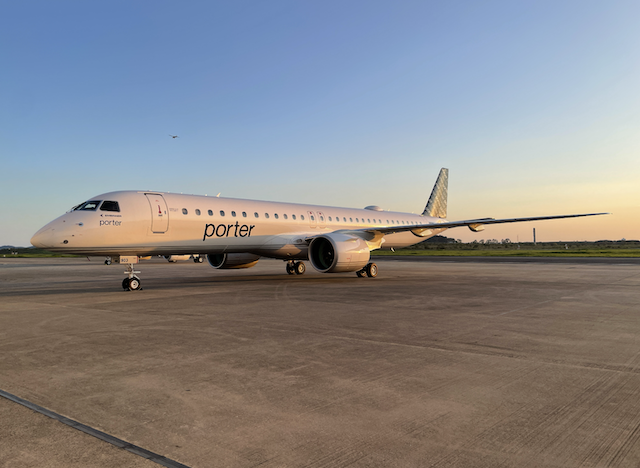
Small narrowbody jets are increasingly tackling distances that would have been thought impossible by previous-generation regional jets.
New generation engines, although still problematic in terms of reliability, are allowing modern aircraft in the 100-150 passenger category to handle routes that would have been close to the limits of mainline narrowbodies a decade ago.
Among those pushing the envelope is Canada’s Porter Airlines, which is increasingly making use of its Embraer E195-E2s on long sectors. In the past two months, Toronto-based Porter has announced a series of services from several Canadian airports—including Toronto, Ottawa and Hamilton—to destinations in the Caribbean and Central America.
Its new Toronto Pearson-Liberia, Costa Rica, service, for example, has a flight time of 5 hr. 40 min. Its service from Ottawa-Puerto Vallarta, on Mexico’s Pacific Coast, is even longer, with an advertised time of 5 hr. 55 min.
These are some of the latest in a series of new Porter services to winter-break destinations for “snowbird” tourists seeking to escape Canada’s chilly temperatures. Notably, they are now largely avoiding Florida, traditionally the location for Canadians to head in winter, which coincides with the downturn in Canada-U.S. passenger traffic linked to ongoing political tensions between the two nations.
However, many of the longest small narrowbody routes are domestic U.S., notably transcontinental sectors such as JetBlue’s A220 seasonal service from New York JFK to Burbank, at just under 6 hr. 20 min., and the similarly long Breeze A220-300 sector from Providence to Los Angeles. These services show the value of new aircraft with good economics being used to link major airports to secondary destinations.
In the Middle East, meanwhile, Royal Jordanian has been utilizing its E2s on similarly lengthy routes over the past year. Services from Amman to Amsterdam and Madrid have clocked in at around 5 hr. and 5 hr. 30 min. respectively.
This, admittedly, was a matter of necessity for the Jordanian flag-carrier, because of the late delivery of its new Airbus A320neos. It was also an opportunity to preserve the number of cycles on the E2s’ Pratt & Whitney geared turbofans while also easing heat stress on the powerplants by dispatching them on routes away from the high temperatures and dust of the Middle East.
Despite the length of the sectors, the E2s proved popular with passengers, with onboard Wi-Fi systems allowing them to stream entertainment to their personal electronic devices.
The Airbus A220 is also tackling services that would not long ago have required a mainline narrowbody to perform.
Notable among carriers using the A220 on what would previously have fallen into the mid-haul category is airBaltic. The Latvian carrier has been operating A220-300s from its home base of Riga as far afield as Dubai, with a block time of up to 7 hr. 30 min.
Further flights to the Canary Island destinations of Tenerife and Gran Canaria also clock in at between 6 hr. 40 min. to 7h, depending on winds and direction.

Related Content