This article is published in Aviation Week & Space Technology and is free to read until Feb 06, 2026. If you want to read more articles from this publication, please click the link to subscribe.

Opportunities, Challenges Suggest Familiar Year Ahead For MRO Sector
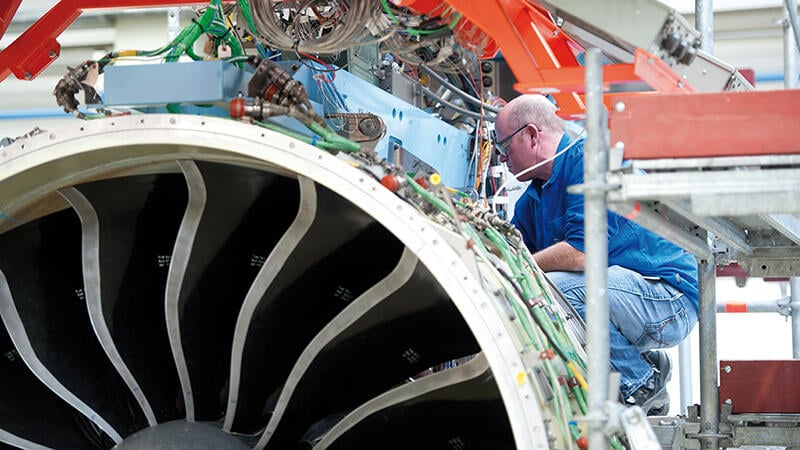
Pratt & Whitney PW1000G engines being inspected

Pratt & Whitney is in the third year of inspecting and upgrading its PW1000G engines.

Credit: MTU

Looking for a sure bet in 2026? Put your money on the commercial aftermarket’s continued strong growth.

From heavy airframe maintenance to parts sales, aftermarket service providers expect to be very busy in the coming year, as they have been for the last few. Overall commercial maintenance, repair and overhaul (MRO) sales growth in the high single digits is well within reach, and the engine market is trending even stronger. Older aircraft will continue to need work that was not forecast a few years ago as passenger demand remains strong, and the gap created by delivery shortfalls, while closing, remains large.

But some of the underlying trends that have boosted commercial MRO in the post-downturn years are changing. Aircraft production rates and deliveries are picking up, closing a capacity and efficiency upgrade gap that opened with the 2019-20 Boeing 737 MAX grounding and related delivery halt. This recovery is expected to help push some older aircraft out of service, which should bolster used serviceable materials (USM) stock. Overall maintenance demand is expected to ease as newer aircraft, which require minimal to no significant scheduled maintenance during their first few years, replace midlife and older models.

  • Macro factors are slowly shifting but not enough to alter 2026 landscape
  • Cost escalation joins labor and materials as main watch items

Boeing came close to 450 737 deliveries in 2025—the airframer’s highest total since 2018’s 580. Output from the 787 program is rising as well, and the long-awaited 777-9 is expected to be close to service entry by 2027.

Airbus revised down in early December its full-year delivery target for all commercial models to around 790. While not quite a record—the company has hit 800 twice—it would be an improvement on 2024’s 766.

Retirements should steadily increase, although the consensus is that the near-term peak will not come until the end of the decade. The proportion being retired is projected to top out at around 3% of the global fleet, equivalent to 1,200 airframes, Aviation Week’s latest forecast shows.

Production rate ramp-ups, increased deliveries and related initial spare parts provisioning, a slow reduction in older aircraft and a slower buildup of USM stock add up to one familiar theme: sustained pressure on part providers.

people working on aircraft maintenance
Airbus partnered with Indian provider GMR Aero Technic to open an aircraft maintenance training school in Hyderabad in 2024. Credit: GMR Aero Technic

PART SUPPLY & COSTS

Material-driven supply chain constraints have been one of the biggest headaches for the aviation aftermarket in recent years. That will not change in 2026. The constraints are loosening, but as one problematic part is crossed off the hard-to-procure list, another one is added.

Airlines, MROs, OEMs and suppliers are implementing new tactics to ameliorate inventory problems and gain operational resilience.

“The first thing is to map your supply chain, Tier 1 to Tier 4, and then analyze the risk and from there take proactive measures to qualify other suppliers,” Thyssenkrupp Materials Business Unit Solutions CEO Patrick Marous advises.

Boeing’s part distribution business, which supports both the company’s aircraft manufacturing and the broader civil and defense aftermarket, adopted this approach. “There are still a lot of categories where there is a single source,” says William Ampofo, senior vice president of parts and distribution and supply chain at Boeing Global Services. Because of that, a key part of the company’s strategy is introducing new capacity and alternative sourcing. “We’re trying to double down on it,” he says.

The single-source supplier is one of the biggest pain points for airlines, says Rohit Singh Tomar, VietJet Air’s director of finance and supply chain, noting that recent supply chain consolidation “has not improved the cost base.”

He points to a significant price difference between parts for mature aircraft versus new-generation ones. “On average, we are spending about a 35% premium on spare parts to maintain new-gen aircraft, which, if you start adding up components, engines and [auxiliary power units], becomes a significant number on a total operating cost basis,” Tomar says. Determining the right suppliers, “being able to identify what risk we can undertake and what is the cost to that risk” is the low-cost carrier’s biggest pain point, he adds.

Vietnam-based VietJet merged its material planning and procurement departments to make the whole process more efficient and to be more proactive in its supply chain.

Spanish carrier Vueling has grouped its 200 suppliers into three categories, based on functionality and spending level, to streamline its complex ecosystem of small suppliers, local providers, OEMs and MROs. “This helps evaluate [a supplier’s] real impact on operations,” says Leonardo Bruno, head of maintenance vendor management, noting that it “highlights the top and worst performance.”

Airline executives grumbling about MRO costs is nothing new. Post-downturn spare part price increases have given them even more reason to speak up. Many suppliers pointed to inflation as justification for heavy annual (in some cases, semi-annual) catalog price increases. Just as prevalent was the enticing opportunity to offset red ink elsewhere by leveraging must-have assets—spare parts for the most efficient and sought-after aircraft in the global fleet.

But the cost escalation is not limited to new parts and platforms. Engine MRO is projected to account for 53% of 2026’s total aftermarket revenue of $139 billion, compared with 49% in 2025 and 46% in 2024. Labor cost escalation explains part of the steady increase; the post-downturn labor shortage has forced airlines and MRO providers to hire and pay aggressively, and the nagging shortage of qualified technicians suggests this is more of a new reality than a short-term trend.

But the problem goes beyond shop floor staff. Overall MRO spending is up a projected 40% this year compared with 2019, while airline capacity is just 10% higher, AeroDynamic Advisory calculates (Inside MRO November, p. 41). The consultancy puts half of MRO spending on new material—the same inventory subject to annual price boosts. “For decades, MRO labor and material inflation was not a core issue for airlines,” AeroDynamic Principal Jonas Murby wrote in Inside MRO. “That has shifted—higher costs appear to be here to stay.”

ENGINE MRO

Among the calming headwinds is engine shop capacity. Some analysts expect the start of the worst of an engine MRO capacity crunch in 2026, particularly on popular models such as the CFM International CFM56 and International Aero Engines V2500. But narrowbody engine MRO suppliers are not forecasting a peak as much as a plateau.

CFM sees annual CFM56 shop visit volume topping out in 2026 at around 2,500 but does not expect it to fall much through the end of the decade. This reflects the enduring value of older variants of these engines, their V2500 counterparts and certain widebody models that have proved popular with operators looking to maximize engine life cycles. Combined with this, increasing numbers of newer-technology engines, such as the CFM International Leap and Pratt & Whitney PW1000 geared turbofan (GTF) models, are going in for shop visits earlier than anticipated.

OEM-led plans to address engine durability fixes will continue throughout the year and bring additional work to already-busy shops. At CFM, these include a high-pressure turbine durability kit and reverse bleed system to address fuel nozzle coking, or carbon deposit buildup, in the Leap-1A. The reverse bleed system has been installed on more than 50% of the affected fleet and will continue to roll out. Similar upgrades for the Leap-1B are expected to be available in 2026.

Pratt & Whitney is entering its third year of undertaking several upgrades to affected GTF engines. Its PW1000G-series contaminated powder metal fleet management program continues. More than 300 aircraft are expected to be grounded on any given day while engines undergo required inspections.

Meanwhile, Pratt is rolling out its Hot Section Plus upgrade for PW1100Gs. The kits, expected to be available in 2026, upgrade more than 30 parts to the soon-to-be standard GTF Advantage configuration, which is nearing production readiness.

The overall picture on engine lead times is mixed. While slightly improved as industry adjusts to supply chain woes, slot availability in shops could remain a challenge as airlines continue to outsource engine MRO to third-party providers. Independent specialists with quick-turn and hospital shop capabilities could benefit from some of this overspill of work. A shortage of much-sought-after spare engines in the market is also expected to continue in 2026.

After picking up speed over the past two years, 2026 should see further advancements in engine aftermarket networks across both the narrowbody and widebody segments. In the narrowbody sector, GE Aerospace and Safran, which form the CFM International joint venture, will play significant roles in growing current- and new-generation engine programs.

GE Aerospace will continue expanding and upgrading multiple MRO and component repair facilities, while Safran’s planned Leap engine facility in Morocco is slated to come on stream by 2026. Once operational, the site is expected to handle around 150 Leap engines annually. Safran’s Leap MRO shop in Hyderabad, India, is slated to come online in the new year, after opening on Nov. 26 following a €200 million ($232.6 million) investment. Once fully ramped up, the facility will target 300 engines annually, a mix of Leap-1A and -1B variants.

For widebodies, the year will start fresh off December’s opening of Rolls-Royce’s new engine joint venture with Air China in Beijing, operating as Beijing Aero Engineering Services Co. The site is the first facility on the Chinese mainland focused on the Trent engine and will service Trent 700s, XWB-84s and 1000s. The UK OEM has expanded capacity at its internal shops in Europe and its aftermarket joint-venture network, including a support facility in Derby, England, where it performs durability enhancements for the Trent 1000; modifications are set to continue in 2026-27.

WORKFORCE DEVELOPMENTS

New shops coming online while current ones are booked to capacity will keep pressure to find qualified aviation maintenance technicians (AMT) high. Airbus and Boeing expect the global MRO sector to need more than 700,000 new technicians by 2044, with demand particularly high in the Asia-Pacific region amid continuing growth. CAE says 416,000 new AMTs will be needed by 2034 as 83% of technicians retire or leave the industry in that period.

In the U.S., the Aviation Technician Education Council’s latest data shows AMT school enrollment grew in 2024 compared with the prior year. But the total number of graduates decreased by 5%, and the FAA issued 4% fewer new mechanic certificates. Stakeholders report that FAA workforce development initiatives are being sidetracked by governmentwide purging of advisory committees and the administration’s efforts to remove diversity, equity and inclusion from federal funding initiatives that help feed many programs.

Despite slow progress on closing the gap, companies continue to expand training partnerships and infrastructure to make a dent in the shortage. JetBlue Airways, United Airlines and others are growing career pathway programs. Several new Part 147 programs have launched over the last year, and Wichita-based WSU Tech invested $45 million to expand its aviation training center. Hawaiian Airlines, which has faced challenges due to a lack of local training infrastructure, partnered with local stakeholders in 2025 to develop new AMT training programs for high school and college students.

In Latin America, Embraer recently launched an MRO training program that it hopes to extend to other locations. During MRO Latin America 2025, executives of providers in the region predicted that Washington’s anti-immigration actions could draw AMTs recruited by U.S. MROs back to their home countries, which could boost the regional workforce.

Across the Pacific, major training investments are following the rapid growth of India’s aviation sector. Airbus and Boeing are supporting new training schools and programs, and Air India plans to open a new maintenance training organization in Bengaluru by mid-2026.

Farther east, Hong Kong and Japan have launched government initiatives to allow foreign nationals with MRO experience to join the domestic workforce. And Korea Aerospace University partnered with the U.S. Aviation Academy last year on a training course that allows its students to study abroad in Texas to prepare for FAA certification.

MROs in Europe continue to expand apprenticeship programs and tap international talent. However, stakeholders in the UK report that Brexit has created challenges in recruiting skilled AMTs from abroad. Interestingly, British Airways recently started a program in the U.S. to recruit students to train at its UK facilities before going on to work at the airline’s U.S. stations. Another European MRO leveraging international training cooperation is Vallair, which is working with the Cameroon Civil Aviation Authority to host bilateral student exchanges and collaborative training programs. Students also have started graduating from Namibia’s first aviation maintenance training school, launched by Signa Aviation Services and Westair Aviation in 2023, and the venture should help the country boost its domestic MRO labor pool. Vallair is working on a potential Saudi Arabia joint venture as well that would likely include a training school.

Middle East MROs continue to build up domestic training capacity. Saudia Technic’s long-term expansion plans in Jeddah, Saudi Arabia, include establishing an on-site training academy as part of an MRO village, and the company is partnering with Lufthansa Technik to develop a joint training program. Etihad Engineering and Joramco opened new technical training academies in recent years. At the Dubai Airshow in November, Etihad Engineering, GE Aerospace and Lufthansa Technik Middle East signed a deal to develop comprehensive maintenance training programs to boost the United Arab Emirates’ aviation workforce.

Sean Broderick

Senior Air Transport & Safety Editor Sean Broderick covers aviation safety, MRO, and the airline business from Aviation Week Network's Washington, D.C. office.

Lee Ann Shay

As executive editor of MRO and business aviation, Lee Ann Shay directs Aviation Week's coverage of maintenance, repair and overhaul (MRO), including Inside MRO, and business aviation, including BCA.

Lindsay Bjerregaard

Lindsay Bjerregaard is managing editor for Aviation Week’s MRO portfolio. Her coverage focuses on MRO technology, workforce, and product and service news for MRO Digest, Inside MRO and Aviation Week Marketplace.

James Pozzi

As Aviation Week's MRO Editor EMEA, James Pozzi covers the latest industry news from the European region and beyond. He also writes in-depth features on the commercial aftermarket for Inside MRO.