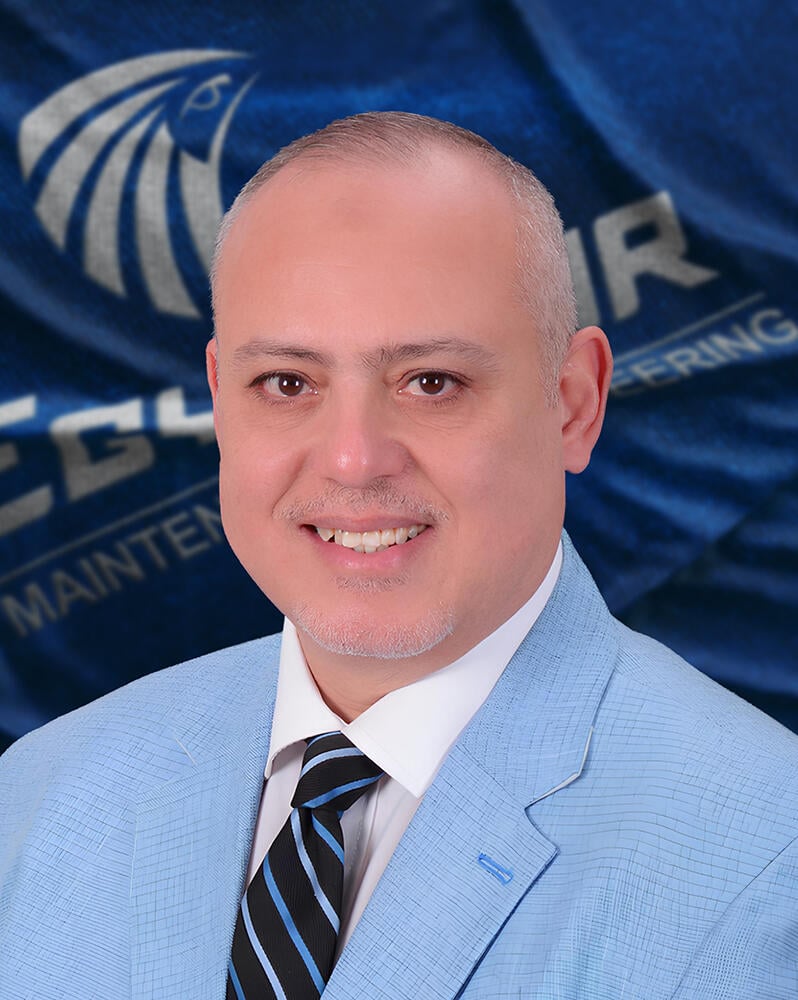
EgyptAir Maintenance & Engineering appointed Mohamed Samy as chairman and CEO in February. With his background in quality oversight, safety management and international accreditation, Samy’s arrival signals a shift in leadership style for EgyptAir’s MRO arm. He spoke with Aviation Week about his plans to increase third-party work and build on technical capabilities to sharpen the company’s competitiveness and support long-term operational growth.
How will your quality and safety background shape EgyptAir Maintenance & Engineering’s (M&E) global growth strategy?
My objective is to transform safety compliance from a cost center into a competitive, high-value differentiator. A safety-first approach directly enhances reliability, reduces turnaround time bottlenecks and secures the long-term OEM partnerships essential for growth.
Our strategy focuses on four key pillars. We are moving beyond baseline compliance toward a matured safety management system that integrates advanced hazard identification and risk management. Central to this is a non-punitive reporting culture that empowers every employee to identify risks early, ensuring safety is a shared responsibility. We are implementing uniform, high-level quality management systems across all organizational functions to guarantee consistent service excellence. Simultaneously, we are conducting rigorous quality audits of our supply chain to ensure that global parts shortages never compromise our rigorous safety standards.
By leveraging artificial intelligence (AI) driven diagnostics and predictive maintenance, we provide proactive care for aging fleets—a primary driver of current market demand. Furthermore, our digital transformation initiative is transitioning the organization to a fully paperless environment to increase precision and efficiency. Lastly, we are investing heavily in upskilling our personnel in digital literacy and AI tools to meet the demands of modern aviation. By addressing competent personnel retention and empowering staff at all levels to voice safety concerns, we are cultivating a sophisticated, quality-focused culture that is prepared for future challenges.
How do you plan to accelerate third-party business while reducing reliance on EgyptAir’s in-house fleet?
We can realize this by properly understanding third‑party needs, EgyptAir’s fleet requirements and continuously assessing both available and anticipated resources. These inputs are consistently built into planning for strategic growth and market positioning to maintain and expand third‑party business. We aim to achieve these goals by focusing on expanding our engine MRO and overhaul capabilities, utilizing a 'hub-and-spoke' model to capture regional demand and leveraging our safety standards to secure long-term agreements with OEMs that prioritize trusted, high-compliance partners.
EgyptAir M&E recently highlighted a rare Boeing 737 “pickle fork” repair capability. How does that reposition the company in the global MRO market?
The 'pickle fork' is a high-strength structural component critical for managing the torque and aerodynamic stresses between the wing’s main spar and the fuselage. Successfully performing this complex replacement proves that we have the technical precision to handle the industry's most demanding structural repairs. This capability elevates our standing among the world’s leading MROs, demonstrating that we can meet the highest technical standards required by global operators.
What is your strategy to commercialize this high-complexity structural repair capability?
With a vast number of Boeing 737NG aircraft worldwide, there is a surge in required airworthiness directive inspections for pickle fork frames. Our strategy is to market this proven expertise to operators across the globe, with a specific focus on the Middle East, offering high-quality structural repairs and competitive turnaround times. This milestone serves as a technical benchmark, showing that we are fully equipped to handle similarly complex modifications across various aircraft models.
What advanced capabilities are next as you build on this milestone?
Building on this momentum, we are prioritizing strategic investments in engine maintenance services and specialized certifications. Our immediate expansion road map includes developing full maintenance capabilities for next-generation aircraft, specifically the Airbus A350, the Boeing 787 and the Boeing 737 MAX. By focusing on these modern platforms, we ensure that our technical offerings evolve alongside the fleets of our global partners.

Related Content