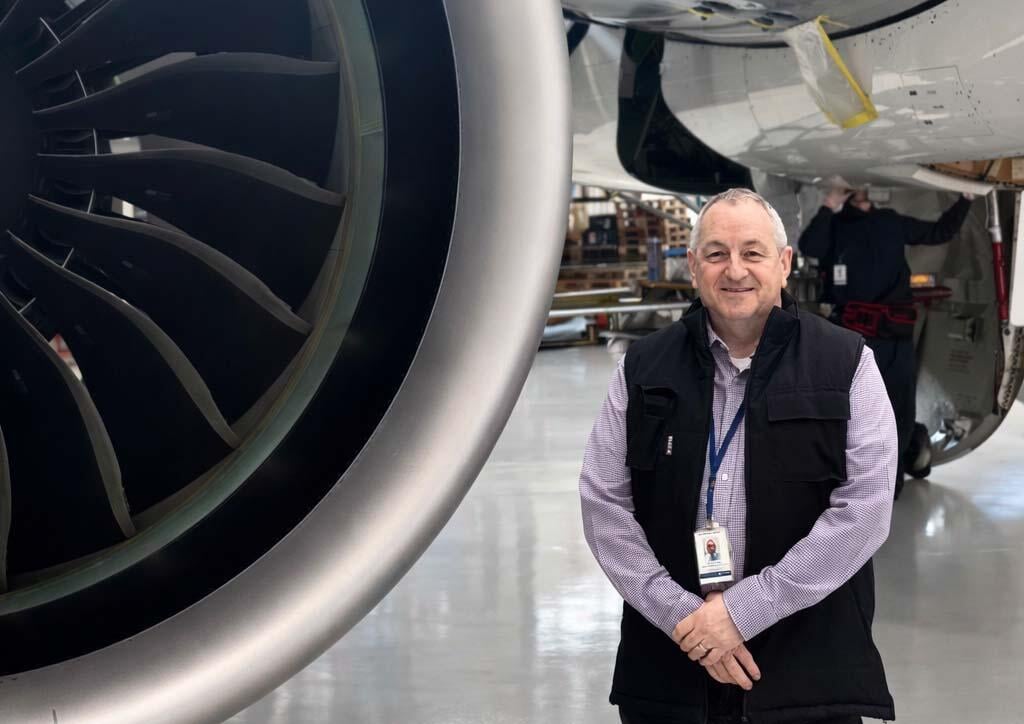
Robert Dando, technical director at Air Astana.
Air Astana recently hit a major milestone with its 50th in-house C check. With both its Astana and Almaty facilities in Kazakhstan now handling all Airbus A320-family C checks internally, the carrier has shifted from outsourced heavy maintenance to full control of its fleet’s reliability, backed by a growing team of European Union Aviation Safety Agency (EASA)-certified engineers. Aviation Week spoke with Robert Dando, Air Astana’s technical director, to unpack what this means for capacity, investment and labor force planning.
How has internalizing all A320 C checks changed costs, turnaround times and control over maintenance?
Bringing C checks in-house has delivered measurable cost savings compared to outsourcing while giving us greater flexibility in fleet planning. We can adjust maintenance slots to align with operational needs, extend aircraft in service when required and optimize downtime accordingly. Our turnaround times are competitive, and we continuously review performance to improve efficiency without compromising safety or quality.
What is your current hangar capacity and throughput, and where are operational bottlenecks?
In Astana, we can run two C check lines simultaneously, while Almaty supports one additional line when needed. Astana is our primary MRO base, approved by EASA and the Aviation Administration of Kazakhstan for all A320-family checks, including 12-year (D) checks and six-year inputs.
Current bottlenecks are linked primarily to Pratt & Whitney engine-related aircraft storage cycles, which compress maintenance planning when return-to-operation timelines coincide with scheduled C1 checks. In those cases, Almaty provides overflow capacity to ease pressure on the main lines.
Are you planning to offer third-party MRO services, and what approvals would be required?
At present, our capacity is fully utilized by Air Astana and FlyArystan aircraft. However, we are constructing two additional hangars in Astana and one in Almaty to support fleet growth and the induction of the Boeing 787.
Once that capacity comes online, third-party MRO services become a possibility. We hold EASA and national approvals for the A320 family, but additional customer and regulatory approvals would be required, typically through an audit process.
How are you developing and retaining EASA licensed engineers?
We launched an in-house apprenticeship program three years ago to support long-term workforce needs. Apprentices are employed full-time and trained to EASA Part 66 and Part 147 standards, graduating with both national and EASA licenses.
Existing staff are also supported through structured self-study programs to obtain EASA certification, strengthening our internal capability as the fleet and MRO footprint expand.
Are you expanding into deeper maintenance, such as structural modifications or D checks?
We already perform 12-year D checks in Astana and have established a dedicated structural repair team capable of handling structural modifications, component replacement and repairs.
From a technical standpoint, we are building the capability to perform the full spectrum of maintenance and modification work required by our fleet strategy.

Related Content