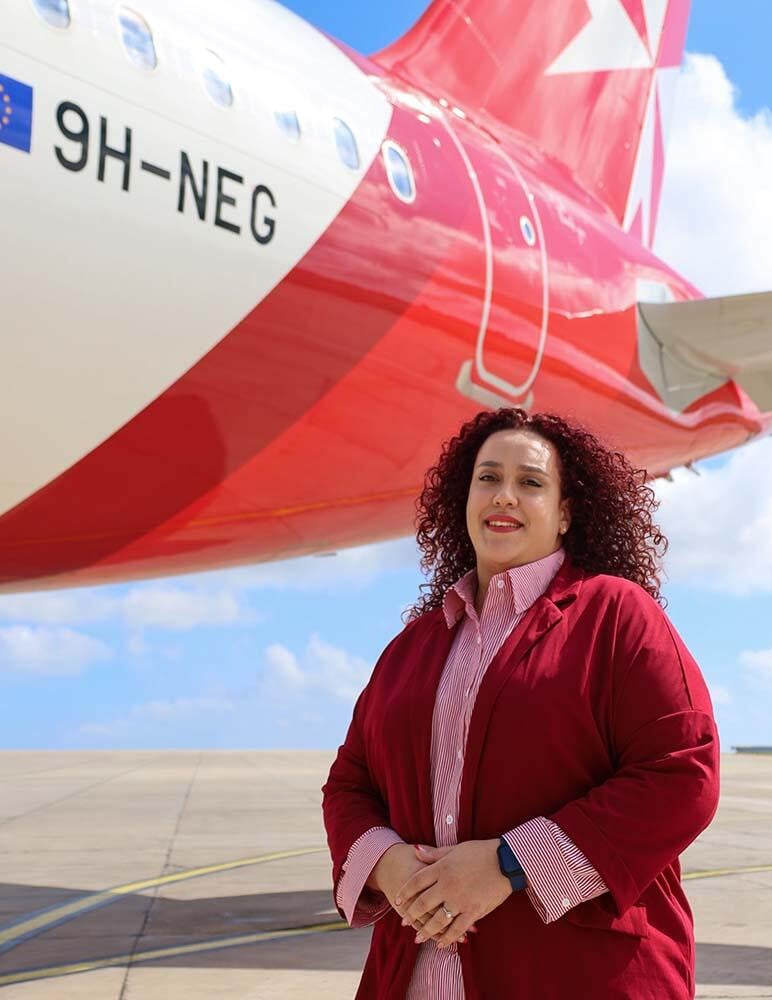
Marija Macelli, head of procurement and logistics
KM Malta Airlines is emerging as a dynamic operator in the Mediterranean with an all-Airbus narrowbody fleet. Marija Macelli, head of procurement and logistics, spoke with Aviation Week about the airline’s approach to fleet support, component strategy and participation in industry-wide pooling and technical initiatives, offering a first look at how the airline is positioning itself within the wider aviation maintenance and aftermarket landscape.
KM Malta Airlines launched as a successor to Air Malta. How did that transition allow you to rethink your MRO and aftermarket strategy from the ground up?
The launch of KM Malta Airlines provided a genuine opportunity to reset and modernize our MRO and aftermarket strategy from a clean-sheet perspective. While we built upon the aviation expertise and foundation established by Air Malta, we were able to redesign our technical and procurement framework to match today’s operational realities. The transition allowed us to rebuild supplier relationships, implement disciplined performance monitoring and establish long-term agreements that prioritize reliability, resilience and operational continuity.
Operating a streamlined fleet of eight Airbus A320neos gives us significant structural advantages. A single-type fleet simplifies maintenance planning, supplier alignment, training requirements, inventory forecasting and reliability tracking. From a procurement standpoint, this enables tighter contract negotiation, improved forecasting accuracy and stronger cost control.
How much maintenance capability are you keeping in-house versus outsourcing?
We retain all line maintenance capability in-house. This is a deliberate strategic decision, as it ensures direct operational control, rapid decision-making and protection of our daily schedule integrity. Additionally, we have agreements in place to provide turnaround and transit checks for other airlines operating into Malta, further strengthening our in-house technical capability and presence at [our] base.
With regard to base heavy maintenance and specialized services, these are outsourced through long-term MRO partnerships and contractual agreements. The long-term nature of these agreements provides stability, structured planning, predictable capacity allocation and cost visibility. This hybrid model allows us to maintain strong internal technical oversight while leveraging established external expertise for capital-intensive and complex maintenance inputs.
As a relatively small narrowbody operator, how do you balance owning rotable inventory versus accessing it through pooling and power-by-the-hour programs?
For an airline of our size, the balance between ownership and access is critical. Most of our rotable components are covered through a pooling agreement, providing broad access to inventory support and reducing exposure to unpredictable removal events. Pooling ensures availability without requiring excessive capital commitment or storage burden.
At the same time, certain rotables are selectively owned or kept in stock based on operational criticality, removal rates and reliability data. This selective ownership enhances control where performance history justifies it.
This balance is continuously reviewed using reliability statistics, removal trends and operational performance metrics to ensure we maintain strong technical dispatch reliability while avoiding unnecessary inventory expansion.
How do you balance tight cost discipline with the need for operational resilience in today’s constrained supply chain?
Cost discipline remains essential, but resilience has become equally important. Supplier evaluation is conducted on multiple criteria: reliability, aviation approvals, financial stability, repair capability, turnaround performance and overall operational resilience. In the current supply chain environment, proactive procurement is fundamental. Avoiding AOG situations as much as possible requires forward planning, careful forecasting and disciplined ordering decisions. It is not about purchasing more, but about purchasing wisely.
Our internal statistics clearly show a reduction in AOG-related orders. This has contributed to improved efficiency, fewer technical delays and higher technical dispatch reliability. When required components are already in stock, we directly see improved on-time departure performance and reduced turnaround time. Resilience today is driven by data visibility, structured supplier partnerships and proactive materials management rather than reactive purchasing.
As host of the 133rd International Airlines Technical Pool (IATP) conference, how important is collaborative pooling to KM Malta Airlines’ technical strategy?
Our support of the 133rd conference of the IATP reflects the importance we place on technical collaboration within the global airline community. IATP membership plays a meaningful operational role in our strategy. Beyond standard pooling support, it provides us access to the aircraft recovery equipment pool, which is particularly critical for an island-based carrier. In irregular or recovery scenarios, that network access becomes operationally significant.
For KM Malta Airlines, collaborative pooling is embedded within our resilience framework. It strengthens industry relationships, enhances AOG response capability and supports operational continuity, all of which are essential to maintaining the standards expected of a national carrier.

Related Content