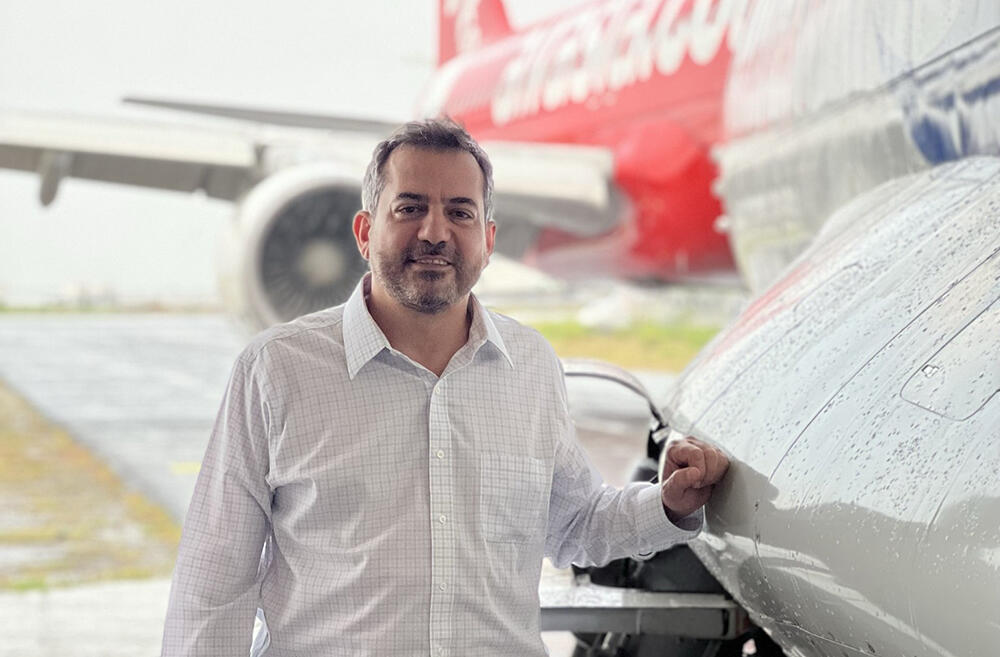
Philippines-based Dornier Technology recently received FAA approval to perform heavy maintenance on Airbus A320-family aircraft. CEO Nikos Gitsis spoke with Aviation Week Network about the certification’s significance and how it will shape the company’s expansion plans.
What does FAA certification mean for Dornier Technology’s global ambitions, and how do you plan to leverage it?
This certification confirms that we are at par with global standards and ready to enter the narrowbody regional MRO market. It significantly enhances our scope and capabilities, enabling us to work on aircraft that require FAA certification. Many of the world’s largest aircraft lessors require FAA certification from the MROs that service their aircraft. A large percentage of their aircraft are leased to operators in the Asia-Pacific region. Our newly granted FAA certification allows us to target these airlines.
How are you preparing your workforce and infrastructure to handle the expected increase in demand from U.S.-registered aircraft?
We are already a certified line and base maintenance facility for narrowbody aircraft, recognized by the civil aviation authorities in the Philippines, Korea, Myanmar, Indonesia and now the FAA. We have successfully completed 75 heavy maintenance checks for clients such as Cebu Pacific and Air Asia. Currently, we are focused on enhancing our capabilities through personnel training, quality processes, acquiring additional equipment to improve operational efficiency, accelerating digital transformation initiatives and expanding our leadership team to ensure effective oversight and sustainable growth.
What was the strategic rationale behind expanding Dornier Technology’s facility at Clark International Airport? What demand signals are you responding to?
With Bulacan Airport [New Manila International Airport] set to open within the next three years, and Manila continuing to serve as a major aviation hub, Clark Airport is strategically positioned for MRO growth. Its proximity to both Manila and Bulacan, well-developed infrastructure, available space for expansion, seamless customs processes and strong MRO support from airport management make Clark a key location for future development. Our group has been here at Clark since 1995.
Why do you believe the Philippines is emerging as a competitive MRO hub in the Asia-Pacific region?
The growth of major carriers such as Philippine Airlines and Cebu Pacific is expected to significantly drive demand for MRO services in the Philippines. Currently, MRO slots in the country are limited, leading these airlines to send their aircraft for heavy maintenance checks abroad. Clearly, there is strong demand, and we believe very much in developing home field capability for local carriers.
We think a strong, independent MRO will benefit the local carriers and give them an edge in their maintenance requirements. Both carriers, Cebu Pacific and Philippine Airlines, are advocates of nation-building, and we expect that they will support local MRO development with their expanding fleets. Workforce-wise, the Philippines remains a global source of skilled MRO labor. Clark Airport’s MRO- and investor-friendly environment further strengthens the country’s position as a competitive MRO hub.
What trends are you seeing in narrowbody fleet maintenance demand across the Asia-Pacific region, and how are you positioning the company to meet that?
We will continue to expand our facilities to support additional maintenance lines and grow our domestic line maintenance stations. We are also committed to developing a robust pipeline of skilled workers through the Dornier Academy. Through partnerships with universities, we aim to bridge the gap between academia and industry by providing specialized, hands-on training that equips aviation maintenance technician graduates with the skills needed to be job-ready upon graduation.
We plan to invest in new technologies that will help us save valuable labor-hours and improve accuracy, compared with traditional methods.

Related Content