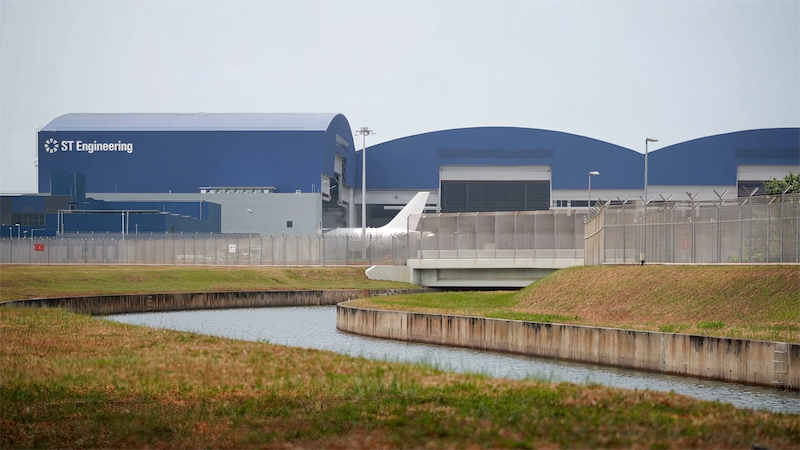
ST Engineering's Changi Creek, Singapore, facility.
SINGAPORE—ST Engineering has opened its new Changi Creek maintenance, repair and overhaul (MRO) facility, a four-bay widebody hangar designed to serve as a testbed for future technologies.
Located north of Changi Airport (SIN), the SG$170 million ($132 million) investment spans 84,000 m2 (904,000 ft.2), including 19,914 m2 of hangar space. It is ST Engineering’s second-largest facility in Singapore.
The four widebody bays include a hybrid painting and maintenance bay capable of supporting line and heavy airframe maintenance for Airbus and Boeing aircraft, including the A330, A350, 767, 777 and 787. The company also has plans to undertake aircraft conversions if demand warrants additional capacity.
The first two bays began operations in May 2026, initially inducting a Japan Airlines aircraft, followed by aircraft from Singapore Airlines, Atlas Air and Air India. The remaining bays are scheduled to open progressively by the end of 2027.
Changi Creek is also intended to serve as a platform for deploying and validating new technologies. These include using drones to inspect aircraft upper surfaces and autonomous cameras to inspect engine nacelles, landing gear and auxiliary power units.
ST Engineering, working with Singapore’s national research agency A*STAR, has also introduced an automated storage and retrieval system. Alphabot robots retrieve parts and transfer them to autonomous mobile robots, which then deliver the components to the relevant maintenance bays.
The company expects the system to save about 8,000 labor hours and reduce the distance technicians travel to retrieve parts by 20,000 km (12,400 mi.) annually.
Another autonomous application is the AI-Fast vehicle, which can transport components weighing up to 500 kg (1,100 lb.) within the hangars.
Kevin Chow, ST Engineering’s commercial aerospace president, says the combined technologies could deliver long-term productivity improvements of 25%, encompassing labor and cost savings as well as shorter turnaround times.
Chow says the company is adopting a more agile approach to technology deployment. Rather than relying on master plans developed years in advance, it is working in three- to six-month blocks, with the aim of scaling successful technologies across its global network within one to two years.
ST Engineering expects Changi Creek to increase its annual widebody MRO capacity in Singapore by 40%, or about 100 aircraft. However, that projected increase is contingent on the eventual closure of its Paya Lebar facility, which is scheduled for the 2030s.
Chow says airframe MRO capacity is dynamic and that ST Engineering could increase capacity at other overseas facilities as needed, leveraging its global network to respond to changes in demand.

Related Content