This article is published in Aviation Week & Space Technology and is free to read until Oct 10, 2026. If you want to read more articles from this publication, please click the link to subscribe.
As Pratt & Whitney transitions new production to the Advantage configuration, it will soon offer upgrades for in-service engines.
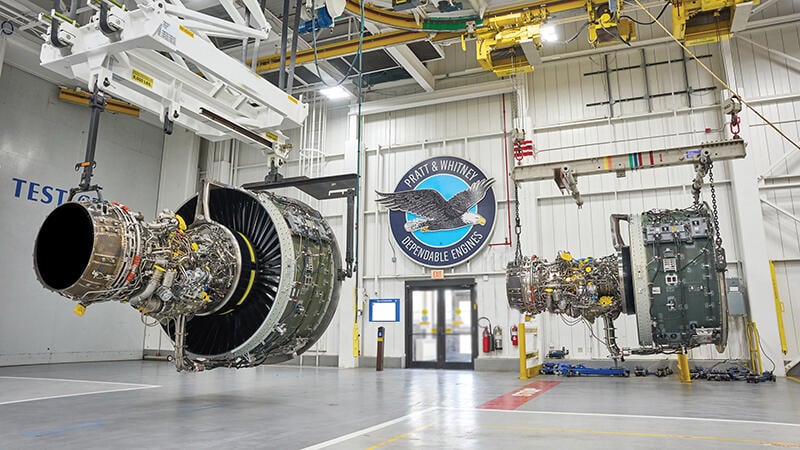
Pratt & Whitney is manufacturing the first batches of its PW1100G geared turbofan hot section upgrade kit in anticipation of earning regulatory approval for the current configuration in the coming months and sending the first units to repair stations.
“It will be rolled out into the market starting simultaneously to certification, effectively,” Pratt & Whitney Commercial Engines President Rick Deurloo told reporters at the company’s engine assembly facility in Middletown, Connecticut.
Kit allocation is to be based in part on customers’ operating environments. The company plans to prioritize airlines that fly regularly in harsh conditions, such as desert regions or areas with low air quality.
“I’m not going to have it for every shop [initially],” Deurloo said. “We’re going to look at our most harsh environments and put it in there first, and then over time we’ll incorporate it within the fleet.”
The kit, announced at the 2025 Paris Air Show and branded Hot Section Plus, installs about 35 hot section parts developed for the Advantage geared turbofan (GTF) variant into in-service PW1100Gs. Recently certified for the Airbus A320neo family, the Advantage is designed to double on-wing life compared with the most updated pre-Advantage-standard PW1100Gs. The updated baseline PW1100G includes a series of durability improvements rolled out in recent years, in part to address challenges in harsher environments.
Pratt anticipates that most customers will opt for Hot Section Plus as it becomes available. But Deurloo said a few may conclude the latest PW1100G standard already meets their needs.
The Advantage—expected to enter revenue service on new A320neo-family aircraft before year-end—and the upgrade kit are planned to bolster the GTF program’s recovery. Inspections and reduced life limits on parts at risk of containing noncompliant powder metal have disrupted GTF operators since late 2023 (Inside MRO September 2024, p. 16). But average daily aircraft-on-ground numbers have slowly fallen below the 350-airframe mark. The company’s original plan saw that level enduring through at least year-end.
With the GTF inspection program trending positively, the company can focus on other aftermarket priorities. At the top of the list is speeding up turnaround times (TAT).
In June, Pratt unveiled its acquisition of artificial intelligence (AI)-enabled engine inspection specialist Aiir Innovations. Aiir’s software analyzes borescope video and flags possible problems for further evaluation based on its database of confirmed issues. The results both shorten engine inspection analysis time and help engineers zero in on possible problems.
“Using AI, you get faster responses, more predictable responses, more consistent responses,” Deurloo said. “As MRO shop visits happen, parts get dispositioned, and an engineer is looking at that hardware. How do you use AI to disposition those parts faster and with more predictability and consistency?”
While faster shop-floor processes help get engines back on wing sooner, the largest headwind is material availability. On current-generation engines, such as the PW1000G, manufacturers allocate parts between the assembly line and MRO shops. Production-rate increases and in-service problems that require spare parts make the juggling act tougher. The PW1000G inspections see TATs of 250-300 days, roughly split between waiting for an open slot and time on the shop floor.
Pratt has been focused on reducing time spent on the shop floor, which will cut induction wait times and overall TAT further.
For the first six months of 2026, total PW1000G overhauls were up 43% year over year, the company said, without providing raw figures. A 23% reduction in shop-floor TAT was the primary driver.
“We continue to ensure that we have strong material flow into our MRO shops,” Chris Calio, president of Pratt & Whitney parent RTX, said on a July earnings call. “We’ve got to continue to keep our MRO network in a very, very strong material position.
“Our goal here, our objective, is to continue to drive this network to consistently achieve that 90-day-or-below turnaround time,” Calio said. “We need material flow in order to do that, right? We need all 15 of [our PW1000G] shops hitting that mark at that standard so we can continue to make this a well-oiled machine in our aftermarket network.”