This article is published in Aviation Week & Space Technology and is free to read until Oct 01, 2026. If you want to read more articles from this publication, please click the link to subscribe.
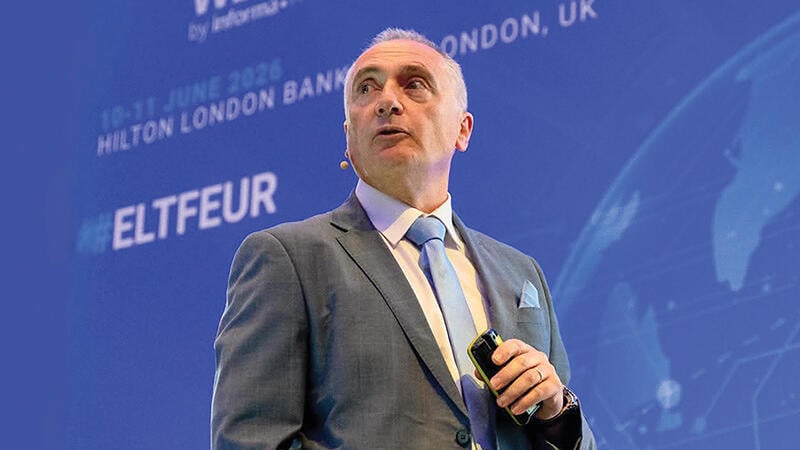
ELFC President and CEO Richard Hough discussed the effects of higher engine MRO costs on a variety of factors
at ELTF Europe.
A combination of spiking maintenance costs, tight engine supply and shifting asset values is reshaping investment decisions across the commercial MRO segment. Discussions at Aviation Week’s Engine Leasing, Trading & Finance Europe show in London in June highlighted how those pressures more frequently influence not only engine leasing and financing investment decisions on current- and new-generation platforms, but also more broadly affect aircraft values, teardown decisions and the pace of the transition to new-technology engine types.
ENGINE ECONOMICS
One of the main themes at Engine Leasing, Trading & Finance Europe (ELTF) was how decisively engine economics drive the wider commercial aircraft market. During his keynote address, Richard Hough, CEO and president of Irish lessor Engine Lease Finance Corp. (ELFC), linked escalating maintenance costs to the growing concentration of aircraft value in engines and, increasingly, the economics of dismantling aircraft relatively early in their life cycles.
At the heart of his point was the rising cost of maintaining newer-generation narrowbody engines. He said much of the operating cost benefit promised by the newer technology, particularly through fuel burn savings, is being offset by elevated maintenance costs, shorter shop intervals and reliability problems in some programs. “The majority, possibly all, of the fuel-burn benefits of new narrowbody aircraft have been eaten up by maintenance costs,” Hough said.
Using a simplified comparison, he suggested that a 20% fuel-burn improvement could translate into a roughly 5% overall benefit in aircraft operating costs. If engine maintenance costs are about two-thirds higher on a per-flight-hour basis, approximately 3.75 percentage points of that gain could be absorbed by maintenance alone. That calculation does not include the additional disruption associated with engine removals, reliability issues and aircraft-on-ground events.
Those increased maintenance costs are also changing engine values. Hough estimated that maintenance condition and life-limited-part (LLP) value can now account for roughly two-thirds of the total value of some latest-generation engines, compared with less than half for previous-generation engines at a similar stage of maturity. For investors, this means a greater share of asset value is tied not simply to the engine itself but to its maintenance, too.
That shift is also influencing decisions at the aircraft level. With engines accounting for such a large proportion of total asset value, the economics increasingly favor separating the powerplants from relatively young airframes rather than keeping the aircraft intact. Hough said that if the engines attached to an aircraft can generate more value independently than the aircraft can as an operating asset, early teardown could become economically rational. According to ELFC data shared in June, about 65 Pratt & Whitney PW1100G-powered Airbus A320neos have already been parted out or are committed to teardown, which could potentially release about 130 engines into the market.
VALUES = FINANCE APPEAL
Engine financing is moving from a specialized aviation niche toward more mainstream investors attracted by higher engine values, stronger liquidity and expanding investor familiarity.
With noticeable growth in available capital for assets in the engine leasing sector, the consensus is that powerplants are becoming an ever-growing priority for investors. “These were inherently a more niche asset, and they were seen as secondary to the whole aircraft,” said David Archer, vice president of asset valuations for Europe at MBA Aviation, noting that perception has shifted over the past decade. “Through COVID-19 and the recovery, where we’ve seen the bottlenecks driven by engines, the demand for engines—the escalation behind it and also an education of the market and investors—has made them a far more liquid asset.”
Supply chain disruptions and new-engine durability issues have accelerated that shift. Arnaud Fiscel, deputy head of corporate banking at the Bank of China, noted that increased requirements for spare capacity, production constraints and new-generation engine teething issues have encouraged lenders to diversify past traditional aircraft financing. “We’ve seen a migration in terms of appetite from lenders, but similarly from airlines and OEMs,” he said. “Many lenders have seen that perhaps you need to diversify away from aircraft to get into an asset class such as engines.”
ELTF Europe participants cited higher engine values as another important driver as investors increasingly look at engine assets. “The valuation ticket now is at a size that it’s generating more and more interest from external third parties,” said Stephen O’Dwyer, chief commercial officer of Amsterdam-based SMBC Aero Engine Lease. “New engines [are] running $20-25 million. . . . That really is a ticket size that investors can look at.”
Aircraft lessors are also entering engine leasing more and more as a greater share of aircraft value becomes concentrated in powerplants. “That’s really bringing more investors into the space, and that’s bringing investors used to looking at midlife aircraft . . . down into the engine space as well,” he added.
The financing base for engines is widening, too, noted François Soldan, director of structured lending at German investment financier Bayerische Landesbank. Soldan pointed to growing participation of credit funds, Japanese investors and other alternative capital providers in the segment alongside traditional banks.
“There’s more capital beyond the standard institutional banks coming into this market and bringing more depth into it,” he said. Potential exists for capital-market structures to develop further as the market becomes easier for financiers to understand, he noted. “There’s also a standardization and harmonization of the products. . . . It’s easier to read for the financiers, which are less specialist than the lessors themselves.”
LESSORS REPOSITION
Engine lessors remain confident in mature assets but are becoming more selective when balancing returns on those engines against exposure to new-generation assets.
Dan Coulcher, senior vice president of joint ventures at Willis Lease Finance Corp., said demand for CFM International CFM56 and IAE V2500 engines in the narrowbody segment remains healthy. At the same time, supply is constrained—he added that Willis is “very confident over the coming years there’s going to be plenty of demand.”
Darren Reilly, vice president of portfolio at ELFC, echoed that point. He said the spare engine leasing specialist has very few genuinely idle engine assets, while operators’ lease extension activity remains strong. “The majority of assets are extending, and we see that continuing for at least the next 18-24 months,” he said. “We are reinvesting in terms of extending the life of our legacy fleet, . . . doing module swaps to support the airlines with more capacity.”
Strong demand does not necessarily make reinvestment in engines straightforward. High material and shop visit costs mean lessors must increasingly weigh the economics of another major workscope against an asset undergoing a full part-out. Coulcher said Willis remains willing to invest in existing assets but is cautious about using today’s elevated lease rates to justify long-term spending decisions. “It’s a debate we’d always have internally as to where to spend money,” he said.
High material and shop costs are prompting greater caution regarding full reinvestment. Reilly noted that while ELFC is reinvesting to extend the life of legacy assets by using module swaps to provide airlines with additional capacity, an extensive shop visit can exceed $8 million once new LLP requirements are included.
That leaves lessors weighing current lease-rate strength against residual values several years into the future and, in some cases, considering part-out rather than another major repair workscope. Reilly identified potential longer-term risks behind reinvestment costs. “In the current market, you can achieve a rental that would make sense for that, but . . . you’re going to hold that asset for another 8-10 years,” he said. “When you go to part it out in 8-10 years . . . what’s your residual value? All those considerations need to take place.”
Tom Robertson, managing director of the aircraft credit department at Sumitomo Mitsui Finance and Leasing, suggested that the expected transition point from legacy to new-technology engines has shifted. “We’re all trying to guess where the inflection point may be,” he said. “The fact that that’s sliding to the right, I think, as a lessor, we, practically speaking, take comfort from that.”
He linked this occurrence to market pricing and demand. “All of that suggests that we have some pricing stability, and demand is going to remain high for some time to come,” he said. Ultimately, it is scarcity of engines, particularly newer models, that is changing what airlines require from lessors. “The actual financing is not what they’re looking for, because everybody in the market can provide them,” Robertson added. “It’s the physical metal.”
Laurens Scheipers, head of portfolio management at MTU Maintenance Lease Services, added that portfolio decisions are directly linked to MRO demand. “We tear down our assets to supply the material to the MRO group and make sure we can get the engines out of the shop,” he said. “That is goal No. 1.” At other times, Scheipers said the MRO will seek to create additional green time on an engine to justify redeployment when market values are high.