This article is published in Aviation Week & Space Technology and is free to read until Oct 14, 2026. If you want to read more articles from this publication, please click the link to subscribe.
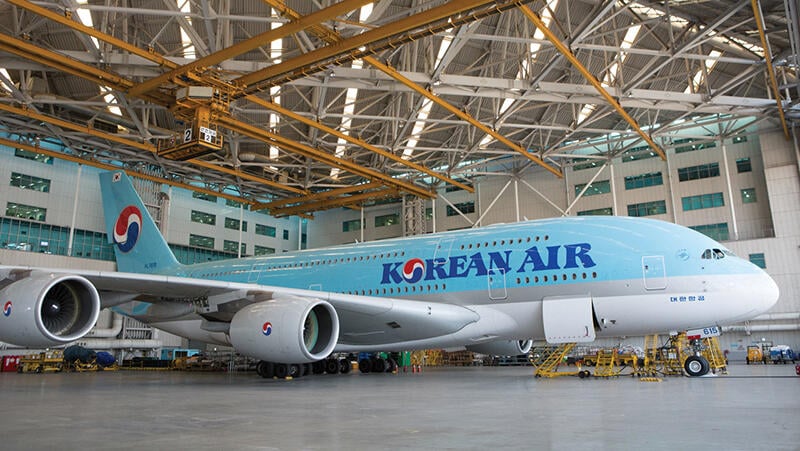
Korean Air recently introduced capability for 12-year checks on Airbus A380 aircraft.
As Korean Air occupies itself with the massive undertaking of integrating with Asiana Airlines, the realities of the global supply chain and a capacity shortage are forcing the flag carrier to expand its own capacity and use third-party MRO services as a new source of revenue.
In July, a Korean Air (KAL) Airbus A380 rolled out of its hangar at Incheon International Airport in Seoul, completing a four-month-long 12-year check—a new capability the flag carrier has introduced into its Maintenance and Engineering unit.
Chan Woo Jung, senior vice president and head of Korean Air’s Maintenance and Engineering division, says constrained global MRO capacity and a scarcity of international heavy maintenance slots has presented a “material operational risk” to its super-jumbo aircraft fleet.
While slot negotiations for heavy maintenance typically commence 1-2 years prior to induction, securing widebody base maintenance slots has become increasingly difficult due to constrained capacity across East and Southeast Asia. This is especially true for the A380, as very few hangars globally can accommodate the type, and only a select few MRO providers have the capability to perform the highly complex 12-year check.
“This operational shift prevents capital outflow from outsourced maintenance, maximizes aircraft utilization by mitigating [aircraft-on-ground] risk and secures independent engineering expertise across the entire superjumbo airframe,” Jung says.
The capability integration took three months. KAL first established a dedicated task force under Maintenance and Engineering to construct the process plan. The airline then allocated a bay at its Incheon hangar for four months and procured over 400 types of specialized tools and materials.
To navigate global workforce constraints, KAL coordinated with Airbus and specialized maintenance vendors, which integrated approximately 100 global maintenance technicians with internal engineering staff as a single unit.
The checks covered 2,000 major structural inspections and airworthiness directive and service bulletin tasks, resolving 1,340 nonroutine defects.
Given the global scarcity of A380 heavy maintenance facilities, Jung says the newfound capability might enable the company to find new opportunities. KAL is also planning to bid on high-value third-party contracts for global A380 operators and next-generation widebodies such as the Boeing 777X.
Aviation Week Fleet Discovery data shows that 12 of the 32 in-service A380s in the Asia-Pacific region are reaching the 12-year mark.
On other airframes, KAL plans to build on its Boeing 787 composite wing and stabilizer repair and painting expertise, extending these capabilities to the incoming A350 fleet. Similarly, the carrier plans to commercialize these services for the broader MRO market.
Meanwhile, KAL is building a new engine maintenance cluster in Incheon’s Unbuk district. With 600 billion won ($580 million) invested, the 140,000-m2 (1.5 million-ft.2) facility is on schedule to be completed late this year, with full operations beginning in 2027. Supporting infrastructure, such as the second engine test cell, was completed last year, giving KAL the capability to test engines up to 150,000 lb. of thrust.
KAL intends to double its engine maintenance portfolio to 12 platforms from six—Pratt & Whitney PW4000-94/100/112 and PW1100G, CFM International CFM56-7B, and General Electric GE90—adding next-generation engines including the CFM Leap, GE Aerospace GEnx and Rolls-Royce Trent XWB. Annual throughput is expected to nearly quadruple to 500 engines from 130.
The new maintenance complex is planned to streamline operations by consolidating shops for components, disassembly, assembly and testing into a single, centralized site, creating Asia’s largest engine maintenance hub.
Jung says that KAL is finalizing memoranda of understanding and formal agreements with global OEMs, major aircraft lessors and Asia-Pacific carriers, with discussions for forward bookings actively underway. The company aims to increase its third-party engine maintenance share to 70% from 25% by 2030, boosting annual revenue in the sector to over $3 billion by the end of the decade.
One milestone will be the integration with Asiana, which is set to be finalized by year-end. The merger will result in a fleet of approximately 230 aircraft—not including around 60 from low-cost carrier subsidiaries—and 4,500 maintenance personnel.
“We are currently consolidating operations across organizational structures, systems and technical facilities,” Jung says. “Post-integration, our focus will center on operational stability under a centralized maintenance system, alongside large-scale cabin retrofits and Starlink deployment. To drive seamless cultural and procedural alignment, we are actively conducting direct personnel exchanges between both teams.”
In the digital domain, KAL is constructing a next-generation MRO data platform that converges flight and maintenance data from both airlines into a unified cloud environment. This infrastructure supports profitability analysis, artificial-intelligence-enhanced workflow optimization, inventory management, used serviceable material circulation and predictive maintenance analytics. The system is to be deployed post-integration to centralize operations.