This article is published in Aviation Week & Space Technology and is free to read until Oct 14, 2026. If you want to read more articles from this publication, please click the link to subscribe.
How A Nonprofit Tackles Remote MRO Challenges In Papua New Guinea
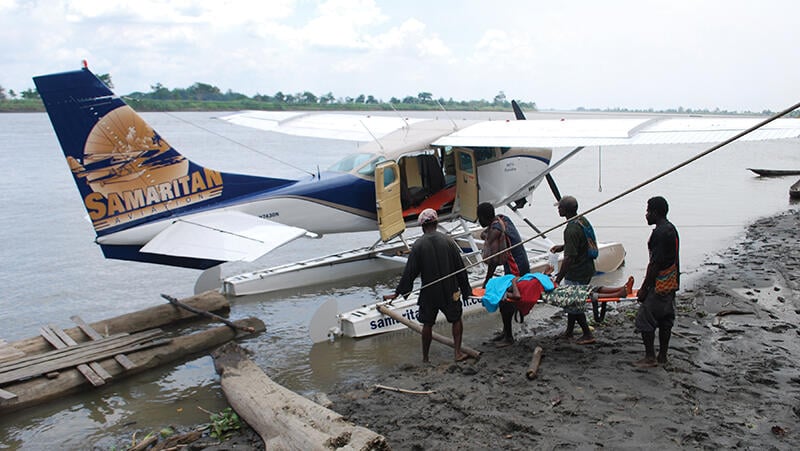
River landings help Samaritan Aviation’s floatplanes access remote villages.
Nearly 200 people from remote villages in Papua New Guinea have been transported by floatplane to medical facilities for care this year by nonprofit Samaritan Aviation. Founder Mark Palm says the nonprofit hopes to reach a record of more than 350 medevac flights in the country this year. However, keeping its floatplane fleet serviceable requires some creative maintenance strategies.
“In the area that we work, there’s a 700-mi. river on the north side of the island,” Palm tells Inside MRO. “It’s the second-largest island in the world, so it’s a very big area, and we serve over 300,000 people. These people are 1-3 days away from the only hospital in the area,” he adds, noting that many villages are reachable only by canoe.
“We knew that an airplane on floats could make the difference between life and death,” Palm says. “The original vision for Samaritan Aviation was [to] take a 1-3-day trip . . . and turn it into a 1-hr. flight.”
The nonprofit now operates a fleet of three Cessna 206 aircraft in Papua New Guinea to perform medevac flights and deliver medical and disaster relief supplies. During Palm’s discussion with Inside MRO at EAA AirVenture in Oshkosh, he walked through some of the many modifications the nonprofit performed on one of its 206 floatplanes, which was performing flights at the event.
Samaritan Aviation installed an upgraded Continental IO 550 engine, an 86-in. floatplane prop, Aerocet composite floats, a Robertson short-takeoff-and-landing (STOL) kit, vortex generators, a Sportsman leading-edge cuff STOL and a right-hand door for ease during docking. “We believe we’ve made this the best 206 flying, and it gives us the best chance to avoid logs and stuff in the river and get off the water as quickly as possible,” Palm says.
The nonprofit recently purchased a hangar in Wewak, the capital of Papua New Guinea’s province of East Sepik, where it performs its fleet maintenance under certification from the Civil Aviation Safety Authority of Papua New Guinea.“We’re able to do all of our own maintenance in-country, and that’s been a game changer,” Palm says. “In the early days, it was a really big struggle to do maintenance.”
The hangar includes a tooling area, medical supply storage and a parts room, which enables Samaritan Aviation to keep parts on hand when quick repairs are needed.
Palm says maintenance in Papua New Guinea is a challenge. “Everything has to be flown in,” he notes. “There are no roads into the town that we live in, so all parts have to come in by ship or by air, and keeping an inventory is a challenge.” For instance, aircraft fuel is shipped from Australia in 50-gal. drums.
Palm says parts take two weeks to arrive, so if an aircraft breaks down somewhere, there is a long lead time before operations can resume. “You’re trying to figure out, ‘What do I need to stock? What do I need to have to be successful?’ ” he says. “So far, we’ve only been stuck in the village a couple nights total over 16 years, and that’s a pretty good track record.”
In terms of staffing, all of Samaritan Aviation’s pilots are also mechanics. The nonprofit also has several local aircraft maintenance engineer apprentices in Papua New Guinea.
Palm says Samaritan Aviation does not charge for its flights. The nonprofit receives 20% of its funding from the Papua New Guinea government and 80% from individuals and foundations in the U.S. and Australia.