This article is published in Aviation Week & Space Technology and is free to read until Apr 05, 2026. If you want to read more articles from this publication, please click the link to subscribe.

U.S. And Israel Attempt Regime Change In Iran From 20,000 Ft.
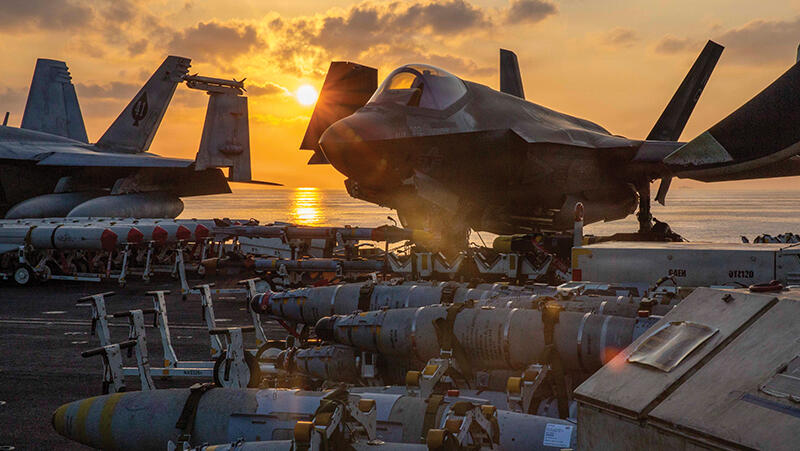
Lockheed Martin F-35s and missiles by the sea

U.S. Navy Lockheed Martin F-35Cs operating from the USS Abraham Lincoln began targeting Iran Feb. 28.

Credit: U.S. Navy

After opening with a surprise, daylight blow on Iran’s capital on Feb. 28, the U.S. and Israel unleashed an expansive air campaign to bring the 47-year-old Islamic Republic to its knees almost entirely through sustained bombing raids and missile attacks on the country’s leaders and military forces.

A NATO air campaign in 1999 helped trigger the overthrow of then-Yugoslavian President Slobodan Miloševic a year later—aided by local resistance that heaped more pressure on Belgrade. It took an armed citizen revolt underpinning coalition airstrikes to topple Muammar Gaddafi in Libya in 2011. Airpower now may face its biggest test in seeking—so far, nearly alone—to destroy Iran’s capacity to threaten regional neighbors and other countries forever.

  • U.S. and Israel attempt regime change from 20,000 ft.
  • Israeli F-35 scores first combat aircraft kill
  • U.S.-copied Shahed drones strike Iran

Sustaining the campaign could strain material and human energy. In the past year alone, the Trump administration has called on U.S. forces to carry out a broad series of strikes on Yemen in Operation Rough Rider, assist Israel in damaging Iran’s nuclear facilities during Operation Midnight Hammer and bomb alleged drug traffickers in the Caribbean before removing Nicolás Maduro, then president of Venezuela, from Caracas in Operation Absolute Resolve.

Now many of the same forces will need to maintain violent pressure on the Iranian regime with an already diminished stockpile of offensive missiles to strike targets and interceptors to shoot down Tehran’s long-range missile and drone attacks.

As they had during the 12-day war in June, U.S. and Israeli fighters and bombers quickly gained air supremacy over Iranian territory. Images showed General Atomics Aeronautical Systems Inc. MQ-9A Reapers—which suffered significant losses last year over Houthi-controlled parts of Yemen—and Israeli Elbit Systems Hermes 900s flying uncontested over Iran, scanning for fleeting targets and recording the aftermath of strikes by nearby combat aircraft. The Israeli Air Force operated over Tehran with impunity within 48 hr. of the start of what Israel calls Operation Roaring Lion.

The opening phase of the war came with its own firsts. An Israeli Air Force Lockheed Martin F-35 downed an Iranian Yakovlev Yak-130 trainer/light-attack aircraft, the first reported intercept of a crewed fighter by any operator of the Joint Strike Fighter. A day earlier, UK F-35s patrolling the skies of Jordan took down their first drone, while Qatar downed two Iranian Sukhoi Su-24s. Kuwait, in a friendly fire incident, shot down three U.S. F-15s; all six crewmembers survived.

Israeli Air Force F-16s deployed in Iran
Israeli Air Force F-16s were deployed to strike targets in Iran. Credit: Israeli Defense Forces

The U.S. for the first time fired the SpektreWorks Shahed-136-lookalike Low-Cost Unmanned Combat Attack System. “These low-cost drones, modeled after Iran’s Shahed drones, are now delivering American-made retribution,” U.S. Central Command (Centcom) taunted Tehran on social media as it fired the weapon in large numbers. Centcom also debuted in combat the ground-launched, long-range Lockheed Martin Precision Strike Missile. Near Sri Lanka, a U.S. Navy submarine also sank an Iranian Navy ship in the service’s first torpedo attack since World War II.

Early targets for the U.S. and Israel were Iran’s leadership—Ayatollah Ali Khamenei and much of the top echelons of the military and intelligence apparatus were killed—and its air defenses and missile infrastructure.

Iran mounted little in the way of air defense. Much of its capability was depleted in attacks last year by Israel and the U.S. The country instead responded with hundreds of ballistic missiles and thousands of one-way attack drones across the region, striking military and civilian infrastructure in Israel, Gulf Arab states, Turkey and Azerbaijan.

Those strikes inflicted casualties at locations such as bases and airports, contributing to the woes the conflict imposed on commercial aviation (page 16). Six U.S. service members died when Iran hit a tactical operations center, and a school in Iran suffered more than 150 dead.

By the fifth day of fighting, the U.S. and Israel were heavily focused on taking down Iran’s residual ability to fire weapons that had been depleted in the opening days. On March 4, U.S. Chairman of the Joint Chiefs of Staff Gen. Dan Caine said Iran’s theater ballistic missile launches had dropped 86% and its one-way attack drone firings by 73% since the opening day of the war.

The U.S. RTX Tomahawk missiles targeting air defense and other sites during Operation Epic Fury
The U.S. began Operation Epic Fury with a barrage of RTX Tomahawk land-attack cruise missiles targeting air defense and other sites. Credit: U.S. Navy

Iran had about 3,000 ballistic missiles in its inventory last year, the Israeli Defense Forces said, before it drained the arsenal during the 12 days of strikes in June. Israel said its air force had struck around 300 Iranian missile launchers as of March 3.

Data from the United Arab Emirates (UAE) Defense Ministry illustrated the slowing pace of Iranian activity. The UAE reported 137 ballistic missile engagements at the end of the first day of fighting. The figure reached 165 ballistic missiles 24 hr. later but rose more gradually to 196 as of March 5. By then, the country also had spotted 1,072 drones fired in its direction and intercepted 1,001, with 71 affecting its territory. As part of air defense operations, the UAE debuted the South Korean KM-SAM Block II system.

Ukrainian President Volodymyr Zelenskyy on March 5 said his country, which has been dealing with Iranian Shahed drone attacks from Russia for more than four years, has received requests from the U.S., Europe and the Middle East for help countering those systems. Ukraine has shortages of its own, he noted, but would be open to swapping interceptors optimized to defeat drones in exchange for Patriot interceptors. “When it comes to technology or weapons exchange, I believe our country will be open to it,” he said.

Around March 4, the U.S. started shifting from using standoff weapons to stand-in munitions such as 500-lb., 1,000-lb. and 2,000-lb. guided bombs and Hellfire missiles fired by uncrewed aircraft. The move also eased the strain on the limited supply of some U.S. high-end missile stock, although Caine insisted: “We have sufficient precision munitions for the task on hand.” By that point, the U.S. had dropped more than 2,000 munitions and Israel 5,000. The first 100 hr. of operations cost the U.S. about $3.7 billion, the Center for Strategic and Inter-national Studies estimates.

Weapons stocks were a concern, however. Maj. Gen. Amir Baram, director general of Israel’s Defense Ministry, convened a meeting with the country’s major defense executives to discuss accelerating production while resupply operations ramped up, the ministry stated. Israel heavily expended Smart, Precise Impact, and Cost-Effective or SPICE guided weapons, but also employed newer munitions, such as the Rafael Ice Breaker cruise missile.

The U.S. also said it was bringing in more forces, while the UK stated on March 4 that it had resupplied air defenses to British and allied bases over the past 24 hr. The country said Royal Navy Leonardo AW159 Wildcat helicopters able to target drones with Thales Martlet missiles would arrive soon in Cyprus, where the Royal Air Force’s Akrotiri airbase was struck by one-way attack drones on March 2.

U.S. concerns about weapon stocks predate this war, as Russia’s full-scale invasion of Ukraine highlighted how such conflicts can exhaust equipment. “We’re going as fast as we possibly can,” Michael Duffey, defense undersecretary for acquisition and sustainment, told lawmakers March 4. “We are driven by maximizing production capacity of our industrial base.”

President Donald Trump late March 2 said U.S. munition stocks were “good” and sufficient to sustain the campaign but said they were “not where we want to be.”

Before launching Operation Epic Fury, as the Trump administration is calling the campaign, the U.S. had massed an array of forces in the region over weeks. The go-ahead came on Feb. 27 at 3:38 p.m. EST. U.S. Cyber Command and Space Command were the first to act to blind Iran, Caine said.

The U.S. struck the first targets at 1:15 a.m. EST on Feb. 28, with RTX Tomahawk cruise missiles fired first. The Pentagon said it struck 1,250 targets over the next 48 hr. The U.S. and Israel, which have tended to conduct raids at night for added protection, opted to commence combat in daylight hours as an element of surprise.

Among other assets Centcom said it employed during the fighting were Lockheed Martin F-22 and F-16 fighters, Fairchild A-10 attack aircraft, maritime patrol Boeing P-8s, intelligence-gathering Boeing RC-135s, MQ-9 Reapers, Northrop Grumman E-11 Battlefield Airborne Communications Node relay aircraft, Boeing E-3 airborne early warning aircraft and vast numbers of Boeing KC-46 and KC-135 refueling tankers. U.S. Air Force Northrop Grumman B-2 bombers, as well as B-1Bs and Boeing B-52s, have also struck Iran. In addition, Centcom said it employed “special capabilities” without naming them.

Gulf allies that traditionally have allowed U.S. fighters on their bases appeared to confine their permissions to support assets, so U.S. Air Force combat aircraft were using locations such as Israel and Jordan.

Caine also described a pincer move that U.S. carrier air wings in the region had carried out in the opening phase. Aircraft from the USS Gerald R. Ford, along with bomber missions, focused on the northern border of Iran, while those from the USS Abraham Lincoln focused on the southeast coast.

The U.S. and Israel said they were prepared to sustain the operation for weeks to ensure Iranian military capacity is diminished for good. To stop Tehran from harassing regional shipping, the U.S. has heavily targeted the country’s navy. It has sunk more than 20 vessels, including the Shahid Bagheri drone carrier and Iran’s most advanced submarine.

Steve Trimble

Steve covers military aviation, missiles and space for the Aviation Week Network, based in Washington, DC.

Brian Everstine

Brian Everstine is the Pentagon Editor for Aviation Week, based in Washington, D.C.

Robert Wall

Robert Wall is Executive Editor for Defense and Space. Based in London, he directs a team of military and space journalists across the U.S., Europe and Asia-Pacific.

Tony Osborne

Based in London, Tony covers European defense programs. Prior to joining Aviation Week in November 2012, Tony was at Shephard Media Group where he was deputy editor for Rotorhub and Defence Helicopter magazines.