This article is published in Aviation Week & Space Technology and is free to read until Jun 12, 2026. If you want to read more articles from this publication, please click the link to subscribe.

CCAs Drive Next U.S. Marine Corps Aviation Transformation

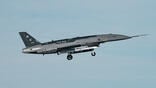
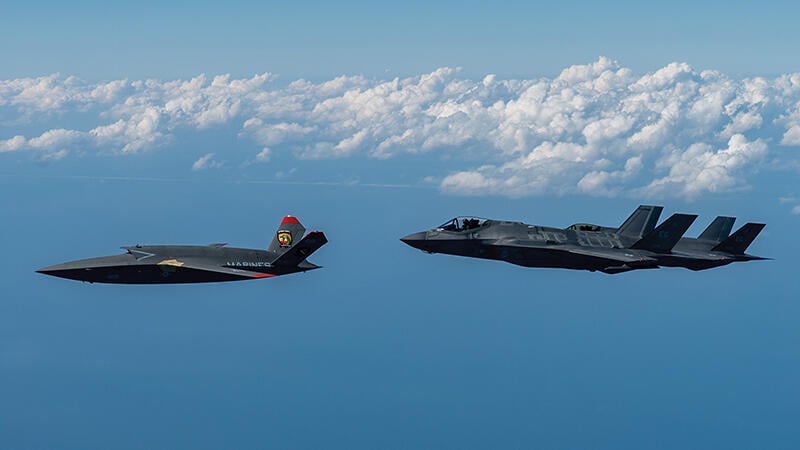
MQ-58 and F-35

Marine Corps MQ-58s are being prepared to partner with the service’s F-35s.

Credit: Master Sgt. John McRell/U.S. Air Force

Although no new crewed aircraft are expected to join the U.S. Marine Corps fleet for about a decade, the service’s leaders see a near-term opportunity to implement the most radical capability transformation to the service’s aviation branch since the arrival of the helicopter in the 1950s.

This changeover will be driven by a diverse collection of Collaborative Combat Aircraft (CCA). The first—the Northrop Grumman/Kratos MQ-58 Valkyrie—is already on contract, but the initial CCA fleet acquired by the Marine Air-Ground Task Force Uncrewed Expeditionary Tactical Aircraft, or Mux-Tacair, program represents only a vanguard. 

  • USMC budget estimates commit $1.28 billion to CCAs
  • Attack, transport and cargo CCAs also envisioned

Starting in 2030, the Marines’ acquisition plans for CCAs are slated to proliferate. Future increments of the Mux-Tacair program are planned to introduce new platforms and payloads to augment a consolidated, crewed fleet of Lockheed Martin F-35B/C Lightning IIs. Autonomous aerial partners also will join other mission areas, such as attack strike, assault support and heavy-lift.

“We are opening up an entirely new realm in Marine aviation here, and I think this is potentially as seismic as what we did when we introduced rotary-wing aircraft to the fleet back in the 1950s,” Col. Richard Rusnok said at the Modern Day Marine exhibition on April 29.

The advent of rotary-wing aircraft inspired a new battlefield concept. For the first time, Marine units were equipped to bypass front lines and troop concentrations and infiltrate the enemy’s territory at their weakest points. The concept of vertical envelopment remains a pillar of Marine Corps war planning.

It is not clear how the Marines envision a family of multimission CCAs transforming future combat operations, but the process of discovery begins with the MQ-58.

The Marines plan to spend $1.28 billion in fiscal 2026-31 to build up an initial cadre of CCAs, according to budget justification documents released by the Pentagon in April.

Final numbers will be decided later, Rusnok said, but the program started this year with signed orders for four MQ-58 prototypes, a type built by Kratos originally for the Air Force Research Laboratory.

The first Marine Corps Valkyries will incorporate newer features than the early Air Force models. The biggest modification is the addition of a tricycle landing gear on each aircraft, replacing the rocket-assisted takeoff and parachute recovery of the Air Force aircraft. Although the latter features seem to align better with the Marine Corps’ short-takeoff-and-vertical-landing F-35Bs, Marine leaders prefer a conventional takeoff and landing approach, which they say will quicken the pace of operations.

In addition to the new landing gear, prime contractor Northrop will integrate a new mission system, although Marine and Northrop officials declined to provide details.

The CCA Increment 1 program for the Marines is focused broadly on making the F-35 fleet more survivable and lethal, Rusnok said. A series of flight demonstrations involving XQ-58s in 2023-25 focused on evaluating how the autonomously piloted aircraft could perform in the suppression of enemy air defense mission. This concept would allow the MQ-58 to tag-team with the F-35 on missions to destroy deadly surface-to-air missile systems, allowing the uncrewed CCA to accept more of the risk of detection and enemy fire.

Northrop’s role as the prime contractor seems logical. The company supplies the F-35 with active, electronically scanned array (AESA) radars—both the original APG-81 and the new, U.S.-only APG-85. Northrop also unveiled a low-cost, multifunction AESA, the Valen, in February. This compact array functions as a radar, electronic warfare system and a communications antenna, making the Valen an ideal complement to the F-35’s mission systems. Northrop recently announced a precision-guided, loitering munition for CCAs called the Lumberjack, too. Northrop has additionally developed the Prism autonomy control system, which has been integrated and flown on the company’s Beacon aircraft testbed for CCA technology.

A Northrop official declined to confirm that the Valen, Lumberjack and Prism are part of the mission systems and weapons intended for the MQ-58. The company emphasized that the system will be designed with an open architecture and standard interfaces to allow software and hardware from third parties to be integrated easily onto the Marines’ first CCA platform.

Steve Trimble

Steve covers military aviation, missiles and space for the Aviation Week Network, based in Washington, DC.