This article is published in Aviation Week & Space Technology and is free to read until Jun 05, 2026. If you want to read more articles from this publication, please click the link to subscribe.
Opinion: Designing A CCA For The Indo-Pacific Theater
Driven by the tyranny of distance in the Indo-Pacific theater, Boeing’s F-47 Next-Generation Air Dominance fighter is being designed for a combat radius exceeding 1,000 nm—almost twice that of the Lockheed Martin F-22.
As the U.S. Air Force moves forward with plans for the incremental evolution of Collaborative Combat Aircraft (CCA) to augment its crewed aircraft and affordably build mass to face a peer adversary, how will the F-47’s range influence the development of these autonomous platforms?
Current thinking on CCA design is divided into two approaches. One is a loyal wingman that flies in formation with the F-47 for the complete mission. Building a ground-launched CCA with the same range as the F-47 would greatly increase weight and cost—it could weigh perhaps as much as 30,000 lb. and cost $35 million, approaching an uncrewed Lockheed Martin F-35 with a nonafterburning engine.
The maintenance burden and logistics tail for such a large aircraft would be expensive and at odds with the need for affordable mass to counter Indo-Pacific threats.
The other approach is DARPA’s LongShot, a missile-equipped uncrewed aircraft that would be carried by crewed fighters and bombers like an air-launched missile or fuel tank. General Atomics Aeronautical Systems is building the X-68A LongShot demonstrator for launch from under a Boeing F-15 wing.
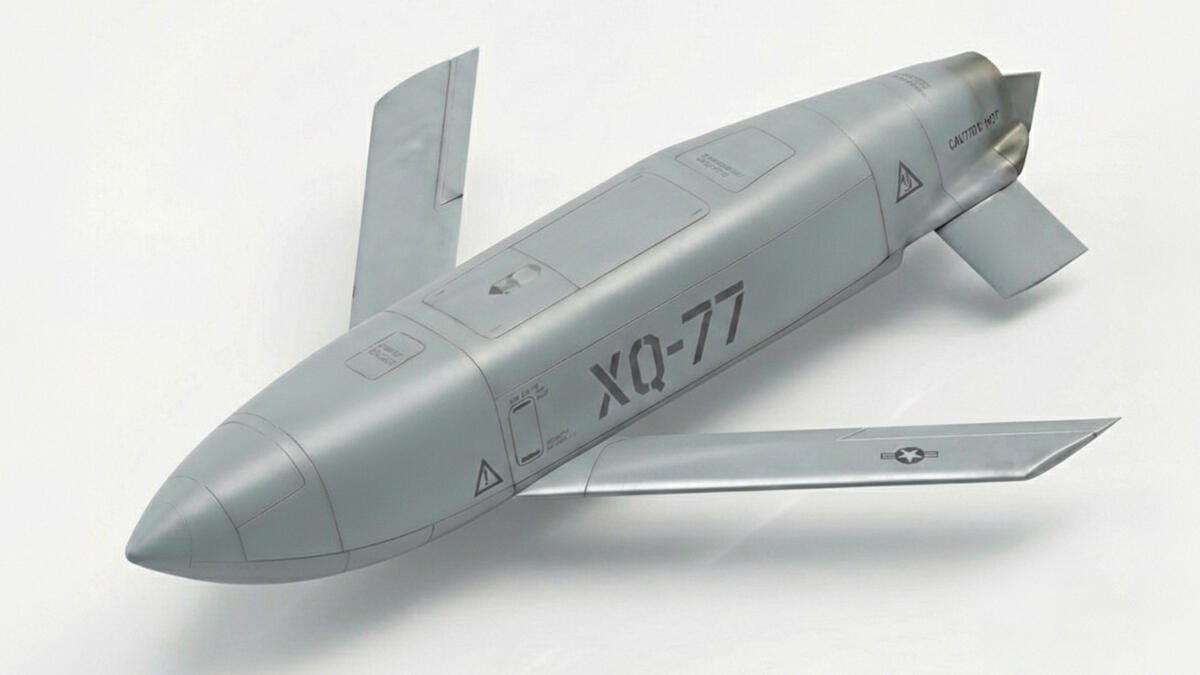
The increased range of the F-47 favors a CCA in the category of the LongShot. My concept for an air vehicle in this category, dubbed the Agile Sword, would fit on an F-47 wing station, requiring a maximum length of about 20 ft., and carry a pair of Raytheon AIM-120 medium-range air-to-air missiles.
The Agile Sword would be air-launched from F-47s and from Boeing C-17 airlifters acting as “deep magazines.” The CCAs would fly ahead to engage airborne and maritime surveillance platforms, fighters, bombers, uncrewed aircraft and other threats.
The mission of the CCA so far is subsonic, so why not design it to integrate with the F-47 wing, like the external gun pod does with the F-35? And as for the C-17, as U.S. Air Force Gen. (ret.) Michael Minihan, former Air Mobility Command head, has said, they must carry the munitions anyway, so why not use them as launch platforms?
Ground-launched CCAs could be prepositioned at austere bases on island chains to reduce the range requirement, but that involves complex planning and coordinating of the joint operation. “Organic” self-carried, air-launched CCAs would alleviate that.
A design driver of the Agile Sword is the need to house a parachute and airbag recovery system used during test and evaluation and during live-fire exercises. I have thus developed two versions of the concept: the attritable XQ-77A, designed for recovery during testing and training, and the operational XQ-77B, on which fuel tanks would replace the parachute and airbag to increase range. The XQ-77B would be expendable.
The recoverable XQ-77A drives the overall design, as the need to deploy the parachute from the vehicle’s upper surface and the airbag from the lower surface means the ideal position for launching AIM-120s is from side bays. The Agile Sword recovery system is based on that used in Northrop’s Model 324 Scarab aerial target, and I have experience with a similar system in Boeing’s X-40A reusable spaceplane testbed.
One unique aspect of the Agile Sword concept is that the core airframe itself would function as an air-to-ground weapon, becoming a cruise missile after expending its air-to-air weapons. To accomplish this, the operational XQ-77B would be fitted with the 200-lb. warhead of the Boeing GBU-39/B Small-Diameter Bomb and the semi-active laser and millimeter-wave radar seeker of the Lockheed Martin AGM-179 Joint Air-to-Ground Missile.
While it is only a design exercise, the Agile Sword concept illustrates how the driving requirements for a CCA that would be compatible with the increased combat radius of the F-47 Next-Generation Air Dominance fighter could lead to development of an autonomous collaborative platform that offers affordability and flexibility.