This article is published in Business Aviation & AAM Report part of Aviation Week Intelligence Network (AWIN), and is complimentary through Aug 18, 2026. For information on becoming an AWIN Member to access more content like this, click here.
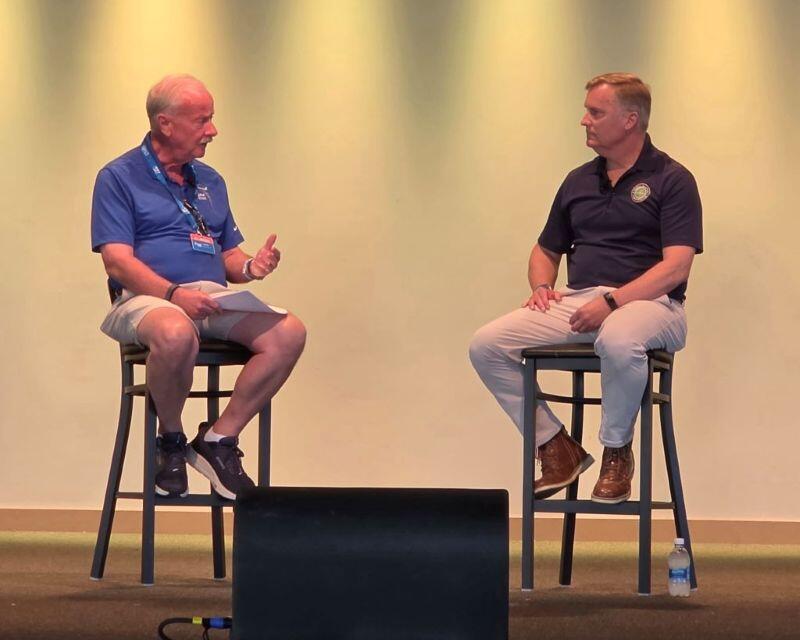
Jack Pelton, CEO of the Experimental Aircraft Association (left) interviews FAA Deputy Administrator Chris Rocheleau during EAA AirVenture Oshkosh.
OSHKOSH—People, safety and innovation are front and center at the FAA, especially as it relates to the FAA’s Flight Plan 2026, an agency road map and organizational overhaul aimed at modernizing the National Airspace System, said FAA Deputy Administrator Chris Rocheleau, in a Meet the FAA forum during EAA AirVenture Oshkosh.
The FAA has received $12.5 billion from Congress as a down payment to modernize the nation’s aging air traffic control system and rebuild a new infrastructure.
“That’s radars, that’s digital radios, that’s going from old-fashioned copper wire to new fiber optic and putting things in the cloud,” Rocheleau said. “All of this to make the system more resilient … We’re doing really well … We’re also looking at airspace redesign,” especially given the growth in eVTOLs, drones and commercial space projects.
“All of that is coming online, and we want to make sure that this national resource—our airspace—continues to be safe and that everybody has an opportunity to operate in the system itself,” he said.
Part of that is modernization of the agency to ensure it is more responsive in aircraft certifications, aerospace medicine certifications and other projects. It also works to improve safety.
“When we look at 2025, we have the lowest general aviation fatality rate since we’ve been tracking it back in 2009,” Rocheleau said. “But we’re not done. Safety isn’t a destination; it’s a continuous journey, whether it’s new technologies, new aircraft, new collaborations—all of that is going to contribute to enhance safety going forward.”
Rocheleau’s forum was held before the announcement that he is leaving the FAA to return to his previous role as National Business Aviation Association COO, the job he held before his appointment by President Donald Trump as acting FAA administrator in January 2025.
During the event, Rocheleau emphasized the use of artificial intelligence and machine learning to improve safety. The question is how to take the complexity of adding the growing number of autonomous systems, such as drones used in drone deliveries and eVTOLs, and safely share airspace with other operators, including airliners, such as Boeing 747s, and governments.
Modernization of the air traffic control system and building out the new infrastructure—going from analog to digital—will enable users to operate safely, Rocheleau said. Electronic situational awareness is key.
“At the end of the day, what we’re all trying to figure out is when you’re in the sky above us, when you’re in this national asset called airspace, how are we sharing that airspace in a safe and efficient manner? A big piece of that has to do with making sure that as equipage becomes more realistic, and there are different airspace sectors, are we working together to make that system more accessible for everyone? It’s really complex.”
The FAA is working to address staffing shortages with a goal of exceeding hiring targets for air traffic controllers. The agency has said it will need to recruit 2,200 “high-quality” candidates in 2026, 2,300 in 2027 and 2,400 in 2028 to stay on track with staffing needs.
Artificial intelligence will be critical to developing new tools for air traffic control operations in two ways, he said. First, the FAA is using AI to leverage safety data, making sure it helps inform “safety mitigations.” Second, the FAA is studying how AI will be used by controllers to manage airspace and airspace traffic “when it comes to all these things that are flying around, whether that’s commercial aviation, business, general aviation, drones, etc.”
Digitization is also reducing the backlog of medical certificate approvals, which is down 20%, and working to make the certification process for aircraft more efficient.
The EAGLE initiative to eliminate leaded aviation fuel in piston-engine aircraft safely by 2030 is an aggressive timeline, Rocheleau told Aviation Week after the forum. “I think we’re going to see that continue to iterate simply because there’s no drop-and-go system or solution at this point. Certainly, we’re going to comply to the extent possible. We’ve also got a great relationship with [Congress] when it comes to the reality of what is available. They will have to make the decision with industry— government-industry working together with Congress to inform them on what the smart, necessary steps are as it relates to leaded fuels and a timeline … We’ll keep at it.”
Experimental Aircraft Association CEO Jack Pelton said he is comfortable that fuel testing timelines will be met. The complicated part will be with petroleum manufacturers and what it will take for them to potentially convert part of their factories to produce the new fuel and distribute it, Pelton said. Fuel will continue to be available in the meantime.
“We will continue to hit the milestones that we get to control, in partnership with you all,” Rocheleau said.