This article is published in Business Aviation & AAM Report part of Aviation Week Intelligence Network (AWIN), and is complimentary through Nov 07, 2026. For information on becoming an AWIN Member to access more content like this, click here.
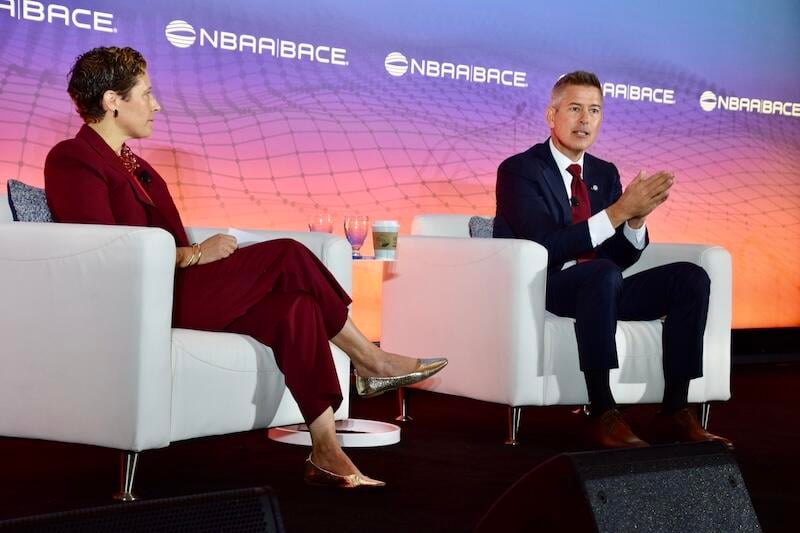
Kristie Greco Johnson, NBAA senior vice president for government affairs, interviews U.S. Transportation Secretary Sean Duffy.
LAS VEGAS—Addressing a business aviation audience at NBAA-BACE on Oct. 21, U.S. Transportation Secretary Sean Duffy touted the Trump administration’s air traffic control (ATC) system modernization drive and the first FAA award of a special operating certificate to an advanced air mobility (AAM) vehicle.
Duffy said the FAA is “on budget [and] things are going incredibly well” with the Brand New Air Traffic Control System (Bnatcs)—the name given to the ATC modernization—after Congress appropriated $12.5 billion to begin the effort in the 2025 One Big Beautiful Bill Act. The administration is now seeking $30 billion more to complete the job.
In September, U.S. Sen. Eric Schmitt (R-Mo.) introduced the Modern Skies Act (S. 5572), which would authorize supplemental funding for the FAA for the second phase of the Bnatcs. The act would provide $10 billion for a common automation surveillance platform, the FAA Enterprise Network Services telecommunications backbone, and the Flow Management Data and Services program. Another $10 billion would replace aging ATC towers.
The third $10 billion, a recent addition to the Bnatcs initiative, would establish a new pilot grant program for midsize airports that serve 5-25 million passengers annually but lack access to capital.
“We want to help midsize airports get some additional funding,” Duffy said. “[With] bigger airports it’s easier to bond those projects. So those midsize airports that need investment, we think we can be helpful as seed money.”
Moderator Kristie Greco Johnson, NBAA senior vice president for government affairs, later welcomed to the stage Beta Technologies CEO Kyle Clark.
The FAA on Oct. 21 announced that it has issued a first-of-its-kind Special Airworthiness Market Survey Certificate to Beta to conduct flights of its Alia 250 electric vertical-takeoff-and-landing aircraft. The certification allows Beta to fly potential customers in the Alia 250 but not to conduct commercial or revenue flights.
Duffy said the FAA is working to streamline its certification process.
“I don't think more time means more safety; those two things don’t always go together,” Duffy said. “We do drive safety. We take people’s lives in our hands every single day on decisions that we make. We can have systems that [not only] match but enhance safety but do it in a far more expedient way,” he said.

Related Content