This article is published in Business Aviation & AAM Report part of Aviation Week Intelligence Network (AWIN), and is complimentary through Nov 07, 2026. For information on becoming an AWIN Member to access more content like this, click here.
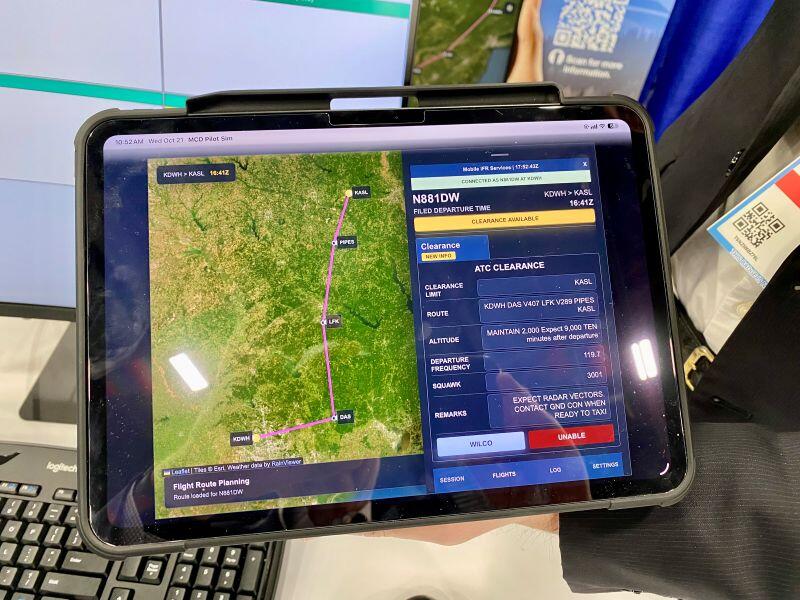
The FAA displayed an example of the Mobile Clearance pilot interface at NBAA-BACE in Las Vegas.
The FAA plans to deploy a mobile clearance capability in early 2027 that enables general aviation (GA) pilots to request and receive instrument flight rules (IFR) departure clearances from an airport by text instead of contacting the tower by voice.
Mobile Clearance mimics the Controller Pilot Data Link Communication-Departure Clearance (CPDLC-DCL) capability used in commercial airliners equipped with VHF data radios but can be accessed by GA pilots using their personal devices over the internet. The ground-based mobile capability will be available from app providers ForeFlight and Garmin.
Years in development, the program is now in an operational evaluation stage that is expected to last until the end of 2026, FAA program executives said Oct. 21 during the NBAA-BACE conference in Las Vegas.
“What’s really exciting about this technology is it’s one of the FAA’s cloud-based technologies, which means that this capability is incredibly scalable,” said Jillian Cheng, FAA Mobile Technologies program manager.
“Because it’s based on the cloud, the controller hardware that’s going into the towers is lightweight,” Cheng added. For controllers “it’s all commercial off-the-shelf products—24-in. monitor, a mini PC, a keyboard, a mouse and an internet connection. It’s not a monolithic system unlike typical FAA systems.”
The operational evaluation began in May at airports in the Houston area, including Sugar Land Regional Airport (SGR), Scholes International Airport (GLS) and David Wayne Hooks Memorial Airport (DWH). The program has since been expanded to Appleton International Airport (ATW) in Wisconsin and New Century AirCenter (IXD) in Kansas. During the evaluation period, pilots have been able to request IFR departure clearances via ForeFlight and Garmin flight-plan apps.
“As many of you know, if you fly today, there are more clearances, even at lower altitudes, where it’s a waypoint to a waypoint, maybe a T-route to a waypoint, and the controller has to phonetically spell all those, and then [receive] the read-back,” said Paul Diffenderfer, FAA Mobile Clearance technical lead. “Getting that in text form is a beautiful thing.”
The controller interface “basically is a web page that is served by that cloud environment, and each tower or approach control [facility] has a unique interface with various settings for their facility,” Diffenderfer said. “They see flight plans that are pending that need to be processed, and they also see those that have been sent a clearance and what the response is from the pilot to that transmission.”
FAA plans call for deploying Mobile Clearance and IFR cancellation (upon landing) capabilities to select non-towered airports around the country. Controllers access flight-plan data from facilities nationwide through the agency’s System Wide Information Management data-sharing backbone.

Related Content