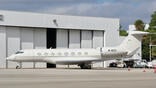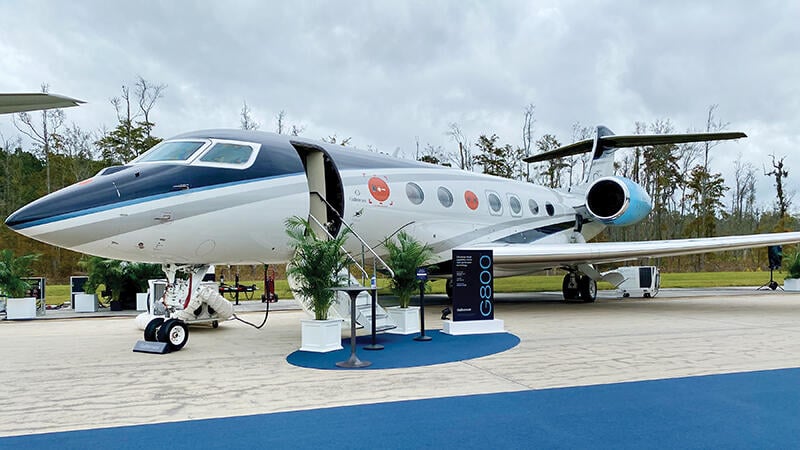
A Gulfstream G800 is displayed at the manufacturer’s Savannah, Georgia, headquarters.
The business aviation market has always been defined by superlatives: biggest, longest-range, fastest. And, of course, highest price. The steady upward progression of all of these metrics over the last half-century was one of the most interesting things that Kevin Michaels and I chronicled in our new book, Time Machines: Business Aviation’s Dynamic Journey, published by the American Institute of Aeronautics and Astronautics in February.
A brief recap of this upward progression, as reflected in price tags. In the 1960s and through much of the 1970s, Gulfstream’s GII and Lockheed’s Jetstar were the most expensive jets, selling for roughly $30 million in today’s dollars. Around 1980, the GIII and Canadair Challenger 601 raised that price point (and commensurate capabilities and features) to around $40 million. By the end of the 1980s, the GIV and Dassault’s Falcon 900 increased the top price toward $50 million. In the mid-1990s, the GV and Bombardier’s Global Express hiked it to about $70 million.
In the early 2010s, Gulfstream created the most recent game-changing generation of business jets. Its G650 raised the top price to around $85 million. A few years later, Bombardier responded with its Global 7500, also at about that price. And that is just the basic sticker tag, before expensive and profitable optional equipment and interior work are added. Naturally, these options grow along with the jet’s size.
Meanwhile, demand for jets at the top of the market has only increased with each new high-end price point. Nearly 1,000 jets in the current high end have been delivered, generating well over $80 billion in revenue.
Clearly, there is little to no price elasticity in this market. If someone builds something more superlative, at a higher price, the market just buys it in equal or greater quantities, with trade-ins of the previous high-end models. That is why we now have three jets—Gulfstream’s G700/800, Bombardier’s Global 8000, and Dassault’s Falcon 10X—on sale for such high-end prices.
This has established a kind of permanent triad at the top. It is very hard for anyone else to break into this rarefied air, but none of the three companies can afford to be left behind. After all, if a top-end customer is offered a new, higher-end product, a jet-maker cannot watch all of the trade-in deals go to the other two players. Both Bombardier and Dassault have been in that position and do not want to repeat the experience.
This endless upward progression—to recap, the price for the best jets on the market has nearly tripled in real terms over 50 years—raises the question: What comes next? Assuming past is prologue, sometime in the next five or 10 years, OEMs will launch even more impressive and costly aircraft.
And here is where it gets complicated. It probably will not be supersonic speeds. That has been tried unsuccessfully many times, and the trade-offs—less range and much smaller cabins—clearly do not appeal to the market. Current maximum speeds (around Mach 0.925) are faster than older models offered as well as all commercial jetliners, but anything closer to the sound barrier would produce instability and heat for little gain.
High-end business jet range is now as good as it needs to be, unless a customer routinely flies to Australia. Flight altitudes are also as good as they are likely to get. Cabins are immense and butting up against Airbus and Boeing jetliners, although aircraft weights have long since blown past maximum levels for certain private airports. Exotic airframe or propulsion architectures are certainly possible, but this tends to be a relatively conservative market.
So any notional Gulfstream 900, Bombardier Global 9000, or Falcon 11X would probably just offer a bit more of everything. On the other hand, given the importance to these OEMs of maintaining their place at the top, if one does something radically new, the other two might regard it as best to follow.
But whatever features or technologies render the next product launches superlative, they will make for a new and exciting generation of jets. That is something the past teaches us, too.
Richard Aboulafia is managing director of AeroDynamic Advisory and based in Washington.

Related Content