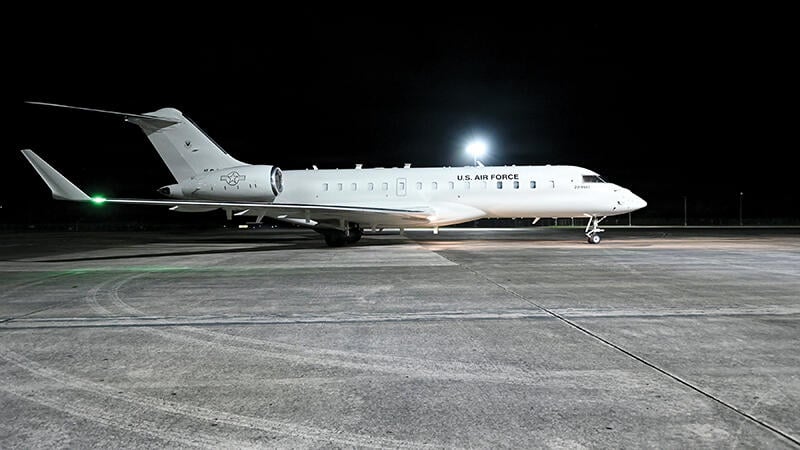
A U.S. Air Force EA-11 deployed late last year to Muniz Air National Guard Base in Puerto Rico to support counter-drug operations.
In the run-up to Operation Epic Fury against Iran, the Pentagon deployed masses of military equipment to the Middle East over weeks. Aircraft carriers cruised to the region. Waves of Boeing F-15 fighters and Lockheed Martin F-22 and F-35 stealth fighters arrived, too.
But the real tell that things were getting serious was something seemingly more innocuous: the appearance of a white Bombardier 6000 with U.S. Air Force markings.
Northrop Grumman had turned the business jet into an E-11A Battlefield Airborne Communications Node (BACN), a system that provides high-speed, internet-protocol-based airborne networking to support the transmission of video, voice and digital messages. The aircraft acts as a router in the sky, stitching together the links used on disparate military platforms to help them talk to each other to coordinate strikes, share information and deconflict operations.
BACN is only one in a growing list of missions that militaries from the U.S. to Australia are packing onto business jets to take advantage of their operating altitude and speed. These so-called special mission aircraft are now used, for instance, as airborne early warning systems, serving as air traffic control for the military. Others are eyes in the sky, equipped with optics or radar to peer deep behind enemy lines.
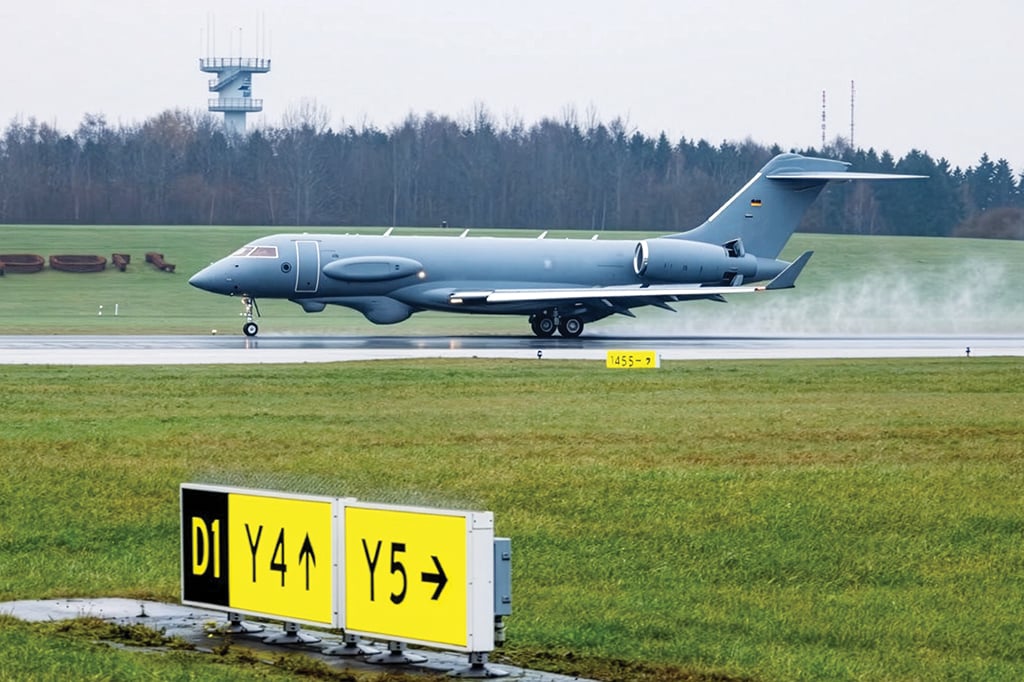
Different configurations allow personnel to listen to adversaries’ communications or detect their radar systems. Some bizjets sport jammers that can transmit radio frequency energy at high power to thwart an enemy’s ability to communicate or use radar.
The U.S. Air Force is now considering shifting to business jets another role: effectively, to oversee the end of the world—the Looking Glass mission. Since the late 1990s, the U.S. Navy has operated the Boeing E-6B Mercury, a modified 707, as the airborne command post to ensure the U.S. can launch nuclear-tipped missiles in case of war.
The E-6B has the dual role of communicating with submarines using very-low-frequency trailing wire antennas, a mission commonly referred to as Take Charge and Move Out (Tacamo), as well as flying Air Force personnel to launch ICBMs under the Looking Glass role. As the Navy moves to replace the E-6B with the smaller Lockheed Martin C-130J for Tacamo, the Pentagon is handing the Looking Glass role back to the Air Force.
The service is in the early stages of the Looking Glass - Next program. Prospective competitors displayed mockups of launch control stations onboard business jets during the Air and Space Forces Association’s marquee Air Warfare Symposium in late February.
“I am committed to delivering that capability as quickly as we can—and relieving the Navy of that responsibility and recapitalizing that important capability,” Air Force Global Strike Command boss Gen. Stephen L. Davis told reporters at the event, noting that the effort was still in its early stages.
The U.S. Army is also getting into the bizjet business, fielding versions to detect and track ground targets. The service has ordered a fleet of Bombardier Global 6500s heavily modified with radars, electronic warfare gear and other sensors tasked with finding targets ahead of a conflict for its long-range fires under the ME-11B High Accuracy Detection and Exploitation System (HADES) program.
The Army in August 2024 awarded Sierra Nevada Co. (SNC) a contract worth up to $991 million to lead integration of the fleet. The service planned to field 14 of the aircraft, though the final number is uncertain after a decision last year to trim the total to six.
In the run-up to awarding HADES, the Army fielded a series of other contractor-owned, contractor-operated modified business jets to conduct reconnaissance missions and develop requirements for HADES. SNC early this year was finalizing work on its two Global 6500 prototypes, known as the Army Theater-Level High-Altitude Expeditionary Next Airborne (Athena), which are to be deployed soon. These follow two other Athena prototypes built by L3Harris and MAG Aerospace that deployed in 2025.
Additionally, Leidos is flying two Bombardier Challenger 650-based aircraft known as the Airborne Reconnaissance and Targeting Multi-Mission System (Artemis). L3Harris operates two Global 6000/6500 aircraft known as the Airborne Reconnaissance and Electronic Warfare System (ARES).
SNC and L3Harris are pitching their approaches internationally as well. SNC is already building a variant of its RAPCON-X for Finland’s Border Guard and has conversations ongoing across the Indo-Pacific, Middle East and Africa, the company says. L3Harris in January announced its business jet-based airborne early warning and control aircraft, AERIS.
Global Applications
The extent to which these special mission bizjets have become a global phenomenon is illustrated by the diversity of customers and applications of development and production programs underway.
The United Arab Emirates was an early adopter, buying from Swedish defense contractor Saab the GlobalEye airborne early warning system, which carries a large radar on the top of the fuselage of a Global 6000.
Australia, meanwhile, is buying the MC-55A Peregrine, an L3Harris-modified Gulfstream G550, which includes signals intelligence antennas and a belly-mounted canoe fairing for a synthetic aperture radar to take images through the clouds. The Royal Australian Air Force plans to operate four of the aircraft, the first of which arrived in January.
In Germany, under the Pegasus program, defense electronics specialist Hensoldt is working with Bombardier and Lufthansa Technik to turn three aircraft into signals intelligence systems for the Luftwaffe, with a plan to double the fleet. The service wants the first Pegasus jet to be fully operational in mid-2029.
Hensoldt wants to build on that success and convince the air force to buy jamming aircraft as well, potentially using business jets. The company could generate $1 billion from introducing this airborne electronic attack capability, Hensoldt CEO Oliver Dörr says. The U.S. is already fielding Gulfstream G550s modified into standoff jammers with L3Harris under the EA-37B Compass Call program that Italy also plans to operate.
In 2020, neighboring France ordered seven Dassault Aviation Falcon 2000 Albatros systems to serve as Maritime Surveillance and Intervention Aircraft, and in 2025 bought five more before the first is even delivered this year. The country also has committed to acquiring the Saab GlobalEye, and is buying a Dassault Falcon 8X modified into a strategic intelligence collection system called Archange.
Dassault also harbors ambitions to get its new Falcon 10X in military service. The cockpit design would enable its use for roles such as maritime patrol or electronic warfare, Antoine Doussaud, a company Falcon 10X test pilot, told reporters in mid-March as the company formally unveiled the business jet.
The type lost out in a French government maritime patrol aircraft competition against Airbus’ A321XLR-based solution in 2024, but that has not deterred Dassault. The Falcon 10X’s flight deck comes with an “Open World” capability, Doussaud said, which allows it to run various applications on the displays. That feature in particular could interest military users that may want to run special mission applications.
The modifications aircraft-makers and their mission partners are undertaking come with plenty of challenges. Among the biggest is making air safety authorities like the FAA comfortable that the modified jets remain flightworthy. That has delayed several efforts and driven costs higher.
Even so, the appetite for these systems is only growing. South Korea last year agreed, with Korean Air as a partner, to buy an airborne early warning aircraft from L3Harris that marries a Global 6500 with an Israel Aerospace Industries Elta radar. Morocco is hunting for bizjet-based special mission aircraft, among other potential buyers. And NATO could buy GlobalEyes after the U.S.’s withdrawal from joint procurement effectively took the Boeing 737-based E-7A Wedgetail out of consideration.
The userbase and applications for these military bizjets will only proliferate along with the conflict zones where they will star.


Related Content