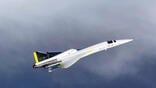
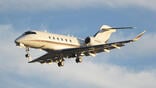
A Bombardier Global 8000 in flight.
A dogfight is underway in the ultra-long-range business jet market as Bombardier, Dassault and Gulfstream roll out or ramp up their latest jets, with ranges approaching 8,000 nm.
Bombardier delivered its first Global 8000 on Dec. 8 to Patrick Dovigi, CEO of environmental services provider GFL, who said it was his eighth aircraft from the company in 16 years.
The flagship Global 8000 achieved two distinctive milestones in the certification process. It increased its maximum operating speed to Mach 0.95 from Mach 0.94, making it the fastest civil aircraft since the Concorde, and lowered the cabin altitude to 2,691 ft., which Bombardier calls the lowest in business aviation.
The next month, as part of his trade war, U.S. President Trump chastised Canada on Jan. 29 via social media for not certifying the Gulfstream G500, G600, G700 and G800. (The FAA certified them in 2018, 2019, 2024 and 2025, respectively.) He then threatened to decertify and slap a 50% tariff on aircraft manufactured in Canada.
A few weeks later, Transport Canada issued a type certificate for the four Gulfstreams—but not blanket approvals, applying only to individual aircraft. My colleague Molly McMillin broke the story about approvals being limited to serial numbers for two G500s, one G600, one G700 and one G800.
As McMillin reported: “The Type Certificates list the aircraft of those types that are currently being exported to Canada,” Transport Canada said in a Feb. 25 statement to Aviation Week. “As more aircraft are sold into Canada, the list of eligible serial numbers will be expanded.”
After BCA goes to the printer, Dassault is releasing its 2025 results on March 4, and then rolling out its Falcon 10X on March 10, so expect news about that jet soon. The aircraft will feature a cabin that is taller and wider, but its range appears to be about 500 nm less than its competitors.
While none of these three OEMs break down deliveries by model, Aviation Week’s Fleet Discovery database approximates that in 2025, Bombardier delivered 38 Global 7500s and one Global 8000, Gulfstream delivered 53 G700s and 13 G800s, and Dassault delivered nine Falcon Jet 8Xs.
Officially, Bombardier’s 2025 annual results report that it delivered 157 aircraft, including 86 large jets, up from 73 the previous year. The company’s order backlog is a healthy $17.5 billion.
Gulfstream’s annual results show that it handed over 158 aircraft in 2025, 136 of which were large-cabin. It holds a $15.5 billion backlog and a book-to-bill ratio of 1.2.
But in terms of units, the smallest aircraft dominate the market—not the longest.
The General Aviation Manufacturers Association’s 2025 numbers, released on Feb. 18, show manufacturers delivered a total of 3,230 aircraft, excluding helicopters. Of those, piston aircraft dominated with 1,782 deliveries, compared to 1,448 total turbine-powered business jets. The Cirrus single-engine-piston-powered SR22T captured the top spot of deliveries that year with 384 units.
With that note, I hope you enjoy this issue, which includes our annual Purchase Planning Handbook, a long-standing stalwart of the industry. A big thank you to all the manufacturers that provided data to John Croft, who compiled this labor-intensive guide that goes beyond the spec sheets to provide a comprehensive picture of performance for operational missions.
Best wishes,
Lee Ann

Related Content